One number frames the whole unit: about half of all lifetime mental disorders have their onset by age 14, and roughly three-quarters by age 24 (figures often cited from Kessler and colleagues; treat them as widely reported estimates, not precise constants). Adolescence isn't just a window for mental illness — it's the window. That's exactly why knowing how to tell typical angst from a clinical problem is a life skill, not just an academic topic.
This unit covers self-harm, suicide, eating disorders, and psychosis, always at the conceptual level — never methods or means. If any of it lands close to home, please reach out. In the U.S. you can call or text 988 (the Suicide & Crisis Lifeline, live since July 2022) any time, day or night. For eating disorders, the National Alliance for Eating Disorders runs a free helpline staffed by licensed therapists at (866) 662-1235 (you can also text ALLIANCE to 741741). Here is the message worth holding onto: the overwhelming majority of the conditions in this unit are treatable, and most people who get care get better.
The rookie mistake this unit exists to prevent: reading a symptom list, recognizing yourself or a friend in it, and self-diagnosing. Symptom lists are the ingredients of a diagnosis, not the diagnosis. Keep reading — the very next section is the rule that separates the two, and it's the single most useful idea on this page.
The impairment rule (the organizing principle)
Here is the idea to build everything else around. In the DSM-5-TR, meeting a symptom count is not enough to have a disorder. Almost every diagnosis also requires that the symptoms cause clinically significant distress or functional impairment — a meaningful cost to how the person feels, relates, learns, or works. Symptoms without that cost are, for most categories, just human variation.
Run a real scenario through it. Tap the card:
Likely not. No distress, no impairment — the symptoms aren't costing her anything. The impairment criterion is precisely what stops a checklist from turning ordinary temperament into pathology. Same symptoms, a struggling student failing courses and losing friends: that may well qualify.
Because it protects against both errors at once: over-diagnosing normal variation as illness, and dismissing real suffering because it "doesn't look that bad." Impairment keeps the focus on the person's actual life, not the length of the list.
"Distress or impairment" is doing quiet work all over this page. When we get to eating disorders you'll see impairment that's medical; with psychosis it's functional; with depression it's often distress the person feels but hides. Same rule, different faces.
The DSM is revised, not received. It's a manual written and rewritten by committees, and it changes as evidence and values change. Two moments make the point. In 1973 the APA removed homosexuality from the DSM — a landmark recognition that the manual had been pathologizing an identity, not a disorder. And the DSM-5-TR (the "Text Revision," published 2022) added Prolonged Grief Disorder and refreshed the text throughout. The lesson for a careful student: diagnostic categories are our current best models, genuinely useful and genuinely provisional — not laws of nature.
The map · the major categories
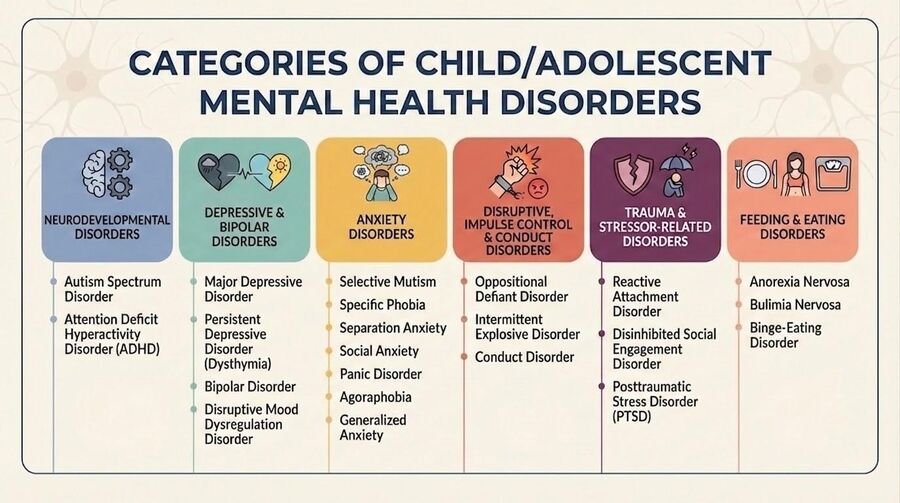
There are a lot of acronyms to keep track of here. Don't memorize them as a flat list — group them, and the structure of the DSM does most of the remembering for you. Tap any header to open it.
Present early and shape development itself. Autism Spectrum Disorder (ASD) centers on social-communication differences plus restricted, repetitive patterns; "spectrum" means wide variation in support needs. ADHD involves developmentally excessive inattention and/or hyperactivity-impulsivity — and, per the rule above, only counts when it impairs functioning across settings.
Major Depressive Disorder (MDD): discrete episodes of low mood/anhedonia lasting weeks. Persistent Depressive Disorder (PDD): lower-grade depression that grinds on for a year or more in youth. Disruptive Mood Dysregulation Disorder (DMDD): chronic irritability plus frequent severe outbursts in children/young adolescents. Bipolar I/II: mood swings between depression and (hypo)mania — episodic, distinct periods of elevated mood/energy. We untangle these below; they're the classic point of confusion.
The most common category in adolescence: generalized anxiety, social anxiety, panic, specific phobias, separation anxiety. Anxiety itself is normal and protective — a threat-detection system. It becomes a disorder when it's excessive, persistent, and (there's the rule again) impairing: when avoidance starts shrinking the person's world.
Oppositional Defiant Disorder (ODD): a persistent pattern of angry/irritable mood and argumentative, defiant behavior toward authority. Intermittent Explosive Disorder (IED): recurrent, out-of-proportion aggressive outbursts. Conduct Disorder: a more serious, repetitive pattern that violates others' rights or major age-norms. These are behavioral, not just moody — and they carry real risk of over-labeling, so the impairment and pervasiveness criteria matter a lot.
What defines this group is a precipitating event. PTSD: intrusion, avoidance, negative mood/cognition, and hyperarousal following exposure to trauma. Reactive Attachment Disorder (RAD): a pattern of inhibited, emotionally withdrawn attachment behavior in children who experienced grossly insufficient early caregiving. Cause is part of the definition here in a way it usually isn't elsewhere.
Anorexia Nervosa (AN): restriction leading to low weight, intense fear of weight gain, distorted body image. Bulimia Nervosa (BN): binge–compensatory cycles. Binge-Eating Disorder (BED): recurrent binges without regular compensation — the most common eating disorder. ARFID: restrictive eating driven by sensory features, low interest, or fear of aversive consequences — not body-image concerns. OSFED: "Other Specified" — clinically serious presentations that don't meet full criteria for another category (more below — it is not "the mild one"). Orthorexia (an obsessive fixation on "clean/healthy" eating) is a recognized clinical concern but is not a formal DSM-5-TR diagnosis — an honest "contested/emerging" case.
Non-Suicidal Self-Injury (NSSI) is deliberate self-harm without suicidal intent; in DSM-5-TR it appears as a condition for further study, not a settled disorder. Early psychosis covers the emergence of hallucinations, delusions, or disorganized thinking — often preceded by a subtler "at-risk" phase. Both get their own careful sections below, kept non-graphic on purpose.
The differential clinic (one symptom, many diagnoses)
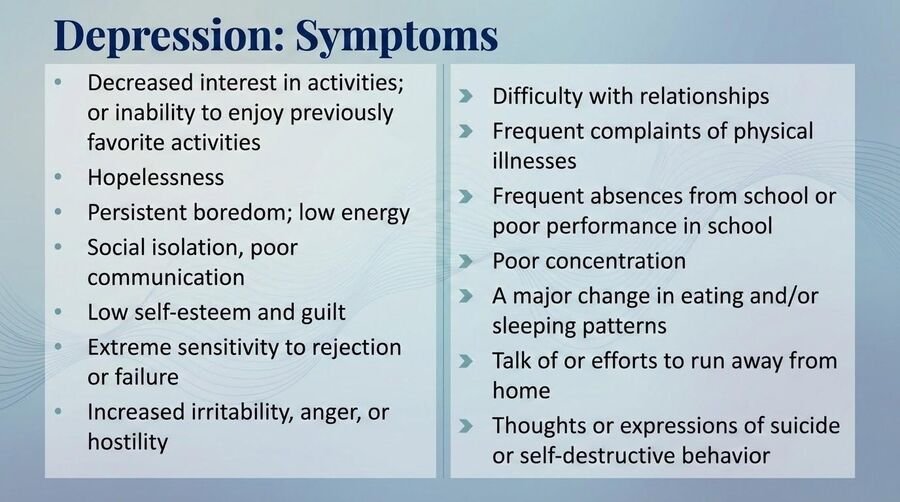
Here's what real clinicians do that a symptom list can't teach: they take one presenting complaint and route it to different diagnoses based on how it shows up. Take irritability in a teenager — maybe the most common complaint of all. The symptom is identical across the doors below. What differs is duration, episodicity, target, and impairment. Tap each door.
The irritability differential
Same presenting symptom — an irritable adolescent — sorted by the four questions a clinician actually asks.
In youth, depression often looks like irritability rather than sadness. Major Depressive Disorder is episodic: a distinct downturn from the person's normal self, with anhedonia, sleep/appetite/energy changes, lasting at least two weeks. Key word: change.
Persistent Depressive Disorder is the long, grey version — less intense than an MDD episode but far more durable (≥1 year in youth). It's easy to miss precisely because it looks like "just how they are."
Disruptive Mood Dysregulation Disorder: persistently irritable/angry mood between outbursts, plus recurrent temper outbursts grossly out of proportion, onset before age 10, diagnosed roughly ages 6–18. The irritability is chronic, not episodic — and that word is the whole ballgame (see the box below).
Bipolar I/II hinges on episodes of (hypo)mania — discrete periods of abnormally elevated or irritable mood plus increased energy, decreased need for sleep, and grandiosity. The signature is episodicity: a clear departure from baseline and back. Chronic, never-lets-up irritability is the opposite pattern.
Oppositional Defiant Disorder is defined partly by its target: an argumentative, defiant pattern directed largely at parents, teachers, authority. The irritability is relational and oppositional rather than a mood episode.
Intermittent Explosive Disorder: recurrent, impulsive aggressive outbursts wildly out of proportion to provocation, with relatively normal mood in between. The distinctive feature is the outburst itself, not a sustained mood state.
Four questions — duration, episodicity, target, impairment — turn one word ("irritable") into six different clinical paths. That's differential diagnosis, and it's why "there's an app that names your disorder" will never be a substitute for a trained clinician.
DMDD exists to fix an over-diagnosis problem. In the 2000s, U.S. clinicians were increasingly labeling chronically irritable children with pediatric bipolar disorder — and rates shot up. But research (led by Ellen Leibenluft and colleagues) showed these kids mostly had chronic, non-episodic irritability, which does not follow the episodic manic course of true bipolar and doesn't tend to become adult bipolar. DSM-5 added DMDD in 2013 to give chronic irritability its own home and steer clinicians away from over-diagnosing bipolar. The distinction that does the work: chronic vs. episodic. Whether DMDD is itself a well-validated category is still debated — an honest "contested" to keep in view.
OSFED is not "the mild one"
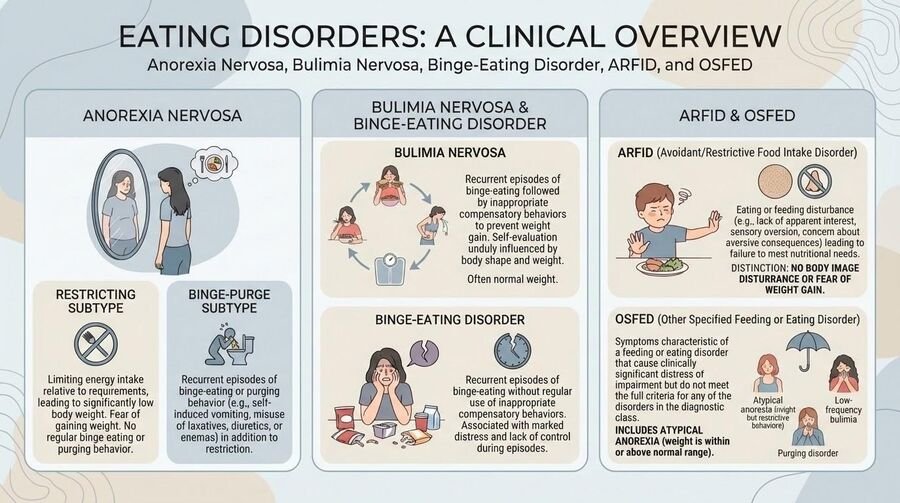
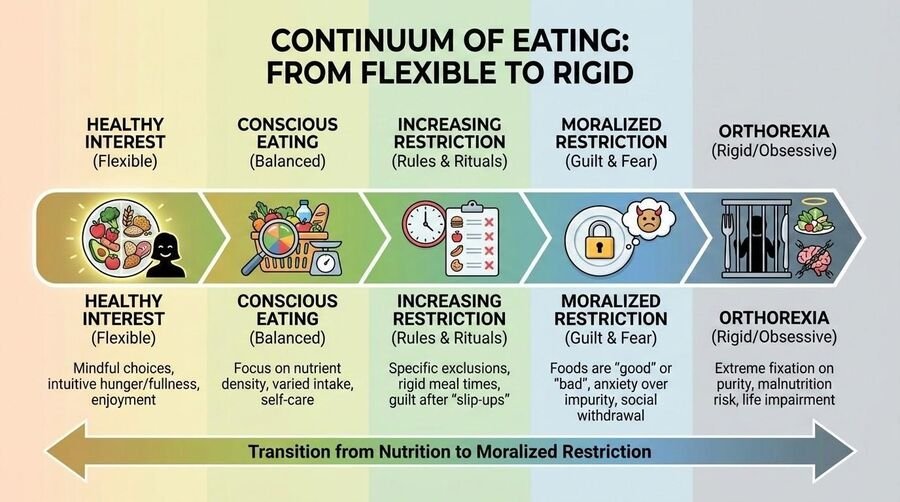
The naming actively misleads. "Other Specified Feeding or Eating Disorder" sounds like the leftover bin for minor cases. It isn't. OSFED is where clinically serious presentations land when they don't tick every box of a named disorder — and medical risk in eating disorders is largely weight-independent. Tap the card:
This is OSFED / atypical anorexia. And it can be every bit as dangerous as low-weight anorexia. The medical dangers of restriction and rapid weight loss don't wait for a number on a chart to cross a threshold. Weight is a poor proxy for risk — treating "normal-weight" as "not sick" is how atypical anorexia gets missed and undertreated.
You cannot rule out a serious eating disorder by looking at someone. Behavior and physiology — not body size — carry the risk. This is also why the impairment rule matters: the impairment here is medical, and it's real long before it's visible.
If you're worried about yourself or someone you care about, the National Alliance for Eating Disorders runs a free, clinician-staffed helpline at (866) 662-1235 (weekdays), or text ALLIANCE to 741741. (A note on sources: NEDA's long-running helpline was discontinued in 2023, so the Alliance is the current go-to referral line.) Eating disorders have among the highest mortality of any mental illness — and they are also treatable, especially with early intervention. Reaching out early is not an overreaction; it's the single most protective thing you can do.
Read the data honestly
The story you've probably absorbed — "adolescent mental health has never been worse" — was accurate for a decade. Then, quietly, the trend line bent. Any account that stops at the scary version is now out of date.
The CDC's Youth Risk Behavior Survey (YRBS) 2023, released in 2024, showed the first improvement in a decade: persistent sadness/hopelessness fell from 42% to 40%, and girls seriously considering suicide fell from 30% to 27%. Distress is still high — this is a bend, not a victory — but a "worse than ever" framing is now a year or more out of date. Two literacy habits to carry forward: (1) YRBS is self-report, sensitive to how questions are asked and to who's willing to answer; and (2) it runs every two years, so the "current" number you're quoting always lags reality by up to two years. Cite the trend, not just the scariest single figure.
Source: CDC, Youth Risk Behavior Survey 2023 (released 2024).
Early psychosis and the DUP clock
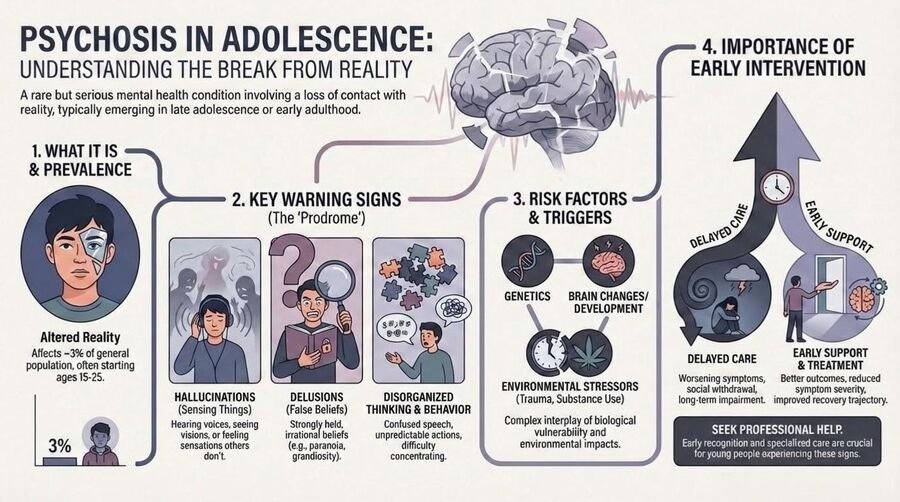
Psychosis — losing some contact with shared reality through hallucinations, delusions, or disorganized thinking — often first emerges in late adolescence and early adulthood. Two ideas from modern early-intervention research change how we should think about it, and both cut against stigma.
First, there's usually an early, milder phase clinicians call CHR-P (Clinical High Risk for Psychosis) — attenuated, sub-threshold symptoms that may (but often don't) progress. Catching it early opens a window. Second, and crucially: DUP — the Duration of Untreated Psychosis, the gap between symptom onset and the start of treatment. A longer DUP predicts poorer functional outcomes. Shortening that gap is one of the most actionable levers in all of adolescent psychiatry.
Coordinated Specialty Care (CSC) is the evidence-based model for early psychosis: a team wrapping medication, therapy, family support, and help staying in school or work around the young person, fast. Programs built on this approach (for example, OnTrackNY) are associated with better functional outcomes than treatment-as-usual. The through-line of this whole section: early, coordinated care beats waiting.
Two stigmas to retire on the spot. Myth: people with schizophrenia are violent. The large majority are not; they're far more likely to be victims of violence than perpetrators. Myth: a psychosis diagnosis means a ruined life. Many people recover meaningful functioning — work, relationships, school — especially with early, coordinated care. Stigma itself is a barrier to treatment, which means busting it isn't just kind; it's clinically protective.
NSSI, without the myth
Non-Suicidal Self-Injury is deliberate self-harm without suicidal intent. We'll keep this brief and non-graphic — no methods, because that framing helps no one. The point worth correcting is the explanation students most often carry: the "it releases endorphins so it becomes addictive" story. That's an oversimplification.
Current models (associated with Matthew Nock and colleagues) frame NSSI mainly by its functions — chiefly emotion regulation (down-regulating overwhelming distress) and interpersonal functions (communicating pain, seeking connection or escape). Understanding NSSI as an attempt to cope — a maladaptive one, but a coping attempt — points toward the right response: not shock or punishment, but helping the person build other ways to regulate emotion, and connecting them to care. Importantly, NSSI is a risk marker worth taking seriously even though it is, by definition, distinct from a suicide attempt.
If you're struggling with self-harm or thoughts of suicide, you don't have to sort out the categories on this page to deserve help. Call or text 988 in the U.S., any time. Reaching out is a strength, and most people who get support feel meaningfully better. You matter, and Bodhi means that.
Interactive · Angst or clinical? Apply the impairment rule
Sort each vignette
Use the rule from the top of the page: is there clinically significant distress or functional impairment? "Typical" means turbulence without a real cost to functioning; "Worth a closer look" means the cost is there. The card turns green when you're right.
Notice the last one: "normal" weight did not make it typical. Behavior and impairment carry the signal — that's the OSFED / atypical-anorexia lesson in action.
These vignettes are for building the concept — not for diagnosing real people. Actual diagnosis takes a trained clinician, a full history, and time. Your job as a psych student is to know when something is worth a closer look, and to help a friend get to that clinician. That's the whole assignment.