One orienting idea before we go deep. American juvenile justice has swung between two visions of a young offender: a child to be rehabilitated and a criminal to be punished. Nearly every date, case, and controversy in this unit is really a fight over which vision wins — and the pendulum has swung hard in both directions within living memory.
The classic trap: memorizing the SCOTUS cases as "the trio" and stopping at three. The trio (Roper, Graham, Miller) is where the arc peaks — but the story doesn't end there. Montgomery (2016) and especially Jones (2021) are where it gets interesting, because Jones is where the Court changed direction. Learn all five, in order, and you'll understand something most study guides miss.
Where the juvenile court came from — and why it exists

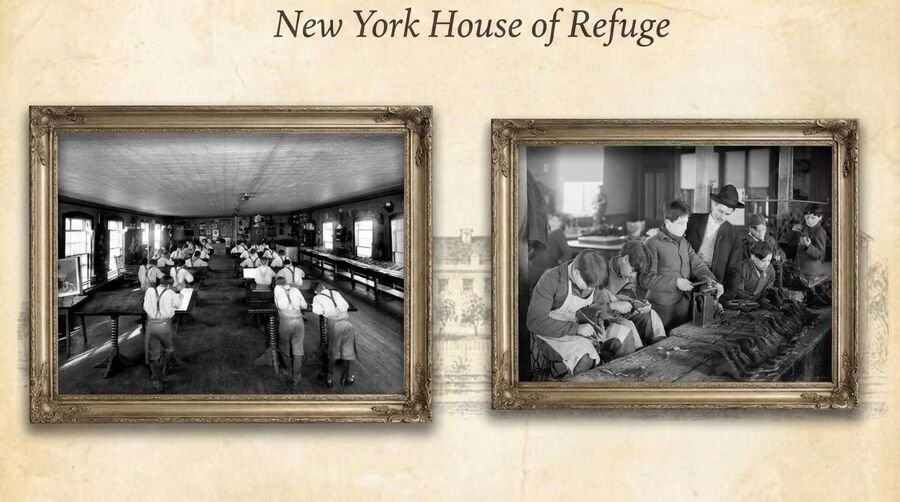
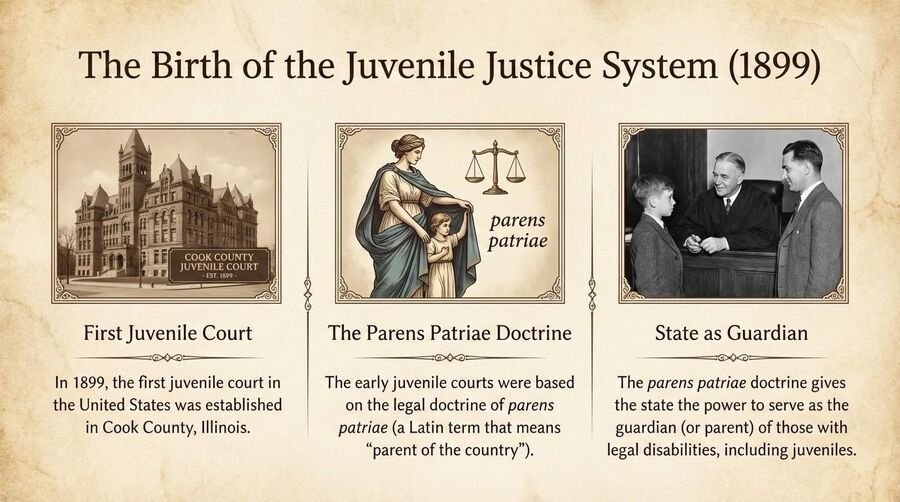
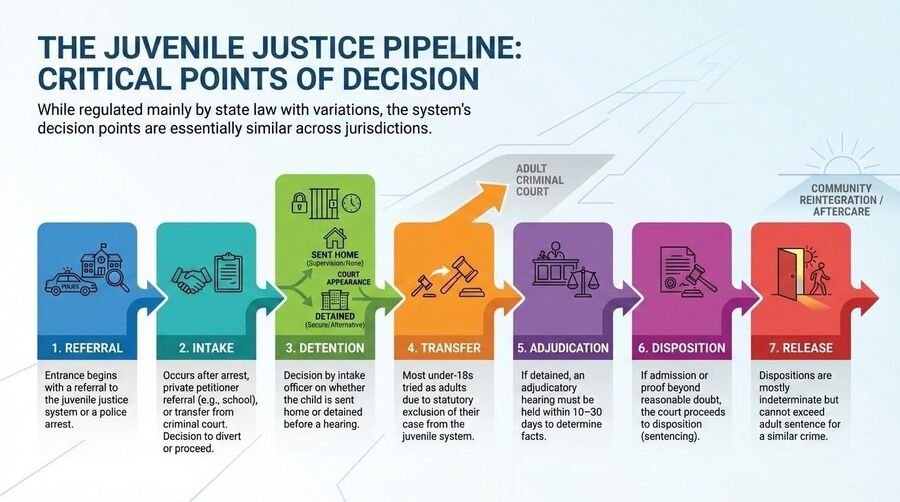
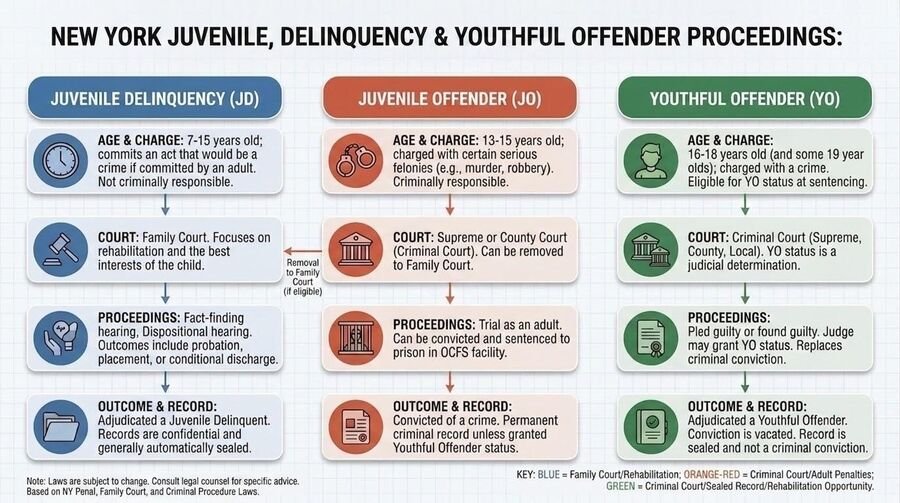
The idea that a fifteen-year-old should be tried differently from a forty-year-old is younger than you'd think, and it was built on purpose. The reform sequence runs like this:
New York opens the first House of Refuge — an institution to house wayward and delinquent youth apart from adult criminals. The premise: young offenders are malleable and should be reformed, not warehoused with hardened adults.
Cook County, Illinois (Chicago) creates the nation's first separate juvenile court. A parallel system — informal, closed, focused on the child's welfare rather than on assigning guilt — spreads across the country within a generation.
Latin for "parent of the nation." The doctrine holds that the state can act as guardian for those who can't fully protect themselves. It justified a rehabilitative, discretionary juvenile court — but also, critically, a court where kids had fewer procedural rights because it claimed to be helping, not punishing.
That parens patriae bargain — softer aims, weaker rights — held for most of the twentieth century. Then it broke.
The 1978 "adult time" pivot. Rehabilitation's reputation cratered in the 1970s amid rising crime and a sharp "nothing works" turn in penal thinking. New York's 1978 Juvenile Offender Law — passed fast after a notorious case — let children as young as 13 be tried as adults for serious violent crimes. It became a template. Over the next two decades, nearly every state widened its transfer and waiver rules, and the 1990s "superpredator" panic (a term whose empirical basis collapsed and whose author later recanted) accelerated the shift. The pendulum swung from "child to be saved" all the way to "criminal to be punished" — and the Supreme Court cases you're about to meet are, in large part, the swing back.
Interactive · The SCOTUS arc, in order
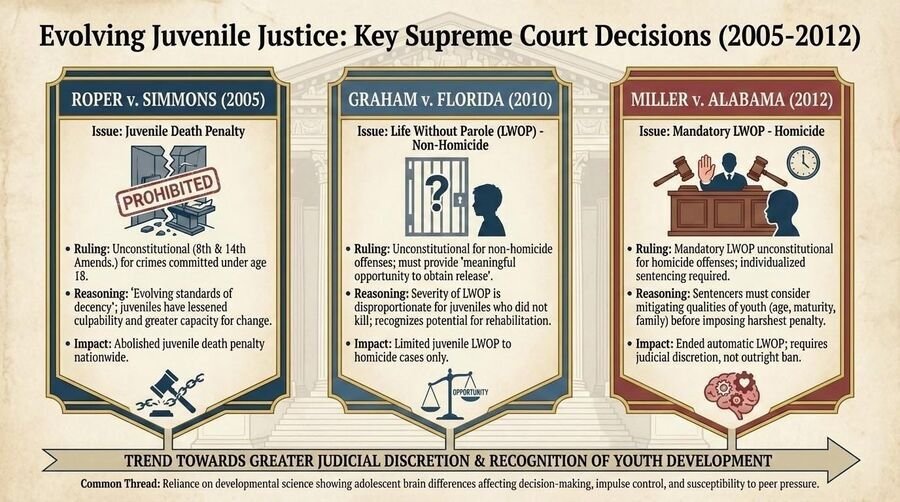
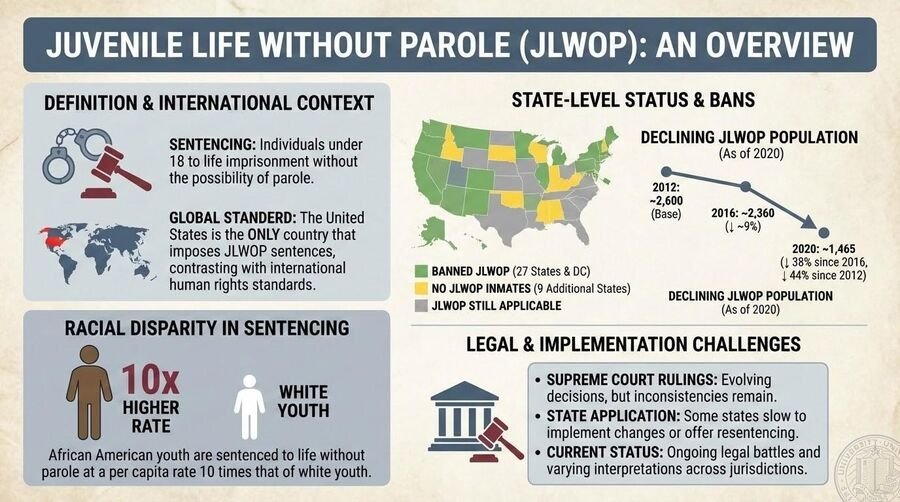
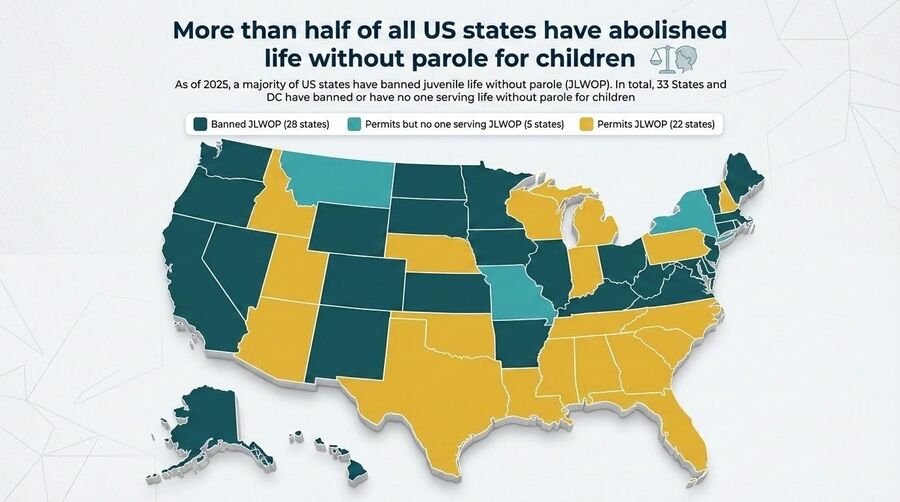
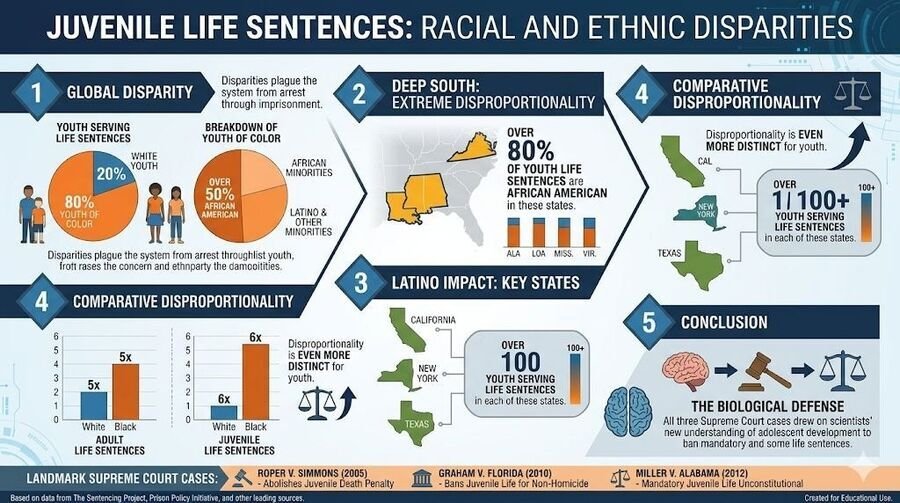
Here is the whole arc in one place. Study guides often give you three cases; there are five, and the fifth reverses the momentum of the first four. Open each in turn — the story only makes sense as a sequence.
Held that the death penalty for crimes committed under 18 is unconstitutional (Eighth Amendment, cruel and unusual punishment). The majority leaned explicitly on developmental science: adolescents show immaturity, susceptibility to peer influence, and a greater capacity for change. This is the case that opened the door — it made "kids are different" a constitutional premise, not just a psychological one.
Held that a juvenile cannot be sentenced to life without parole for a non-homicide crime. The state doesn't have to guarantee release — but it must give the person some "meaningful opportunity" to demonstrate rehabilitation. The logic of Roper extended from execution to permanent imprisonment.
Held that a mandatory sentence of juvenile life without parole is unconstitutional — even for homicide. Read the word "mandatory" carefully: Miller did not abolish JLWOP. It banned automatic JLWOP, requiring the sentencer to individually consider the offender's youth and its "hallmark features" before imposing it. JLWOP survives; it just can't be the reflexive default.
Held that Miller applies retroactively — it announced a substantive rule, so people sentenced to mandatory JLWOP before 2012 became entitled to resentencing or parole review. (A date that's easy to get wrong: Montgomery was decided in 2016, not 2017. Henry Montgomery had been imprisoned since 1963 for a crime committed at 17.) This is the ruling that emptied out much of the pre-Miller JLWOP population.
The case people often leave out — and the most consequential one for today. Held that a sentencer imposing JLWOP does NOT have to make a separate factual finding that the juvenile is "permanently incorrigible" or beyond rehabilitation. A discretionary sentencing process that considers youth is enough; no formal on-the-record determination of irredeemability is required. In effect, Jones narrowed Miller and Montgomery — it kept the procedural shell while loosening the substantive protection many lower courts had read into those cases. The federal constitutional floor is now lower than the trio seemed to promise.
After Jones, where do the real protections live? At the state level. This is the federalism pivot the arc has been building toward. Because Jones set only a modest federal minimum, the strongest limits on sentencing children now come from state constitutions, legislatures, and high courts — many of which have gone further than the Supreme Court requires, some banning JLWOP outright. Reasonable people disagree sharply about whether Jones was a faithful reading of Miller or a retreat from it; that debate is live in the case law right now. The teaching point is durable regardless of who's right: after 2021, "what protects a child at sentencing" depends heavily on which state you're in.
Two phrases students blur that the law keeps apart. Life WITHOUT parole means no release, ever. Life WITH parole eligibility means a genuine chance at review down the road. Post-Montgomery resentencing mostly converted the former into the latter — so the count of juveniles serving true JLWOP has fallen sharply. Roughly 28 states plus D.C. now ban JLWOP, and the number keeps climbing — but treat any exact figure as a moving target, not a fact to memorize. What's stable is the direction: fewer children, in fewer states, are serving sentences with no possibility of release.
Why "mature enough" has two answers
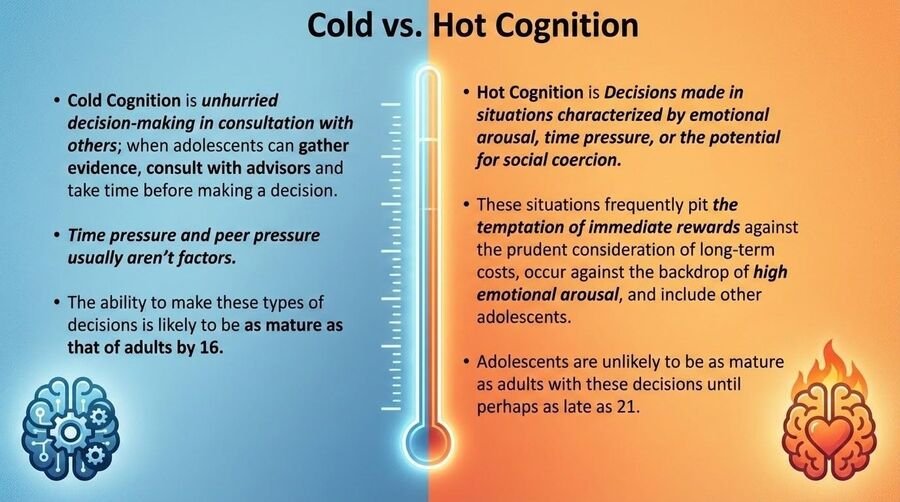
Here's the puzzle that trips people up. The APA has argued in Supreme Court briefs that adolescents are mature enough to make a medical decision (like consenting to an abortion) but not mature enough to be held fully responsible for a crime. Critics called that a contradiction. It isn't — and the resolution is the single most useful construct in this unit.
Cold cognition is reasoning done calmly, with time, information, and no emotional pressure — the kind you use deciding whether to have a medical procedure or whether you're competent to stand trial. It matures early, reaching roughly adult levels by about age 16. Hot cognition is reasoning under emotional arousal — thrilled, frightened, peer-watched, time-pressured — the kind that governs most real criminal decisions, made in the moment. It matures late, not reaching adult levels until around age 21 (or later). So there's no contradiction: a 16-year-old can be cold-cognition mature (fit to consent, fit for trial) while still being hot-cognition immature (impaired in exactly the split-second, high-arousal situations where crimes happen).
This maps cleanly onto the brain story from Unit 5: an early-maturing reward/emotion system racing a still-developing prefrontal control system. Cold cognition is the control system on a good day. Hot cognition is what happens when the reward system is screaming and control hasn't finished wiring. Try sorting real-world decisions by which system runs the show:
Hot or cold? Sort the decision
For each scenario, decide whether the developmentally relevant system is cold cognition (calm, deliberate — matures ~16) or hot cognition (aroused, pressured, peers present — matures ~21). The card turns green when you're right.
Notice the pattern: the "cold" items are the ones the APA says teens can handle; the "hot" items are exactly where adolescent judgment is most impaired — and where the justice system does most of its damage.
The interrogation room is a hot-cognition trap
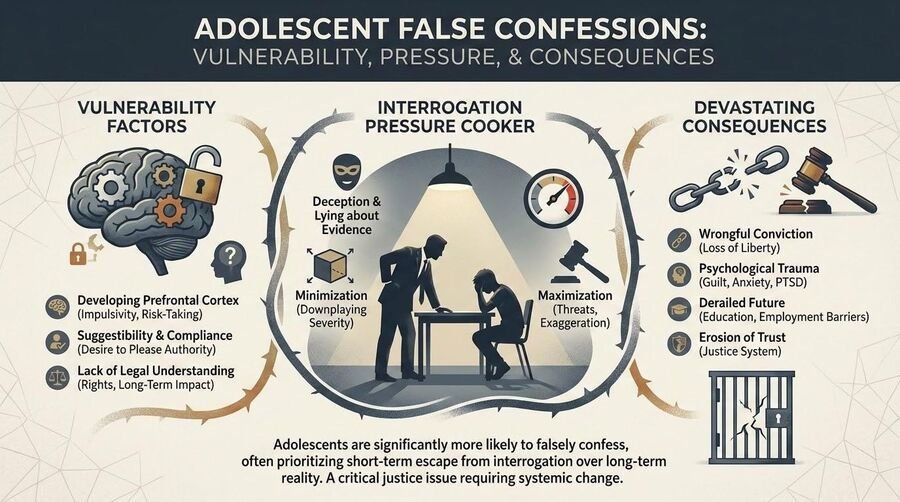
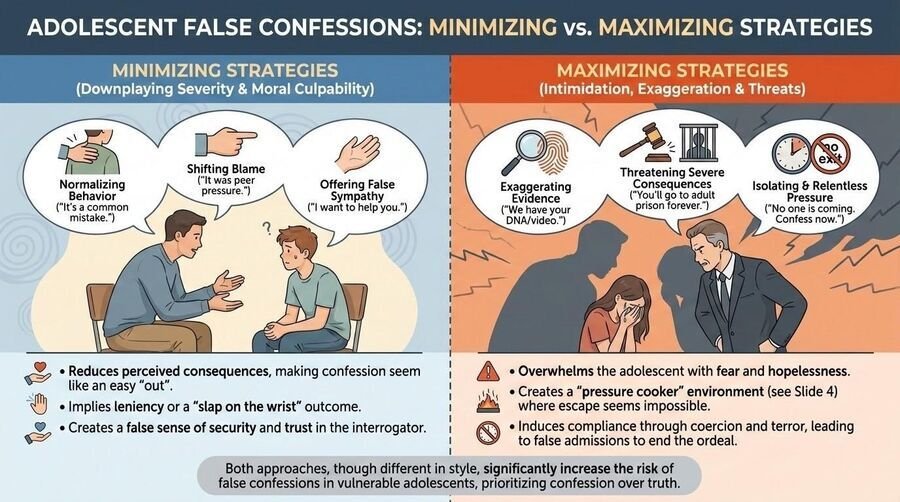
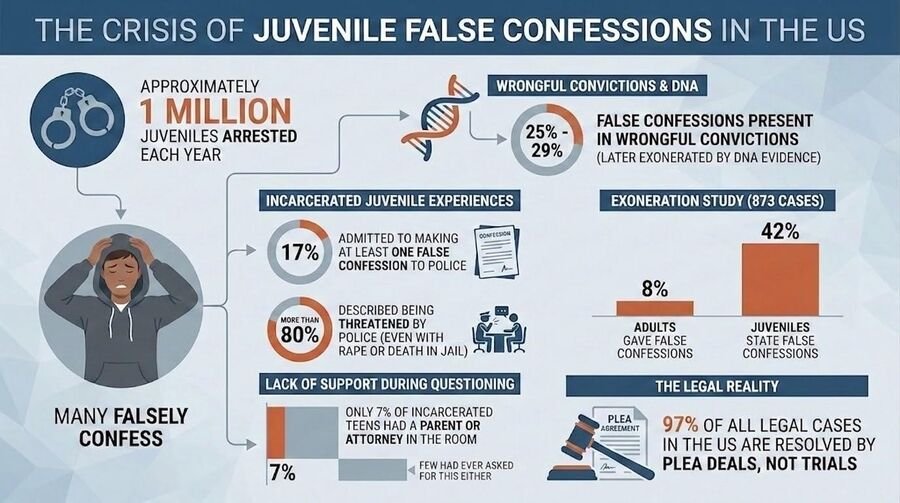
Follow that last scenario into its consequence. The same immediate-reward bias and stress-driven judgment that make adolescents risk-prone in the car make them dangerously vulnerable in the interrogation room — where a trained adult offers a child an immediate escape ("just say it and you can go home") in exchange for a signature that lasts a lifetime.
Per the National Registry of Exonerations, juveniles falsely confess at strikingly higher rates than adults — false confessions appear in roughly 40%+ of juvenile exoneration cases, versus something on the order of 8–11% for adults. The mechanism is the hot-cognition story: under interrogation stress, adolescents heavily discount the future ("years in prison" is abstract) and over-weight the immediate reward of ending the ordeal ("go home now"). The Reid technique — the dominant U.S. interrogation method, built on confrontation, minimization, and implied leniency — is especially hazardous with a developing brain. Distinguish two failure modes: a coerced-compliant confession (the person knows they're innocent but confesses to escape the pressure) versus a coerced-internalized confession (the person, worn down and confused, comes to genuinely doubt their own memory and believe they might have done it). The Exonerated Five (long known as the "Central Park Five") are the textbook case — five Black and Latino teenagers who gave false, coerced confessions and were later fully exonerated by DNA and a confession from the actual perpetrator.
Source: National Registry of Exonerations (figures are directional and update over time).
There is another way to run an interview: PEACE
The Reid critique isn't just hand-wringing — an alternative exists, and much of the English-speaking world outside the U.S. already uses it. Britain developed the PEACE method in the early 1990s, directly in response to a wave of false-confession scandals produced by coercive questioning. The premise inverts Reid: the goal is not a confession but a full, accurate account of events, gathered without presuming the suspect's guilt.
Preparation and Planning: the interviewer works out objectives and reviews the evidence before anyone sits down. Engage and Explain: rapport first — the literature calls this the single most influential stage. No confrontation, no accusation.
The suspect gives their uninterrupted account of events. Only afterward does the interviewer clarify, expand, and — if the evidence contradicts the story — challenge specific inconsistencies. Information first, evidence second, pressure never.
Closure: summarize the account back and verify mutual understanding. Evaluation: the interviewer reviews what the interview achieved and how it could have gone better — the method audits itself.
Connect PEACE to everything above and you'll see why it belongs in this unit. Reid-style interrogation works by manufacturing exactly the conditions under which adolescent judgment fails: stress, exhaustion, an authority figure, and a vivid immediate exit ("confess and go home"). PEACE removes the trap rather than asking a hot-cognition-immature brain to survive it — no minimization, no implied leniency, no deceptive evidence. The evidence base backs the design: a meta-analytic review found that information-gathering approaches reduce false confessions while preserving — even improving — the rate of true confessions (Meissner et al., 2014), and field research shows skilled PEACE interviewers obtain comprehensive accounts from most suspects without any confrontation at all (Walsh & Bull, 2010). PEACE is now standard in the UK and adopted in Australia, New Zealand, Norway, and parts of Canada. The U.S. still overwhelmingly trains Reid — which means the interrogation room an American teenager walks into is the one least designed for the brain that walks in with them.
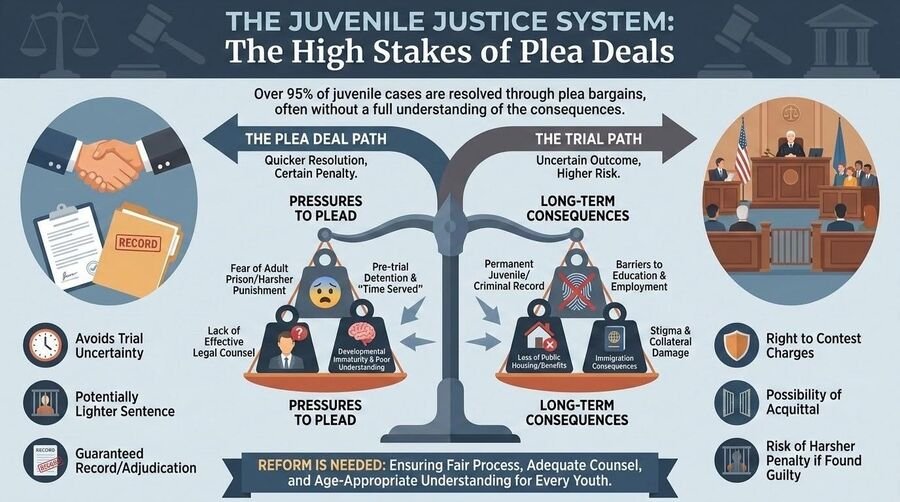
The same bias runs the plea deal. The overwhelming majority of criminal cases — for juveniles and adults alike — never go to trial; they end in a guilty plea. Put a frightened teenager in front of a choice between "plead now, known sentence" and "risk trial, unknown but scarier sentence," and immediate-reward bias pushes hard toward the plea — sometimes even for a crime they didn't commit. It's the interrogation-room dynamic in a courtroom. Miranda warnings assume a rational actor weighing long-term consequences; hot cognition is a poor fit for that assumption.
Felony murder, and one line that isn't drawn by age
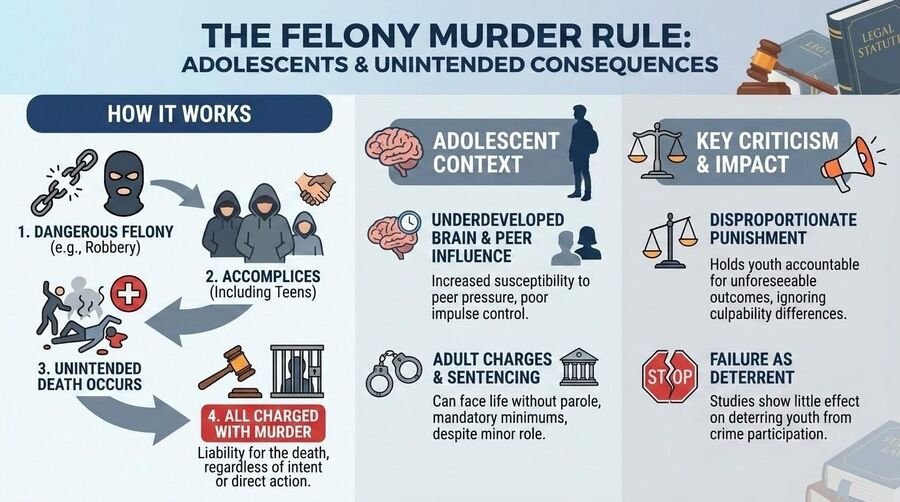
Not every hard edge in this unit is about the age of the defendant. Some are about doctrines that catch young people in counterintuitive ways. Felony murder is the clearest example.
If someone dies during the commission of a dangerous felony, participants in that felony can be charged with murder — even if they didn't kill anyone and never intended a death. Intent to commit the underlying felony substitutes for intent to kill.
Under the proximate-cause approach (some states use it), a defendant can be convicted of murder even when the person who fired the fatal shot was a police officer or a victim — and even when the person killed was one of the defendant's own co-felons. You can be guilty of your accomplice's death.
Four young men in Elkhart, Indiana broke into a home; the homeowner shot and killed one of them. The surviving four were charged with the felony murder of their own friend. The case became a national flashpoint for how far felony-murder liability can stretch — and how easily it sweeps in teenagers who never touched a weapon.
Two more places the age line gets drawn — inconsistently
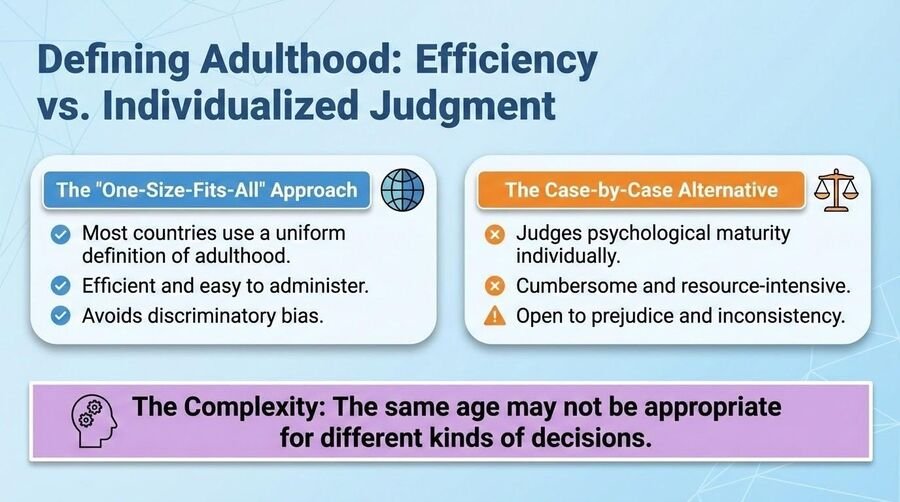
Raise-the-age laws. Over roughly the past decade, a wave of states raised the top age of juvenile-court jurisdiction to 18 — meaning 16- and 17-year-olds who were once automatically funneled into adult court now start in the juvenile system. Only a couple of states still set the line lower. This is the same "one-size-fits-all age line" problem the hot/cold distinction exposes: the law loves a bright numerical cutoff, but development doesn't arrive all at once, and different jurisdictions draw the line in different places for different purposes.
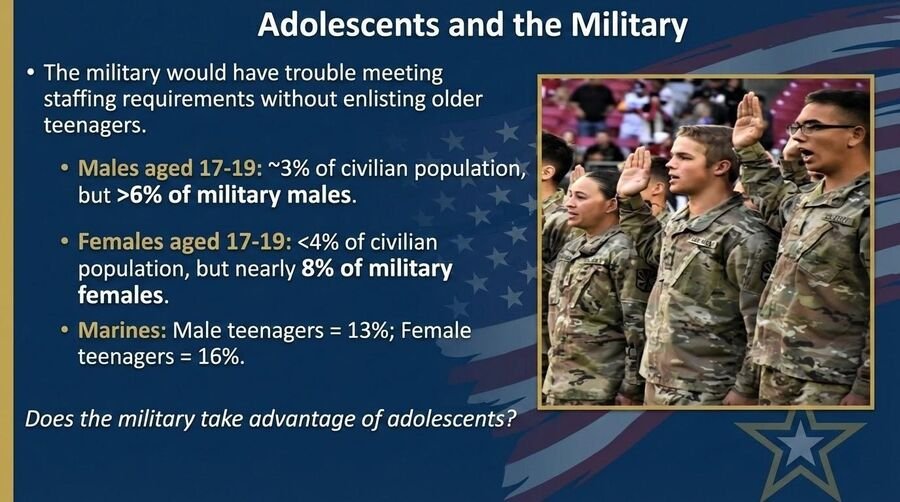
Adolescents and the military. The U.S. lets 17-year-olds enlist (with parental consent) and permits younger participation in some junior programs — while the same young people can't vote, drink, or, per the APA's own hot-cognition argument, be trusted with high-arousal split-second judgment. Is that a contradiction, or a reasonable line-drawing given training, supervision, and structure? Advocates and critics genuinely disagree, and this course won't hand you a verdict. Hold it as a live tension: our institutions have not settled on one age of adulthood, and the military line sits uneasily next to the justice-system line drawn just a few pages ago.
One thread runs under everything above and it can't be softened: racial disparity is woven through every stage. Compared with white peers, Black and Latino youth are more likely to be arrested, transferred to adult court, detained, and sentenced to the harshest terms — including JLWOP — for comparable conduct. The Exonerated Five weren't a coincidence of race. When you evaluate any reform in this unit — raise-the-age, resentencing after Montgomery, the state-level protections after Jones — ask not only "is it more lenient?" but "does it narrow or widen the gap between who the system punishes hardest?" That question is the moral center of the whole unit.