One orienting distinction before the chemistry. Adolescent problems split into two broad families: externalizing — acted outward (substance use, aggression, rule-breaking) — and internalizing — turned inward (anxiety, depression, withdrawal). Substance use is mostly an externalizing story. But the most interesting thing about this unit is how the two families have moved in opposite directions over the last fifteen years. Hold that in mind — we'll come back to it.
If you take one fact from this unit, take this: teen substance use is near the lowest levels ever measured. The scary-drug story you might be expecting is a story about a problem that has been shrinking. That doesn't mean "don't worry" — it means worry about the right things. Keep reading.
The headline that's easy to miss
A drug-by-drug tour can leave the impression that adolescent use is a rising crisis. The best national data say the opposite. The Monitoring the Future study (University of Michigan, funded by NIDA) has surveyed U.S. secondary students annually since 1975. Its 2024–2025 findings: teen use of alcohol, cannabis, and nicotine sits at or near the lowest levels in decades.
This deserves its own section, not a throwaway line. Across the 2010s and into the 2020s, teen use of the major substances declined — and the drops accelerated around 2020. In 2024, roughly four in five 10th graders and two in three 12th graders reported abstaining from all three of alcohol, cannabis, and nicotine in the past month. A careful reader asks the follow-up questions: MTF is a school-based self-report survey (it misses chronically absent and out-of-school youth), and "past-30-day use" is a specific, conservative measure. But the trend is large, consistent across substances, and holds across independent surveys.
Source: Monitoring the Future, University of Michigan / National Institute on Drug Abuse, 2024 release.
"Use is at historic lows" and "some drugs are more dangerous than ever" can both be true at once. Prevalence is going down; potency and contamination are going up. Confusing those two is the single most common mistake people make about this topic — including in the news.
The risk paradox
Here's the tension worth thinking hard about. Over the 2010s, externalizing risks fell — substance use down, teen pregnancy down, delinquency down. Over the same window, internalizing distress rose — anxiety and depression up. Behavioral risks down, inner distress up. Two curves crossing.
One prominent hypothesis links both trends to the same underlying shift: adolescents spend far less time together in person than they used to. Less in-person socializing means fewer parties, fewer cars full of teenagers, fewer of the settings where drinking and risk behavior happen — which would help explain the externalizing decline. But that same withdrawal from face-to-face connection may also erode the relationships that buffer against loneliness and depression — which could feed the internalizing rise. Smartphone displacement is the mechanism usually named. It's a genuinely compelling story — and it is contested: correlation is strong, causation is disputed, and other candidates (rising academic pressure, news/climate stress, better screening that catches more cases, reduced stigma around reporting) remain in play. Treat this as an analytic tension to reason about, not a settled fact to memorize.
Why is use falling? MTF's own analysis points to a durable predictor: use tracks with perceived risk and social disapproval. When more teens see a substance as harmful and their peers frown on it, use drops. That's mostly good news — but it contains a warning. Perceived harm of cannabis has been declining even as reported use stays low. Because perception tends to lead behavior, falling perceived-harm is the kind of signal that can precede a future uptick. Low use today is not a guarantee about tomorrow.
Stress physiology & the coping vulnerability
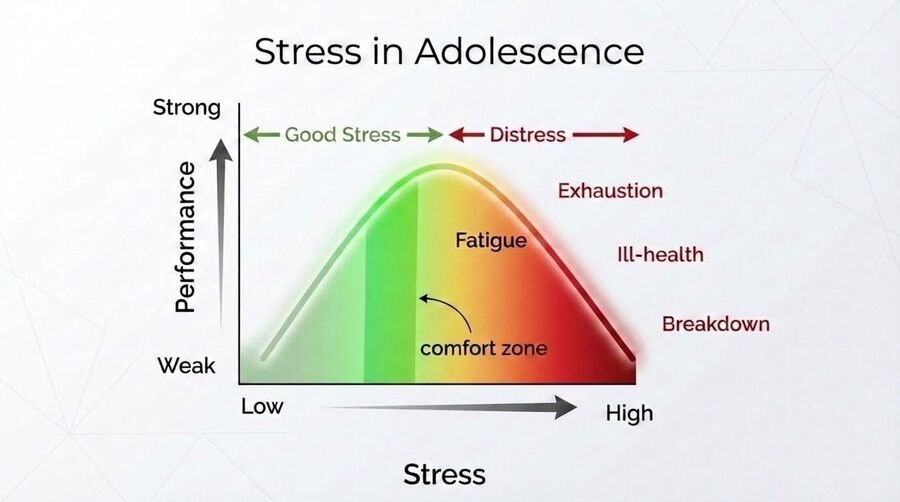
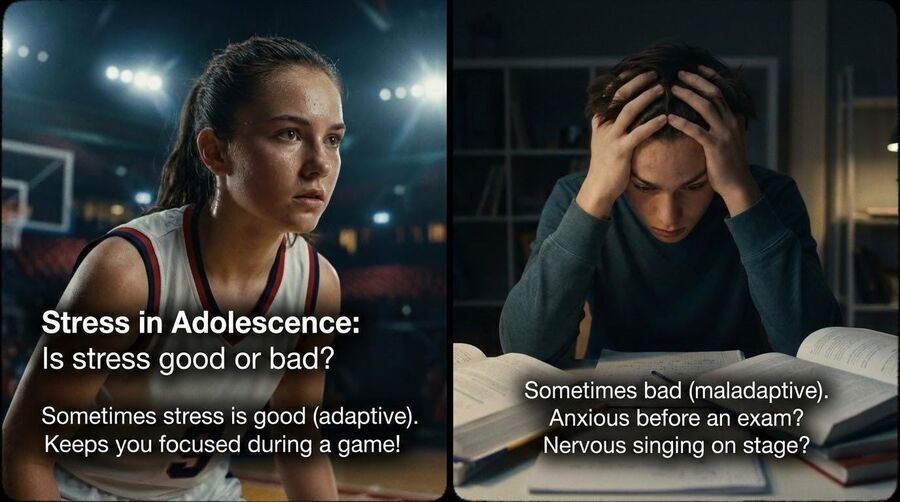
Why do some adolescents reach for a substance under stress? Start with the stress response itself. A perceived threat trips the fight-or-flight system: the sympathetic nervous system and the HPA axis flood the body with adrenaline and cortisol, sharpening focus and mobilizing energy. That's acute stress — adaptive, self-limiting, and over quickly. The problem is chronic stress: when the alarm never fully switches off, sustained cortisol wears on the body and the developing brain.
Now layer on the developmental fact from Unit 5. In adolescence the emotional, threat-detecting amygdala is running at full strength while the prefrontal cortex — the deliberate, regulate-and-plan system — is still maturing. That mismatch is a coping vulnerability: strong stress signal, still-developing brakes. Under load, the fast relief a substance offers can win out over the slower, better strategies the prefrontal cortex would otherwise supply.
Maladaptive or healthy coping?
Coping isn't good or bad by feeling — it's defined by whether it addresses the stressor or just muffles it. Sort each response. The card turns green when you're right.
The pattern: healthy coping engages the stressor (or genuinely restores you); maladaptive coping avoids it and often adds a second problem on top. Substances are the classic avoidance shortcut — fast relief now, bigger stressor later.
How addiction hijacks the reward system
Every addictive drug, by a different door, drives up dopamine in the brain's reward pathway. That's the pleasure-and-learning signal that normally tags food, connection, and accomplishment as "do that again." Flood it artificially and often enough, and the brain adapts to defend its balance: it downregulates — dialing back dopamine receptors and output.
Two consequences follow directly, and they're the whole engine of a substance use disorder:
With fewer receptors responding, the same dose does less. It now takes more of the drug to reach the old effect — the definition of tolerance, and a step toward escalation.
A downregulated system produces less dopamine on its own. Ordinary pleasures feel muted and the person feels flat or low without the drug — so use shifts from chasing a high to escaping a deficit. That's the trap.
A still-plastic, still-developing brain learns these reward associations faster and more durably. Earlier onset of nicotine or cannabis use is associated with higher risk of later addiction — one of the more robust findings in the field.
Screening and treatment, in plain terms. Naming the drugs is one thing; here's what clinicians actually do. Adolescent screening often uses the CRAFFT — six yes/no questions (Car, Relax, Alone, Forget, Family/Friends, Trouble) that flag risky use quickly. When treatment is warranted, the front-line psychosocial tools are Motivational Interviewing (MI), which works with ambivalence rather than lecturing against it, and Cognitive-Behavioral Therapy (CBT), which targets the triggers and thought patterns around use. For some substances — notably opioids — Medication-Assisted Treatment (MAT) pairs medication with counseling and is the evidence-based standard, not a moral failure or "trading one drug for another."
The drugs, updated
Now the substance-by-substance layer — with the modern details that older accounts tend to miss.
Nicotine & the product-substitution story
Nicotine is a fast, potent reinforcer, and the addiction math is stark: roughly 90% of adult smokers started before age 18. Combustible-cigarette smoking among teens has fallen to historic lows. But nicotine didn't disappear — it changed shape.
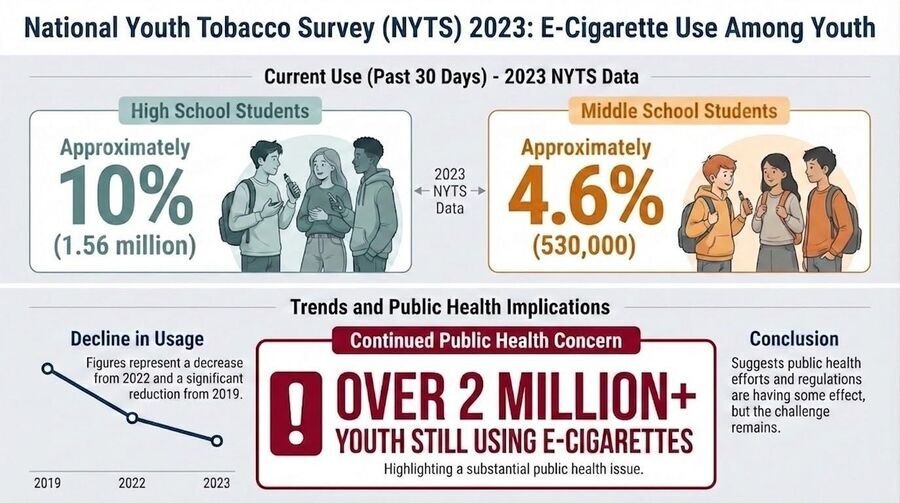
Teen vaping surged to a peak around 2019 (the Juul era) and has since declined substantially. Reading that as a clean victory misses what replaced it. The fastest-growing product is now oral nicotine pouches — Zyn dominates the youth pouch market — a discreet, no-vapor, no-smell delivery that's easy to use unseen. The FDA authorized marketing of certain Zyn products in January 2025. The pattern to notice is product substitution: as one nicotine product falls out of favor, another engineered for convenience rises to catch the same demand. "Vaping is down" is true and incomplete.
Cannabis: same plant name, different drug
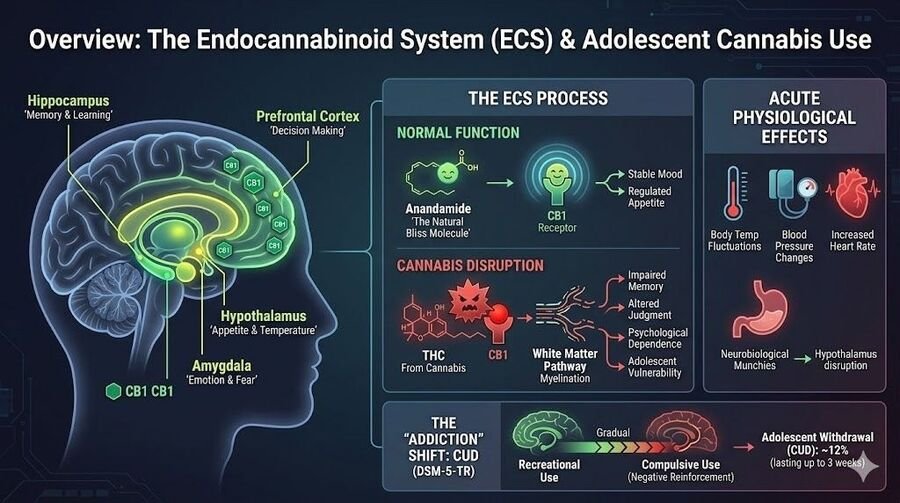
Cannabis acts on the body's own endocannabinoid system — the network whose natural signaling molecule is anandamide. THC works by mimicking anandamide at those receptors. The reason today's cannabis is a genuinely different exposure than a generation ago is potency and delivery. Tap each card.
Averaged roughly 1–3% THC. This is the "weed" of the studies and the stereotypes many older narratives are built on.
Commonly 15–25% THC — roughly a five-to-tenfold jump in the core product itself, before you even reach concentrates.
Dabs, wax, and vape carts commonly run 70–90%+ THC. A different intensity of exposure entirely — and easy to underestimate by "one hit" intuition.
Delayed onset (30–120 min) invites redosing before the first dose lands — a leading path to accidental overconsumption and ER visits.
Hemp-derived, semi-legal delta-8 products exploit a regulatory gray zone — often sold outside dispensary controls, with uneven labeling and testing.
Cannabis can be addictive — Cannabis Use Disorder is a real diagnosis, and risk is higher with earlier onset and higher-potency products. "Natural" ≠ "harmless."
Alcohol: the neurochemical sledgehammer
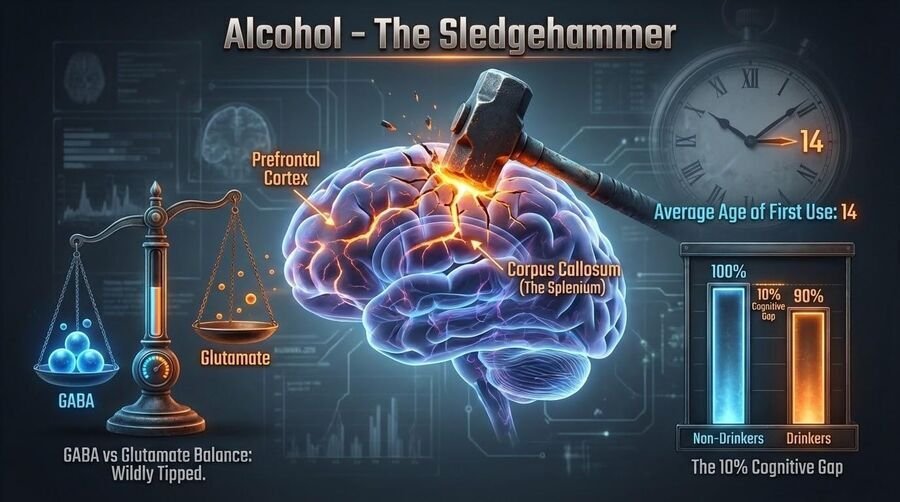
Where nicotine and THC act on fairly specific receptor systems, alcohol is a blunt instrument. It does two opposing things at once: it enhances GABA, the brain's main inhibitory (calming, slowing) neurotransmitter, and it suppresses glutamate, the main excitatory (activating, signaling) one. Push the brakes and cut the accelerator simultaneously and the whole system slows — which is why heavy alcohol impairs coordination, memory, judgment, and, at high doses, the brainstem functions that keep you breathing. That "sledgehammer" breadth is exactly why alcohol remains, by volume, the most consequential substance for young people even as overall use falls.
The topic that often gets left out
Here is the hard piece a "use is at historic lows" story must include to be honest. In the 2020s, fentanyl-contaminated counterfeit pills became a dominant driver of adolescent overdose deaths. Illicitly pressed pills — made to look like prescription Xanax, Percocet, or Adderall — increasingly contain fentanyl, and a fatal amount is invisibly small. This is why teen drug deaths can rise even as teen drug use falls: the change isn't more kids using, it's the potency and contamination of what a small number encounter, often without knowing what they took. The practical, non-judgmental public-health responses — assume any non-pharmacy pill may contain fentanyl, and know that naloxone reverses opioid overdose — belong in this unit precisely because the prevalence numbers alone can lull a reader into thinking the danger is over. It isn't; it changed form.
Fewer adolescents are using substances than at almost any point on record — and the ones that are used are, in places, more potent and more dangerous than ever. Good news and a sharpened risk, side by side. Carry both.