Before any content, one framing that unlocks the whole unit: five ideas people routinely fuse into one. Biological sex (bodies), gender identity (your inner sense of self), gender expression (how you present), gender roles (what a culture expects), and sexual orientation (who you're attracted to) are five separate dimensions. They correlate — but they're not the same variable. Keep them apart and most of the confusion in public debate dissolves.
Some numbers in this field are solid; others are repeated far more confidently than the data warrant. I'll flag which is which — not to push a side, but because a psychologist's real skill is knowing how strong the evidence is. If a figure here is contested, you'll see me say so out loud.
The five dimensions · the Genderbread model
The Genderbread teaching model lays out the five dimensions as independent sliders rather than a single switch. The pedagogical point is not political — it's conceptual precision. When a study measures "gender," ask which of these five it actually measured, because they behave differently and have different causes.
Chromosomes, hormones, gonads, and anatomy. Usually categorized male/female, but development is a cascade of steps — and, as intersex/DSD conditions show, those steps don't always line up.
Your internal sense of being a girl, boy, both, neither, or something else. It's a felt experience, typically stable by early childhood — not a body part and not a choice made on a whim.
Clothing, mannerisms, voice, name — the outward signals a culture reads as masculine or feminine. Highly culture-bound: a "feminine" color or garment in one era or place is "masculine" in another.
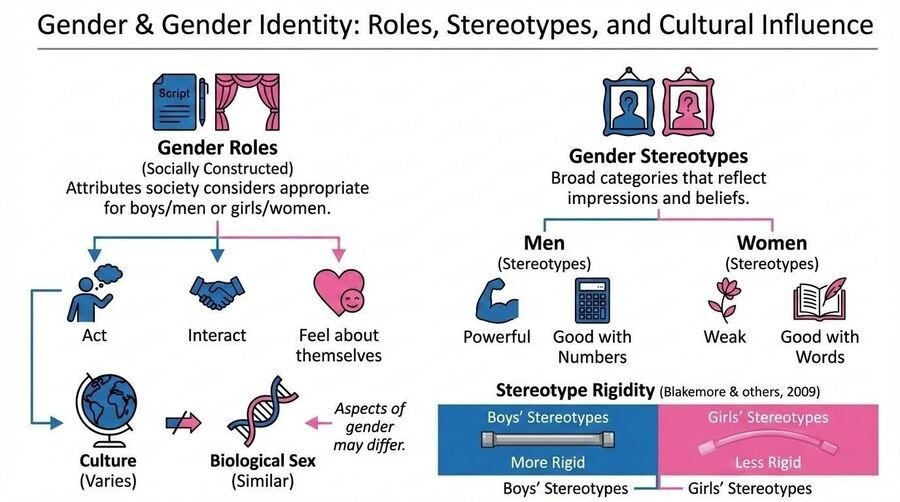
The behaviors and jobs a society expects of each sex. These are the stereotypes — and because they vary across cultures and decades, they're strong evidence that much of "gender" is learned, not fixed.
The pattern of your romantic/sexual attraction. This is separate from identity: a transgender person can be straight, gay, or bi, just like anyone else. Fusing the two is the single most common error here. (Unit 7 goes deeper.)
A common real-world trap: assuming a transgender woman must be attracted to men, or that a "masculine" presenting person must be gay. Identity, expression, and orientation are three different sliders. Knowing one tells you very little about the others.
Where sex itself isn't binary at the edges · intersex & DSD
Human sex development usually runs a tidy sequence — chromosomes → gonads → hormones → anatomy. Intersex conditions (clinically, differences/disorders of sex development, DSD) are cases where that sequence produces a body that doesn't fit the typical male or female template: for example, androgen insensitivity, congenital adrenal hyperplasia, or certain chromosomal patterns. Biologically, this is the clearest reminder that even sex — the most "physical" dimension — has genuine edge cases.
But how common is it? This is where students meet their first contested statistic — and it's a perfect teaching case, because the honest answer is: it depends entirely on how you define the category.
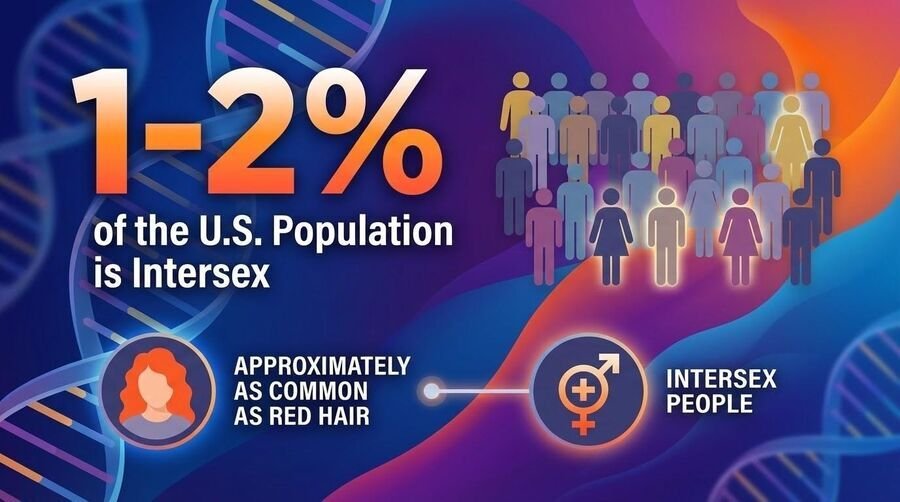
You'll see intersex cited as roughly 1–2 in 100 people (~1.7%). That figure comes from Anne Fausto-Sterling's team (Blackless et al., 2000) and uses a broad definition — it counts any deviation from an idealized male/female template, including conditions that are subtle, discovered only in adulthood, or arguably not "intersex" in a clinical sense. Critics (e.g., Sax, 2002) argued that if you restrict the count to conditions where anatomical sex is genuinely ambiguous at birth, the estimate falls to roughly 1 in 5,000 (~0.02%) — about a hundredfold difference. Neither number is a "lie." They answer different questions. The lesson isn't which figure to trust; it's that a prevalence statistic is meaningless until you know the case definition behind it.
Sources: Blackless et al. (2000), American Journal of Human Biology; Sax (2002), Journal of Sex Research. Figures remain genuinely disputed in the literature.
Interactive · How strong is the evidence?
Three of this unit's own numbers, put under the microscope
This is the most important skill in the unit. Each panel below takes a figure you might see quoted and asks: where does it come from, and how confident should we be? Tap each to expand. Notice that "the honest answer" is rarely a single tidy number.
Verdict: depends on definition — cite the range, not a point. The ~1.7% figure uses a broad definition (Blackless et al., 2000); a narrow, clinically-recognized-DSD definition yields ~0.02%, about 1 in 5,000 (Sax, 2002). A careful writer presents both and names the definitional dispute. A careless one picks whichever number fits their argument.
Verdict: this specific framing is miscited — retire it. Alarming "×more likely to die" figures typically trace back to surveys that measured lifetime suicide attempts or ideation (self-reported), not completed suicide, and often used non-representative samples. What the better evidence does support is that transgender youth report elevated rates of suicidal ideation and attempts — and, crucially, that these rates are strongly moderated by family and social acceptance. This is a correlational, minority-stress pattern, not an intrinsic outcome of being transgender. Swapping the sensational stat for the accurate mechanism is exactly the upgrade this course is training you to make.
Verdict: use a primary source with a stated method. The best-anchored U.S. estimates come from the Williams Institute (2022): about 1.6 million people ages 13+ identify as transgender, including roughly 1.4% of youth ages 13–17 (~300,000) and about 0.5% of adults. When you see a dramatic state-by-state percentage, treat it as a flag to check the primary source and its sampling method — county- and state-level breakdowns carry much more uncertainty than the national figure.
Takeaway: "How was this measured?" and "Who was sampled?" are not pedantic questions. On a contested topic they're the whole ballgame.
Are the sexes really so different? · the gender similarities hypothesis
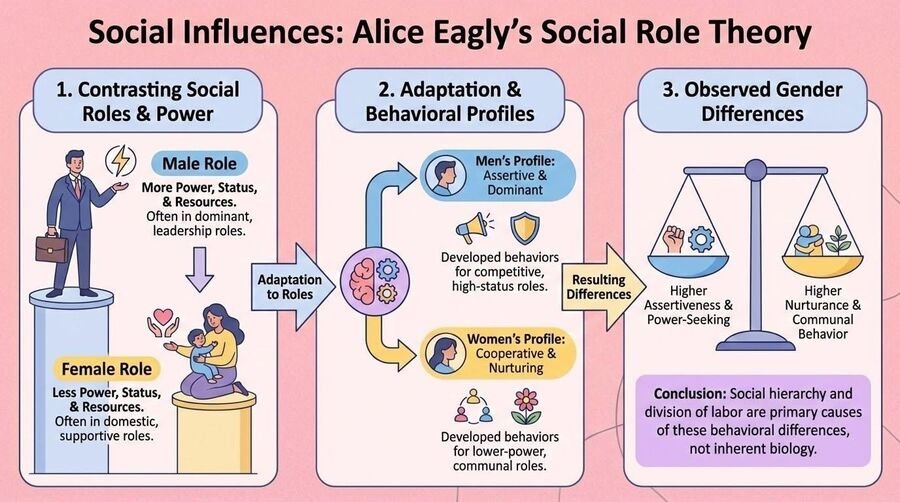
Popular culture insists men and women are "opposite." The data say otherwise. Janet Hyde's gender similarities hypothesis — supported by large meta-analyses and reaffirmed in 2010s–2020s reviews — is now the mainstream position in psychology: on the large majority of measured psychological variables, males and females are far more alike than different. Most gaps in cognitive abilities like math and verbal skill are near-zero or trivially small; a handful of differences (e.g., some measures of physical aggression, certain spatial tasks) are more reliable but still show massive overlap between the distributions.
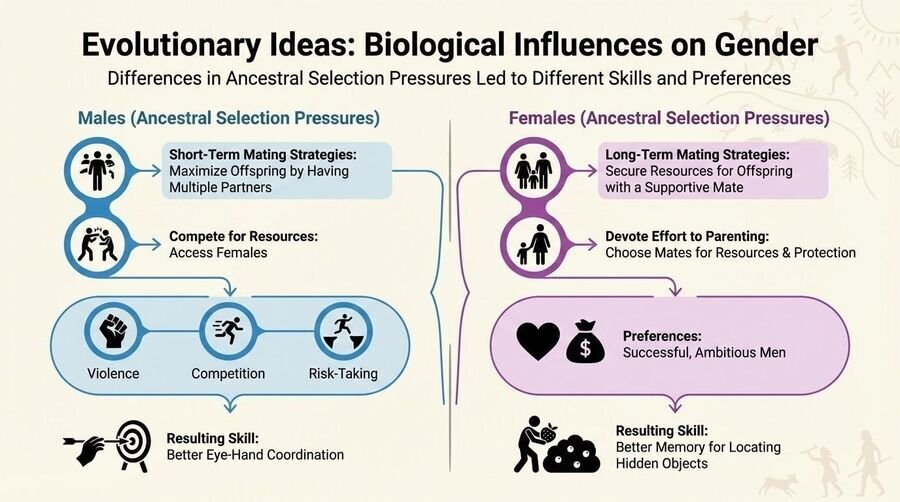
Two live debates, presented without a verdict. (1) Why do the few reliable differences exist? Evolutionary theory (e.g., Buss) argues some sex differences reflect ancestral reproductive pressures and are partly built-in. Its critics counter that many "evolved" differences shrink or vanish as societies become more gender-equal — which points instead to social role theory (Eagly): the differences we see are largely products of the roles cultures assign to each sex. (2) How much is the near-zero average gap masking differences in variability at the extremes? These are open empirical questions, argued by serious researchers on both sides. A good student can state each position fairly before deciding what they find persuasive.
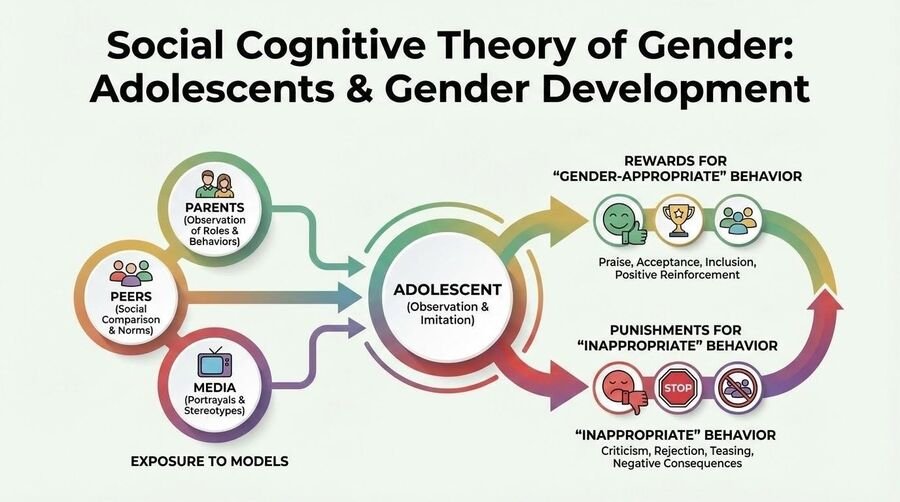
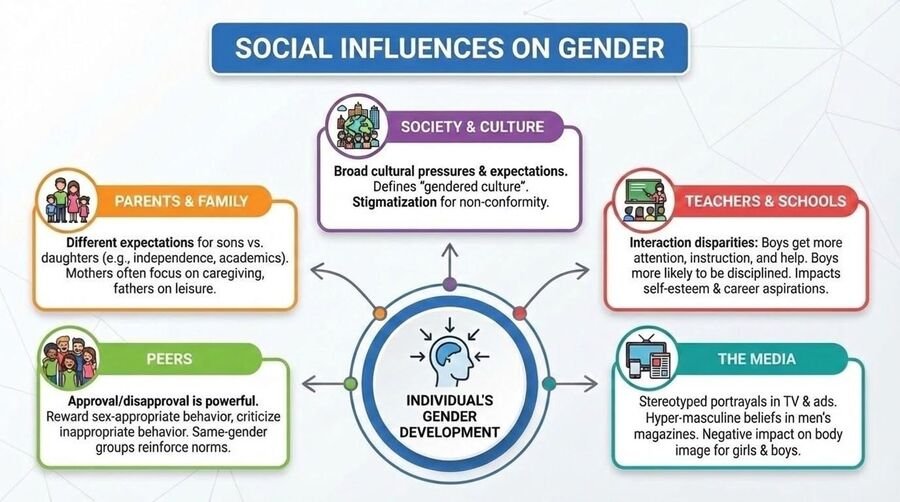
Social cognitive theory and social role theory agree on the engine even if they'd weight it differently: children learn gender by observing, imitating, and being reinforced — by parents, peers, teachers, and media. Eagly's addition is that the content of what's learned tracks the social roles a society happens to assign. Change the roles, and the "differences" often follow.
Does adolescence intensify gender? · a hypothesis with mixed support
The gender intensification hypothesis (Hill & Lynch, 1983) proposed that at puberty, socialization pressure to conform to traditional gender roles ramps up — girls pushed toward "feminine" norms, boys toward "masculine" ones — partly driven by adults reacting to newly adult-looking bodies. It's an intuitive idea, and a widely cited one. Here's the careful part: the longitudinal evidence for it is mixed and generally weak. Some studies find modest effects; several well-designed longitudinal tests find little support for a systematic intensification. Treat it as a plausible, still-debated hypothesis — not an established fact.
Don't write "research shows gender intensifies in adolescence" as if it's settled. The honest sentence is: "The gender intensification hypothesis is plausible but has received mixed and generally weak longitudinal support." That hedge isn't wishy-washy — it's accurate.
Transgender, cisgender, non-binary · the vocabulary, precisely
Cisgender: your gender identity matches the sex you were assigned at birth. Transgender: it doesn't. Non-binary: you don't experience your identity as exclusively male or female. These are descriptive terms for the identity dimension of the Genderbread model — nothing more, nothing less.
A frequent point of confusion is the clinical language, so let's get it exactly right, because the precise wording carries the science.
The current manual (DSM-5-TR) is deliberate about this: being transgender is not, in itself, a mental disorder. The diagnosis is gender dysphoria — the clinically significant distress that can arise from a mismatch between one's experienced gender and assigned gender. The manual updated its terminology to "experienced/assigned gender" precisely to separate identity from pathology. This follows a bedrock rule of clinical psychology you'll use all course long: a state is only a "disorder" when it causes clinically significant distress or impairment. No distress, no diagnosis — the identity alone is not the condition.
Source: American Psychiatric Association, DSM-5-TR (2022).
Is there a biological contribution to gender identity? · the twin evidence
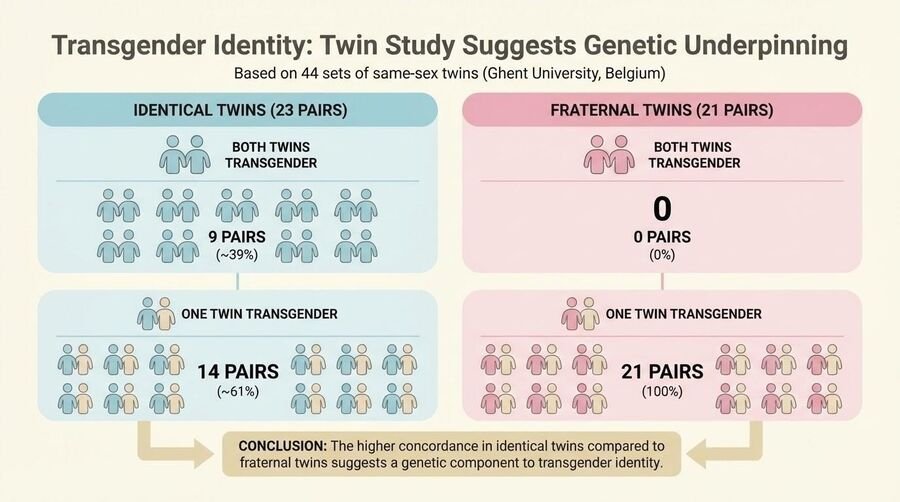
Because identity forms early and is typically stable, researchers ask whether biology contributes. One line of evidence comes from twin studies. Heylens et al. (2012) reviewed twin cases and found that identical (MZ) twins showed higher concordance for gender-identity variance than fraternal (DZ) twins. The standard logic of behavioral genetics reads that MZ>DZ gap as a signal of a heritable / biological contribution to gender identity.
Read this carefully, in both directions. MZ concordance is well below 100%, so genes are clearly not the whole story — environment and development matter too. But the elevated MZ concordance is hard to explain if identity were purely a free choice or purely social. The measured, defensible conclusion: gender identity has a partial biological/heritable component, operating alongside developmental and social factors.
This is the same both-and logic you've seen since Unit 1: nature and nurture, not nature or nurture. The twin data don't "prove trans identity is biological" in a slogan sense, and they don't let anyone claim it's "just a choice" either. Partial heritability with real environmental input — that's the grown-up answer.
The unifying framework · minority stress
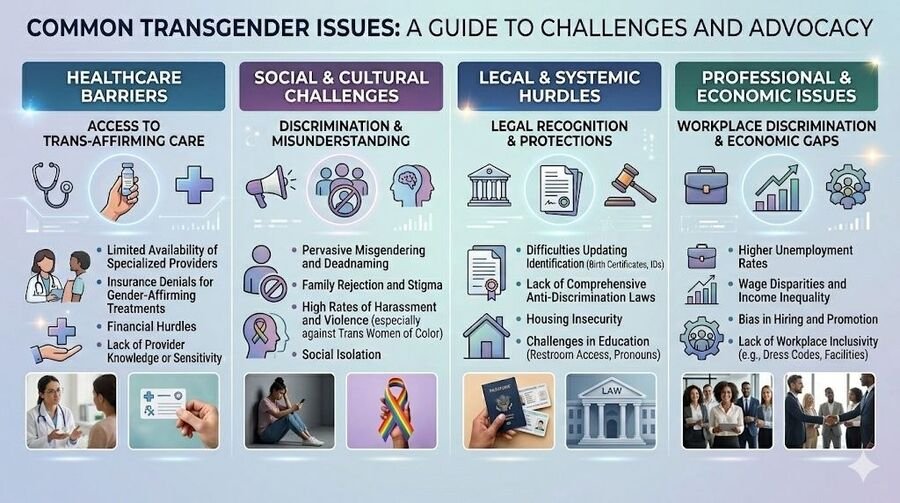
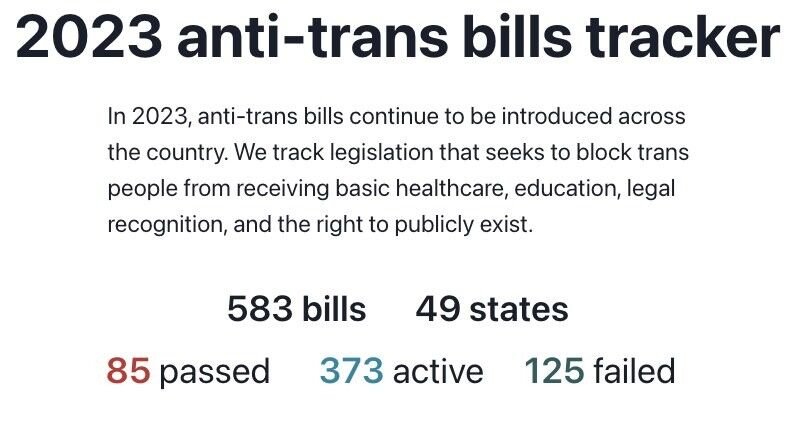
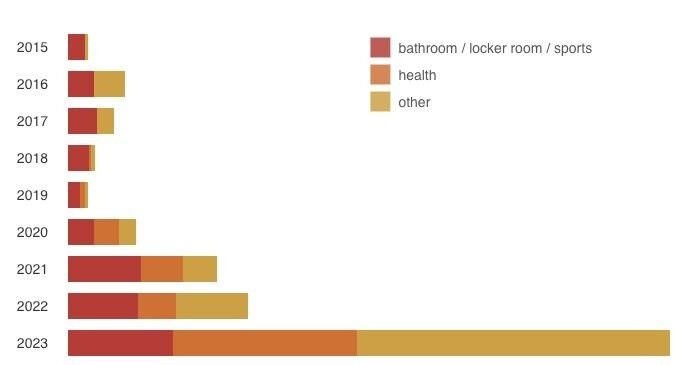
Scattered across this topic are findings that transgender and gender-diverse youth report elevated rates of anxiety, depression, and suicidal ideation. What ties these disparities together — and keeps us from misreading them — is the minority-stress model (Meyer). It also connects this unit directly to the course's stress and mental-health units.
The model describes a sequence: distal stressors (external discrimination, rejection, victimization) → proximal stressors (internalized stigma, expectation of rejection, concealment) → health outcomes (elevated anxiety, depression, suicidal ideation). Critically, the whole chain is moderated by acceptance and support: family acceptance, affirming peers, and safe school climates substantially reduce the disparities. The takeaway is precise and non-partisan — the elevated distress is best understood as a response to stress and stigma, not an inevitable feature of the identity itself. That's why the same studies that find disparities also find that support changes the outcome.
Intellectual honesty requires flagging this: questions about medical regret, detransition, and desistance in youth are actively and heatedly debated, and the topic is politically charged. There is a real research literature here, but studies vary widely in their samples, definitions, follow-up length, and methods, and different high-quality reviews reach different conclusions. The scientifically appropriate stance for this course is intellectual humility: we can describe that the debate exists and why it's hard to resolve, without pretending the data have settled it in either direction. If a source tells you this question is "obviously" settled — either way — that's your cue to check its evidence.
Gender across cultures · Two-Spirit and third genders
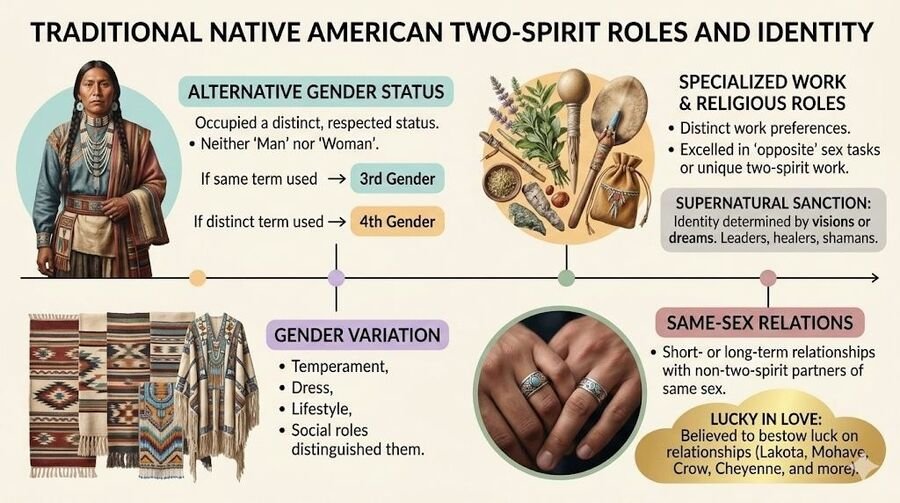

The Western two-box model isn't universal, and this is solid anthropology, not ideology. Many cultures have long recognized more than two gender categories. Two-Spirit is a modern umbrella term (adopted in 1990) for a range of distinct third- and fourth-gender social roles across various Indigenous North American nations — each with its own specific name, meaning, and ceremonial role in its own culture. Comparable third/fourth-gender roles appear worldwide (for example, hijra in South Asia). The point for a psychologist is empirical: gender categories are partly cultural constructions, even though the felt sense of identity is deeply real to the person experiencing it.
"Two-Spirit" is an umbrella, not a single role — and it's specific to Indigenous North American contexts. Don't flatten dozens of distinct cultural roles into one label, and don't use it for non-Indigenous people. Respecting that specificity is the scientific move: it keeps you from over-generalizing.
The numbers, anchored to a primary source
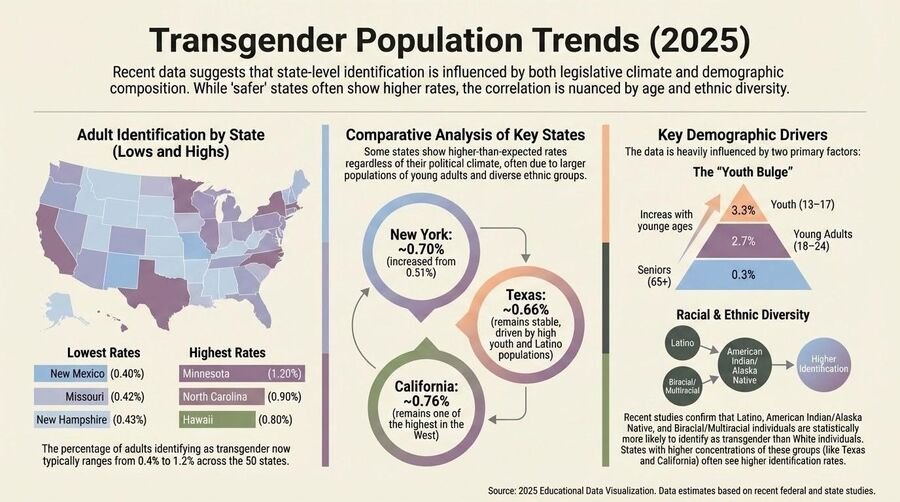
When you cite population figures, anchor them and name the source and its uncertainty. Here are the best-anchored current U.S. estimates.
Notice the youth percentage (~1.4%) is higher than the adult one (~0.5%). That gap is itself contested: it may reflect a real generational shift in identification, greater openness in a more accepting climate, differences in how surveys reach teens versus adults — or some mix. The data are relatively well-sourced (Williams Institute uses federal survey data with a stated method); the interpretation is where reasonable people differ. Report the figure, then be honest that its meaning is still being worked out.
Source: Herman et al., Williams Institute, UCLA School of Law (2022). National estimates; sub-national figures carry more uncertainty.
Interactive · Which dimension is it?
Sort the dimension
The single most valuable skill from this unit is keeping the five dimensions apart. For each scenario, pick which slider of the Genderbread model it describes. The card turns green when you're right.
Why it matters: confusing these dimensions is the root of most bad reasoning about gender — in coursework and in public arguments alike. One slider tells you very little about the others.