One orientation before the deep dive. Everything here rests on a single idea: the adolescent brain isn't just a smaller adult brain waiting to grow — it is reorganizing. Circuits get faster (myelination), get pruned (synaptic elimination), and mature unevenly, with the reward system running ahead of the control system. Hold onto "uneven," and both the risk-taking and the sleep stories fall out of the same biology.
The most common slip in this unit: memorizing "fire together, wire together" as a slogan and stopping there. That phrase (Hebb, 1949) is a mechanism — repeated co-activation strengthens the synapse between two neurons. It's why practice builds skill and why LTP is the cellular story behind learning. Keep the mechanism, not just the rhyme.
From one neuron to a whole brain
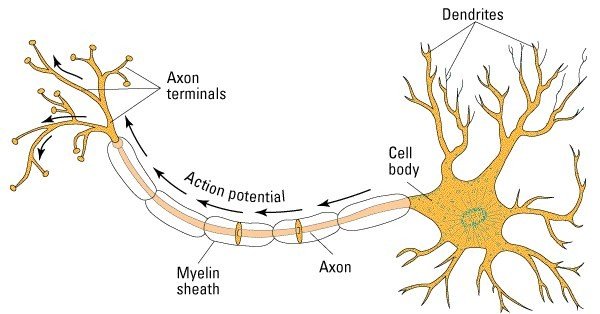
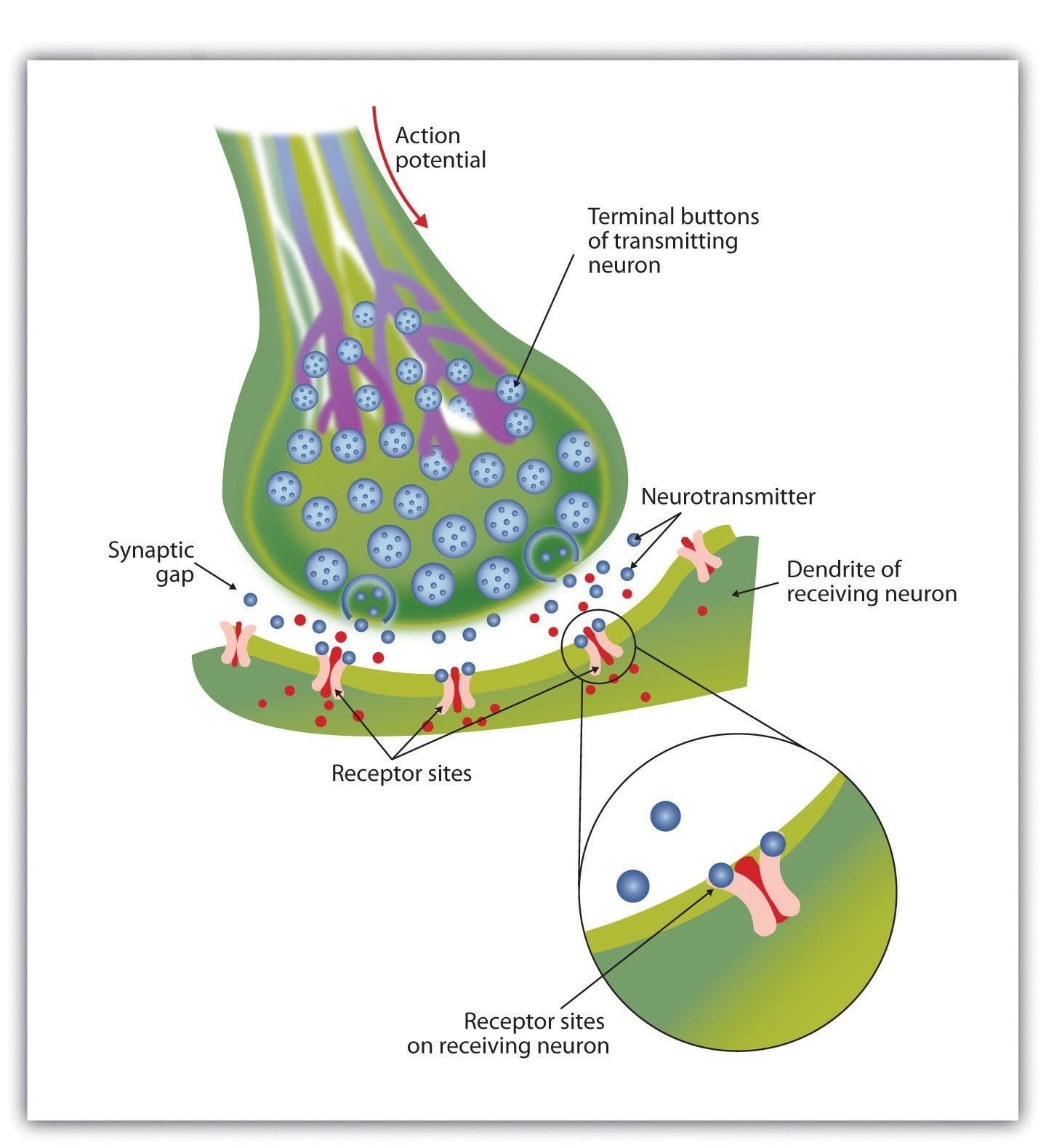
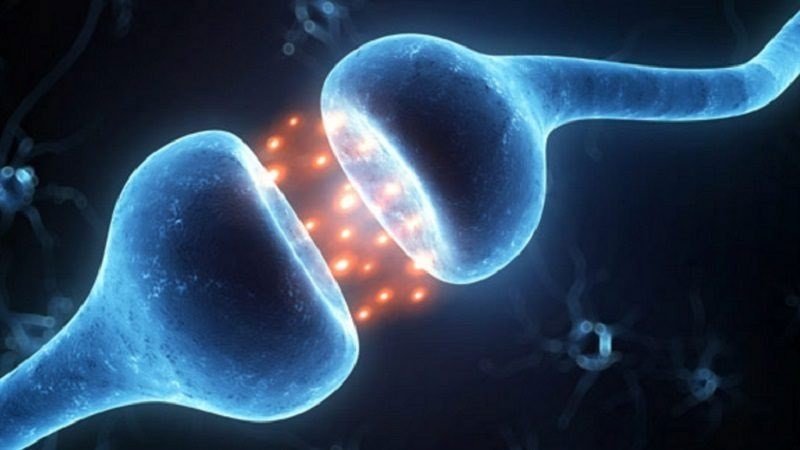
Start small. A neuron receives signals on its dendrites, integrates them in the cell body, and — if the summed input crosses threshold — fires an all-or-nothing action potential down the axon. That electrical spike triggers the release of neurotransmitters across the synapse, where they bind receptors on the next cell. This is the loop that everything else is built on: electrical inside a neuron, chemical between neurons.
Two ideas do most of the heavy lifting in adolescence. Tap each to see the mechanism.
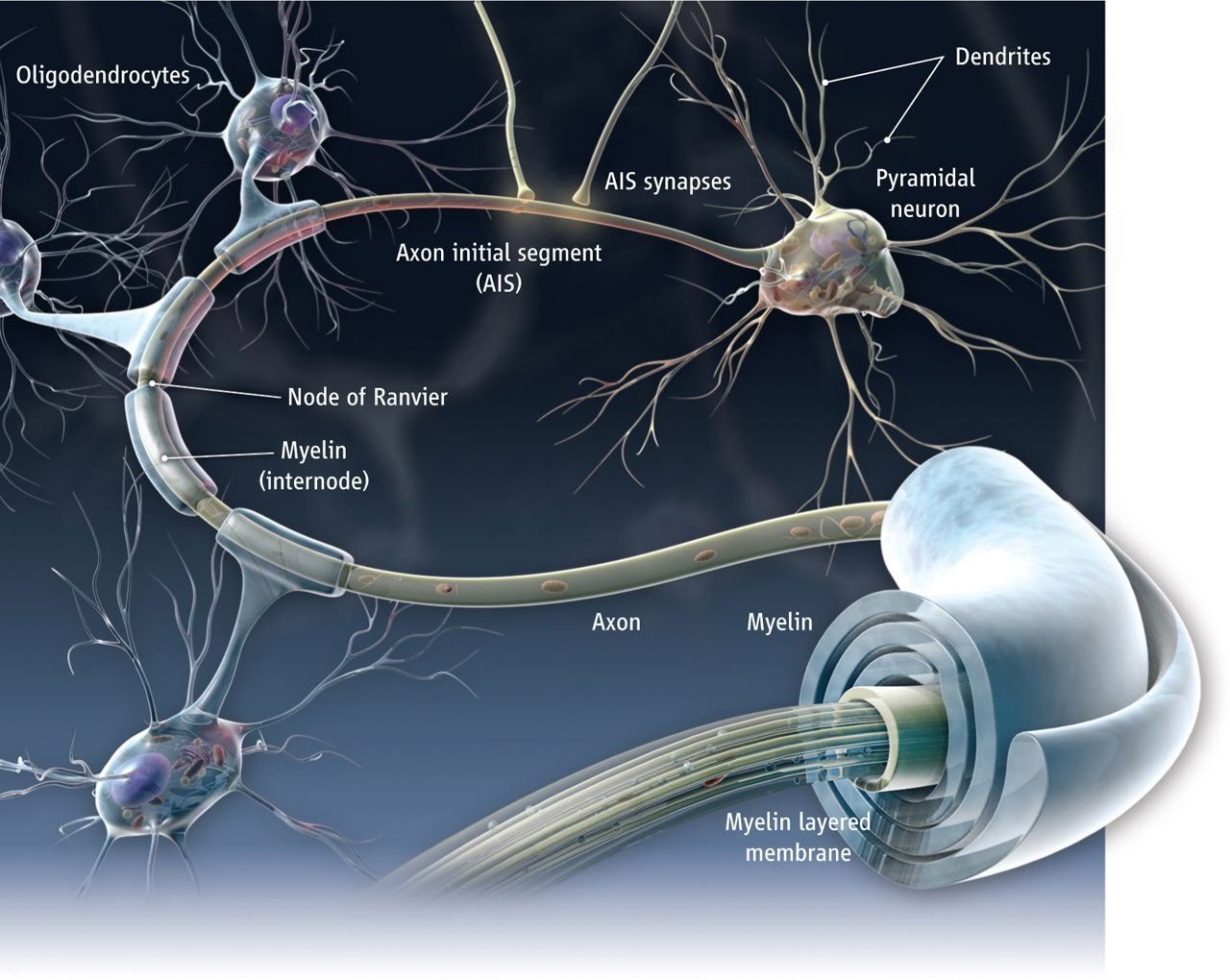
Glial cells wrap axons in a fatty myelin sheath with gaps (nodes of Ranvier). The action potential "jumps" node to node — saltatory conduction — so signals travel far faster and more reliably. Adolescence is a peak myelination window, especially in the fibers linking front-of-brain control regions.
When neuron A repeatedly helps fire neuron B, their synapse strengthens — long-term potentiation (LTP). Hebb (1949) predicted this before it could be measured. The flip side matters just as much: connections that go unused weaken and are pruned. Experience literally sculpts the wiring.
An agonist mimics or boosts a neurotransmitter's effect; an antagonist blocks it. This is the whole logic of how drugs act on synapses — and, as you'll see below, it's exactly how caffeine works on sleep pressure.
Dopamine (reward, motivation, movement), serotonin (mood, sleep regulation), GABA (the brain's main inhibitory brake), and acetylcholine (attention, muscle activation, memory). Keep dopamine in view — it's the lead actor in the adolescent risk story.
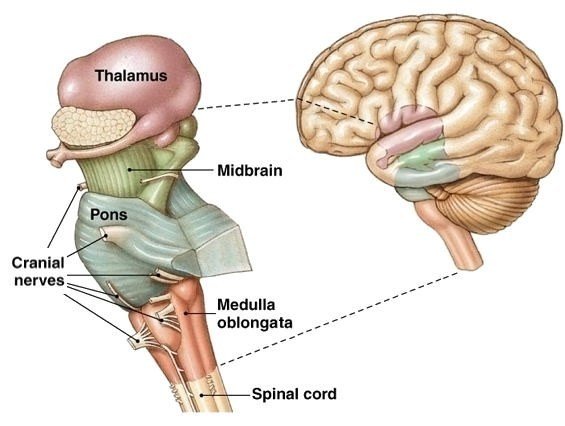
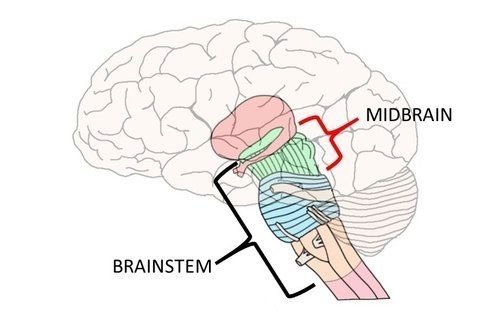
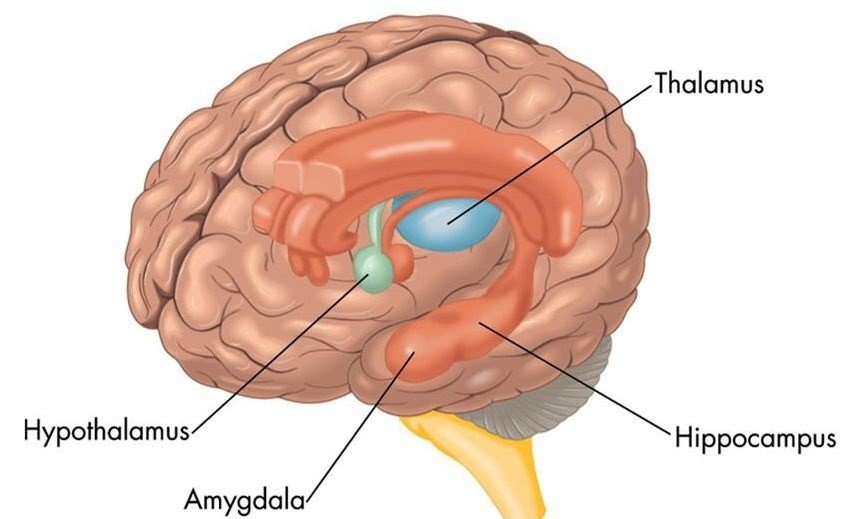
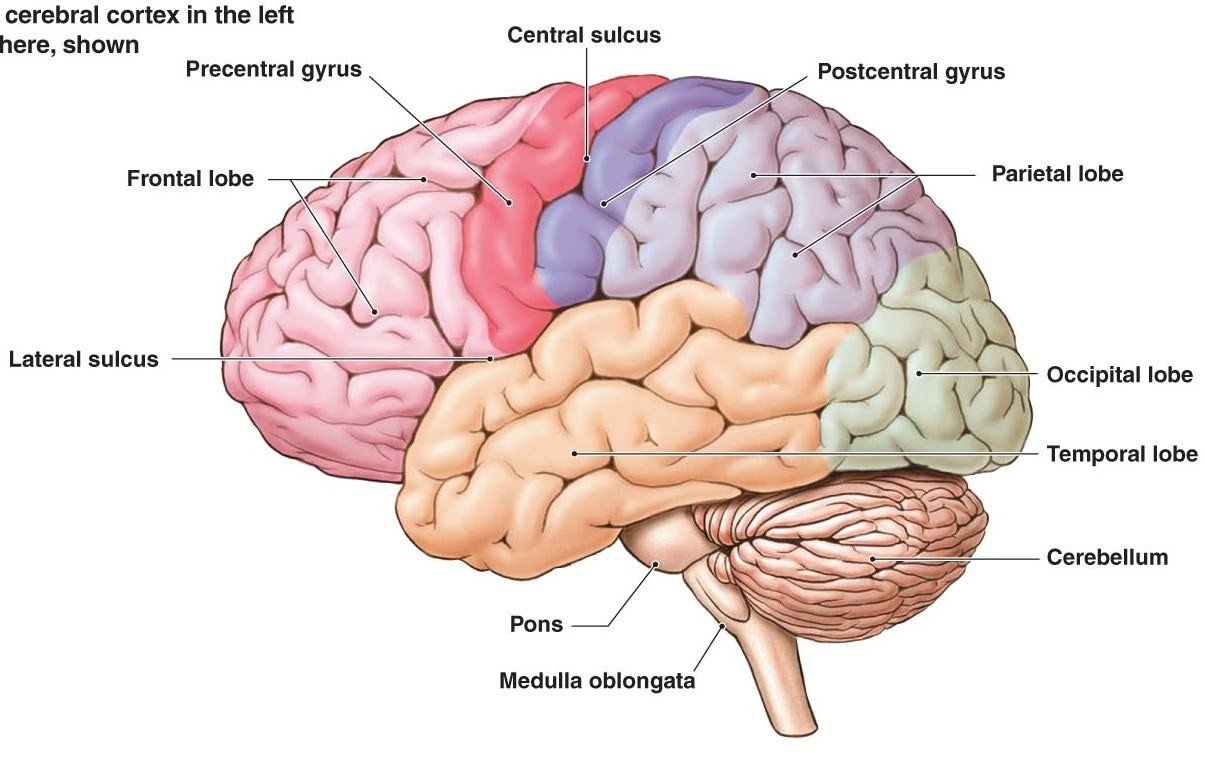
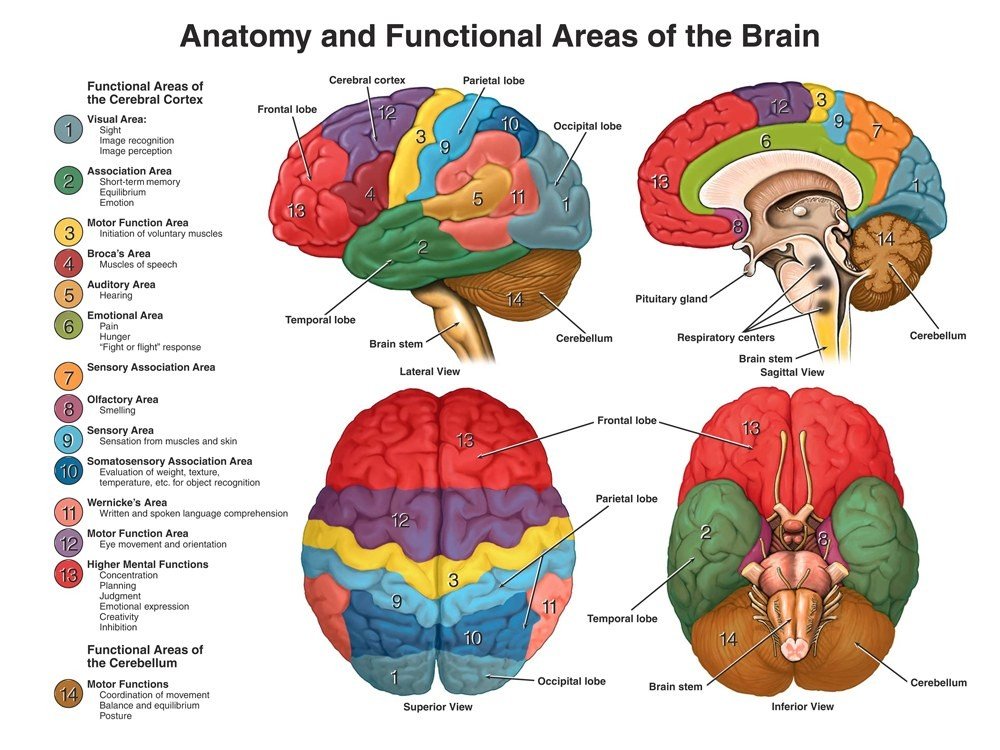
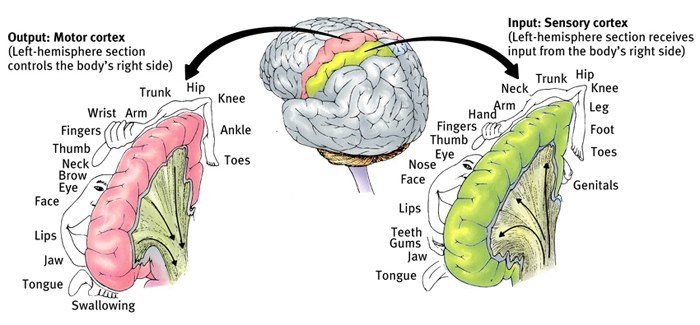
Zoom out and those cells assemble into regions: the hindbrain (brainstem and cerebellum — the life-support and coordination floor), the limbic system (emotion and reward, including the amygdala for threat and salience), and the cortex with its four lobes, where the prefrontal region handles planning, impulse control, and weighing consequences. The adolescent plot twist is about the timing of how these mature relative to one another.
The "teenage brain," carefully
Here is the standard account, and it's genuinely well-supported at the group level. Across adolescence, gray matter volume declines as unused synapses are eliminated — synaptic pruning — while white matter increases as axons myelinate. Both make the brain more efficient. Crucially, this maturation proceeds back-to-front: sensory and motor areas mature early, the prefrontal control regions late.
Layer on the dual-systems model (Steinberg and colleagues): a dopamine-rich reward/socioemotional system that becomes hyper-responsive around puberty, racing an cognitive-control system that matures slowly into the twenties. The vivid metaphor for it:
"A Ferrari engine with bicycle brakes." Powerful reward drive, still-developing control. It's a useful picture of why sensation-seeking and reward sensitivity peak in the teens even when teenagers can reason about risk perfectly well in a calm room. But a metaphor is a teaching tool, not a finding — hold it loosely, because the next section is where researchers (including Steinberg himself) started poking holes.
Remember Unit 1's "risk behavior" flavor of storm and stress? This is the mechanism it was handed to. The history unit told you risk-taking peaks in adolescence; this unit tells you why — an early-maturing reward system out ahead of a still-wiring control system. Same person, one story.
Debate · Is the teen brain broken?
Short answer: no — and the field has spent the last decade saying so more loudly. The dual-systems / maturational-imbalance model is a real advance, but it got flattened in pop science into "teenagers are defective adults." Here's the more honest picture. Open each critique.
If the reward-vs-control gap were a fixed feature of human biology, sensation-seeking should look the same everywhere. It doesn't. Large cross-national work (from Steinberg's own later collaborations across many countries) finds that the developmental trajectory of sensation-seeking and self-regulation varies with cultural and economic context. A universal-biology-only story can't accommodate that variation, which is a strong hint the mechanism is biology filtered through environment — not biology alone.
A growing reframe treats adolescent risk-taking as developmentally useful: heightened reward sensitivity and novelty-seeking push a young person to explore, leave the nest, form new bonds, and learn from a wider world at exactly the life stage when that exploration pays off. Under this "adaptive" view, the behavior isn't a broken brake — it's a feature the deficit framing mislabels as a bug. (This doesn't mean every risk is good; it means the disposition has an evolutionary logic.)
Group-average curves are real, but real-world individual risk — who actually gets hurt — is predicted badly by dual-systems measures. Poverty, peers, access to means, supervision, and opportunity often matter more than any brain index. A model that explains a population trend can still be near-useless for a single adolescent in front of you, and it's important not to oversell it as a clinical or forensic crystal ball.
A common oversimplification swings too far the other way and implies hormones don't matter. That overcorrects. Pubertal hormones (testosterone, estradiol, adrenal steroids) modulate limbic reactivity — they're part of why the reward/emotion system revs up when it does. The right synthesis: puberty's hormones help set the timing and intensity of the socioemotional system, which then plays out inside a cultural context. Biology and environment aren't rival explanations here; they're a chain.
Where this lands: the teen brain is not broken — it's differently tuned, for reasons that made adaptive sense, and it varies a lot across people and places. "Immature control system" is a fair group-level description; "defective" is not.
This line has hardened into pop-neuroscience fact, and it's an oversimplification. There is no biological event at age 25 where development clicks off. The largest brain-charting effort to date — Bethlehem et al. (2022, Nature), pooling scans across the lifespan — shows brain structure follows continuous, gradual, and highly individually variable trajectories, with different features peaking at different ages and no clean finish line. Maturation continues past the twenties for some measures and plateaus earlier for others. So: "the prefrontal cortex keeps maturing into the twenties" is defensible; "the brain finishes at 25" is a slogan the data don't support.
The complete sleep reading lives on its own page. The two clocks, stages and EEG, chronotypes, learning and consolidation, school start times, screens, sleeping with a partner, sleep paralysis, and sleep disorders — is in Unit 05 · Sleep. The sections below are the short version.
Why teens can't just "go to bed earlier"
Now the sleep half of the unit — and it's not a separate topic. The same maturing brain runs a biological clock. Deep in the hypothalamus, the suprachiasmatic nucleus (SCN) keeps circadian time, cued by light. As evening falls, the pineal gland releases melatonin, the "it's night" signal that lets sleep begin. In adolescence this whole schedule shifts later: melatonin is released roughly two hours later than in childhood, and clears slowly in the morning.
That is a genuine, measurable phase delay — a later chronotype baked into the biology of puberty — not teenage laziness. A 15-year-old told to fall asleep at 10 pm is being asked to sleep before their brain has sent the signal. Meanwhile the biological need is high: adolescents require roughly 8–10 hours, and most get far less.
Two systems govern sleep, and it helps to keep them separate. The circadian clock (SCN + melatonin) sets when you're inclined to sleep. Sleep pressure — driven by a molecule called adenosine that builds up the longer you're awake — sets how badly you need it. Caffeine acts on the second one, and not the way most people think. Flip the card below.
Caffeine is an adenosine antagonist — it blocks adenosine receptors, so the brain stops reading the "you're tired" signal. It doesn't add energy and it doesn't remove sleep pressure; the adenosine is still there, still building. It just masks it. When the caffeine wears off, the accumulated pressure hits at once. (Notice this is the agonist/antagonist idea from the top of the page, applied to a molecule you use every day.)
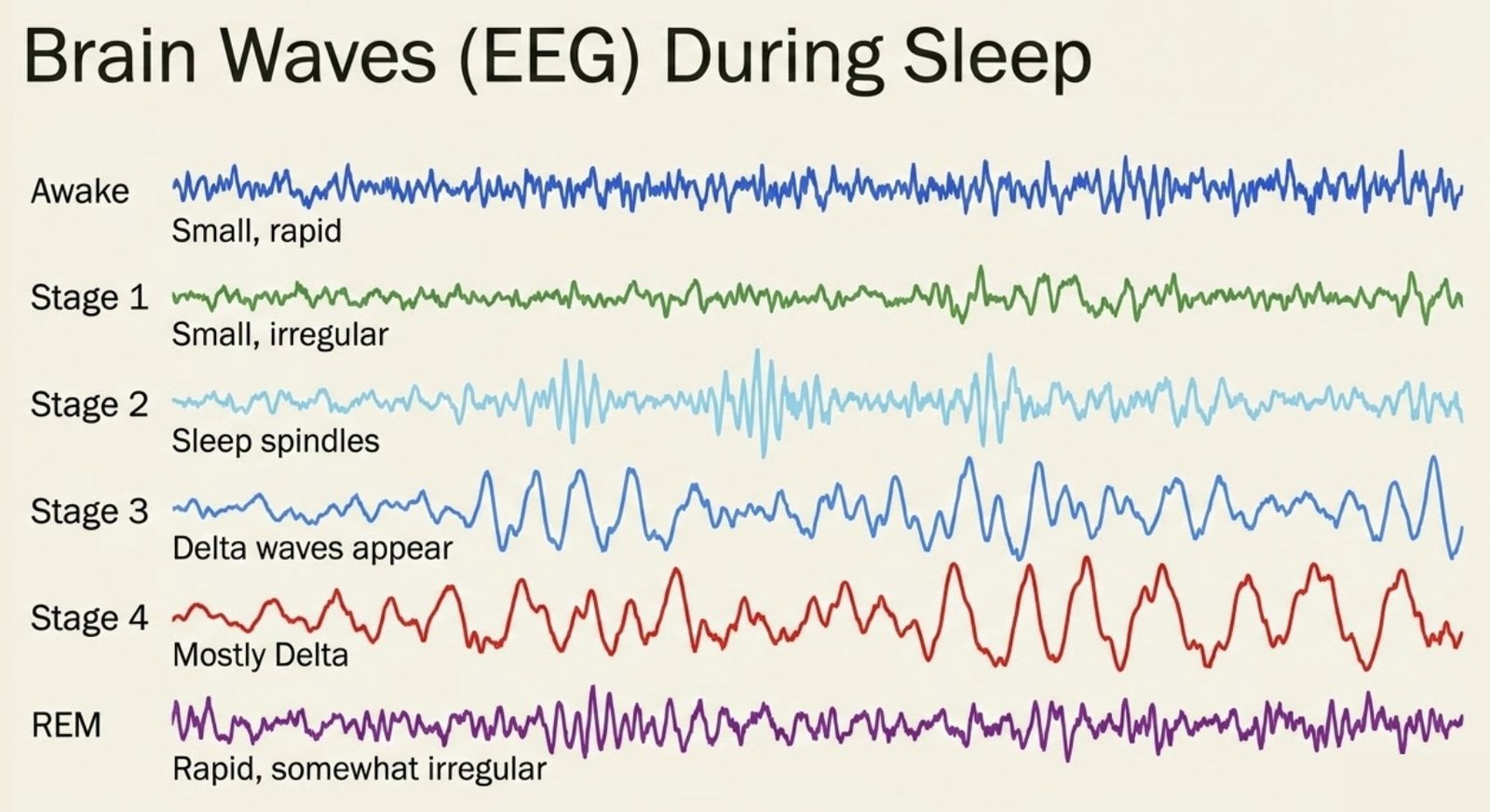
A night cycles through NREM (including deep slow-wave sleep, front-loaded early) and REM (dreaming, memory consolidation), and REM stages get longer and denser in the last cycles before waking. So cutting sleep from 8 to 5 hours doesn't shave off an even slice — it disproportionately removes the back-loaded REM. That's the "early alarm penalty": the 6 am wake-up isn't costing generic sleep, it's costing the REM that helps consolidate what you learned yesterday.
When REM leaks into waking: sleep paralysis
During REM the brainstem switches on REM atonia — a near-total muscle shutdown that keeps you from acting out your dreams. Usually the atonia and the dreaming switch off together when you wake. In sleep paralysis, the sequence desynchronizes: consciousness comes back online while the atonia (and sometimes the dream imagery) is still running. You are awake, aware, unable to move or speak — often with a vivid sense of a presence in the room or pressure on the chest, because the REM hallucination machinery hasn't shut down either. Episodes last seconds to a couple of minutes and end on their own.
This belongs in an adolescence unit for two reasons. First, the best-documented triggers are sleep deprivation, irregular sleep schedules, and stress (Denis et al., 2018) — which is a fair description of the phase-delayed, early-bell, weekend-catch-up sleep pattern this page has been describing. Second, first episodes cluster in the teens: roughly 8% of the general population experiences sleep paralysis at least once, but the lifetime rate runs near 28% in student samples (Sharpless & Barber, 2011).
Frightening, common, and benign. It isn't a stroke, a psychiatric symptom, or anything supernatural — it's a timing glitch between two systems you've now met by name. Regular sleep is the best prevention, and the episode always ends on its own. (Cultures have named this experience for centuries — Japan's kanashibari, Newfoundland's "Old Hag" — same biology, different story.)
Interactive · The sleep-policy lab
Where should high school start?
Because adolescent melatonin runs ~2 hours late, an early bell forces the sleep loss onto teens whose clocks physically can't comply. The AAP and CDC recommend high schools start no earlier than 8:30 am, and California's SB 328 made later start times state law. But policy has tradeoffs. Drag the start time and watch what has to give.
There's no free lunch: pushing the bell later helps sleep and daytime alertness, but it collides with bus-fleet scheduling (elementary/high-school staggering), sports practice and daylight, and students who work evening jobs. "Right answer" here means a defensible balance, not a maximum. That's what makes it policy, not biology.
Screens and sleep, updated
The familiar version is "blue light suppresses melatonin, so screens wreck sleep." The wavelength story is real but has been oversold. Newer work suggests that for typical evening device use, what disrupts teen sleep is less the color of the light and more three other things:
A tense group chat, a competitive game, or an autoplaying feed keeps the brain aroused and vigilant — the opposite of the wind-down state sleep needs. An engaging phone is stimulating regardless of its color temperature.
The simplest mechanism: hours on the device are hours not spent asleep. "One more episode" pushes the whole night later — and given the phase delay, teens were already starting from behind.
Night-mode and blue-blocking filters show small effects on sleep at best. If the wavelength were the whole story, they'd help a lot; they don't. That's part of why the field is shifting the emphasis.
This is an area where the science is genuinely moving — treat it as "here's the current lean," not settled law. The practical takeaway survives either way: getting the phone out of the bedroom protects sleep more reliably than tinting the screen orange, because it fixes arousal and displacement, not just wavelength.