One idea organizes this entire unit: puberty is not a switch, it's a sequence with a clock. The hormones are the machinery; the timing of when the machinery turns on is what carries the psychological weight. Hold that distinction and everything from the leptin bridge to body image to the dual-systems risk window lines up.
The classic slip: memorizing the HPG cascade as a list of hormones and stopping there. The key insight is directional — hypothalamus signals down, gonads report back up, and the whole loop can be started earlier or later by signals from the body. Learn it as a circuit with a start button, not a vocabulary set.
The machinery · the HPG axis, read as a circuit
Puberty runs on the hypothalamic–pituitary–gonadal (HPG) axis. Here's the causal chain in order, so you can reconstruct it from the logic rather than recall it by rote:
The hypothalamus begins releasing GnRH (gonadotropin-releasing hormone) in pulses. This is the master timer. What re-awakens it after a childhood pause is the real question of the unit — hold that thought for the leptin bridge below.
GnRH tells the anterior pituitary to release two gonadotropins: FSH (follicle-stimulating hormone) and LH (luteinizing hormone). These are the messengers that travel through the bloodstream to the gonads.
FSH and LH stimulate the gonads (ovaries/testes) to produce estrogens and testosterone, driving physical maturation. Those sex hormones then feed back up to the hypothalamus and pituitary — the loop that keeps the system self-regulating.
Who actually turns the key: kisspeptin. It's easy to stop at "the hypothalamus starts releasing GnRH" — but what wakes the hypothalamus? A neuropeptide called kisspeptin is now understood to be the upstream gatekeeper: it drives the GnRH neurons that had gone quiet during childhood. Kisspeptin is where the environmental signals converge — energy status, stress, light. It's the switchboard between "the body's condition" and "the reproductive timer."
Two more signals matter because they explain timing, not just mechanism:
A hormone released by fat tissue. It acts as an energy-availability signal — a "there's enough fuel to reproduce" message. Rising leptin helps permit kisspeptin/GnRH activation. This is the physiological hinge of the whole secular-trend story below.
The sleep-timing hormone. Its adolescent shift pushes the body clock later (delayed sleep phase) — which is why teens are wired to fall asleep and wake later, and why school start times collide with biology (more in the health section).
Two waves, in order. Adrenarche (~ages 6–8) is the adrenal glands ramping up weak androgens — think early body odor, first pubic/underarm hair. Gonadarche is the later HPG-driven wave that produces the visible sexual maturation. Adrenarche comes first and is a separate system.
Menarche = a girl's first menstrual period. Spermarche = a boy's first ejaculation/sperm production. Both are late markers — they happen well after puberty is underway, not at its start. U.S. mean menarche sits around ~12.5 years, but that average is drifting, which is where this unit gets interesting.
Measuring the process · growth spurt & Tanner stages
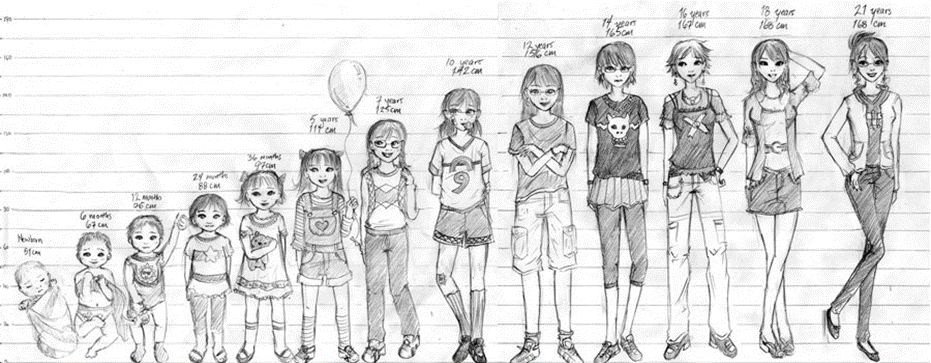
Because puberty is a sequence, clinicians need a way to say where in the sequence someone is. Two tools do that:
The adolescent growth spurt is a burst of skeletal growth; its fastest point is peak height velocity (PHV). Timing differs by sex — girls' spurt tends to come earlier in the sequence (often before menarche), boys' later. Growth is also distal-to-proximal: hands and feet before limbs before trunk, which is why early-adolescent proportions can look temporarily awkward.
The Tanner stages (also called Sexual Maturity Rating, SMR) are a standardized 1–5 scale describing physical development — breast and pubic-hair development in girls, genital and pubic-hair development in boys. Stage 1 is prepubertal; stage 5 is adult. It's how the field converts a messy continuous process into a shared, ratable language.
You'll hear the phrase "puberty blockers." Medically, these are GnRH analogs, and their oldest, best-established use is treating precocious puberty — pausing a puberty that started too early so it can resume at a typical age. That clinical use is a separate topic from gender-affirming care, which is its own distinct and highly-debated area. For this unit, know only the endocrinology: a GnRH analog works by down-regulating the HPG axis. I'll leave the policy questions to other rooms.
The leptin bridge, one causal through-line
Here is the single most connective idea in the unit. Follow the arrows:
Rising childhood body fat → more leptin → earlier kisspeptin activation → earlier GnRH pulses → earlier puberty. Because leptin signals "enough energy to reproduce," a heavier childhood body can trip the reproductive timer sooner. That one chain does three jobs at once: it gives a physiological mechanism for the secular trend (puberty arriving earlier across generations), it links a population health trend (rising childhood adiposity) to a developmental outcome, and it sets up the dual-systems risk window — because a body that matures early does not come with an early-maturing brain.
The prefrontal cortex — the brain's control-and-planning system — matures on its own slow timetable (that's Unit 5's whole argument). So when the leptin bridge pulls the body forward, it widens the gap between an early-arriving, reward-sensitive, adult-looking adolescent and a still-developing regulatory brain. This is the dual-systems logic applied to timing: early maturers spend longer in the mismatch zone, treated as older by peers and adults while their self-regulation is still under construction.
Feel the course threading again: this unit hands the "early-maturing body / late-maturing brain" gap straight to Unit 5 (the adolescent brain) and to the risk-behavior story. Puberty isn't a self-contained biology lecture — it's the opening move in the dual-systems argument.
The secular trend, updated and honest
Puberty is arriving earlier. True — but the modern picture is stranger and more interesting than "the whole thing moved up."
Thelarche has advanced faster than menarche. Recent research shows the start of puberty — thelarche (breast development) — has crept earlier faster than menarche (first period) has. The two milestones are decoupling, and the interval between them is widening. That's the puzzle the field is actively chewing on: puberty isn't just starting earlier, its internal timing is stretching. A large 2024 analysis of the Apple Women's Health Study (published in JAMA Network Open) reported that mean age at menarche declined across successive birth cohorts, with a rising share of girls reaching menarche before age 9. Treat this as a strong, recent finding — the "earlier puberty" claim now has fresh cohort-scale data behind it.
Source: Apple Women's Health Study analysis, JAMA Network Open (2024). U.S. mean menarche historically ~12.5 yrs.
Endocrine-disrupting chemicals are a suggested contributor to earlier/altered puberty — but don't overclaim from any single compound. The field points to broad classes: phthalates, BPA and other bisphenols, PFAS, and parabens, found in plastics, personal-care products, and food packaging. These are candidate contributors that may interfere with hormone signaling. The evidence is suggestive, the mechanisms are debated, and no one chemical is "the cause." The scientifically careful sentence is: adiposity/leptin is the best-supported driver, with endocrine disruptors a plausible, actively-studied co-factor. (Contested — hold it loosely.)
Early family stress predicts earlier menarche. The framework behind the familiar "stress or trauma" shorthand is life-history / psychosocial acceleration theory (Belsky and colleagues; Ellis): early adversity — father absence, harsh or unpredictable family environments — is associated with earlier pubertal timing in girls. The evolutionary logic: a childhood that signals an unstable, risky world may bias development toward maturing and reproducing sooner. It's a robust, testable body of work — worth knowing by name, not just as "stress speeds things up."
Interactive · does the timer run too early?
Precocious, or on the early edge?
Precocious puberty means the process starts abnormally early — roughly before age 8 in girls, before age 9 in boys — and it's about ~10× more common in girls. That's different from simply being an early-but-normal maturer. Sort each scenario. The card turns green when you're right.
Why it matters: the age thresholds differ by sex, and the sex ratio is lopsided (~10:1, girls). Precocious puberty is a clinical category — sometimes treated with a GnRH analog to pause the process — not just "on the early side of normal."
Interactive · pubertal timing is not symmetric
The deepest finding in this unit: the same timing carries opposite risk depending on sex. Early is hardest for girls; late is hardest for boys. Flip each card.
The disadvantaged group. Early maturation in girls is linked to more body dissatisfaction and depressive symptoms, plus earlier exposure to older peers and adult attention their regulation hasn't caught up to. This is the clearest timing-risk finding in the literature.
The disadvantaged group for boys. Late maturation is the harder path for boys — smaller and less physically mature than peers during years when size and athleticism carry social status, with associated hits to body image and confidence.
An early female body diverges from a thin cultural ideal and draws premature adult attention; an early male body matches a masculine ideal of size/strength. So "early" helps boys' status but harms girls' — and "late" flips it. Same clock, opposite meaning.
If you carry a single sentence out of this unit, make it this: early maturation is the risk factor for girls; late maturation is the disadvantage for boys. And it's rarely the biology alone — it's the body's timing colliding with the surrounding social meanings.
Adolescent health · what the numbers actually say
The unit closes on well-being. Here the textbook answer has genuinely changed, so read the number and know its recency.
Read this as an update, not a static fact. Among U.S. adolescents and young adults, drug overdose — largely fentanyl — has overtaken motor-vehicle crashes as the leading mechanism within unintentional-injury deaths. And firearms are now among the leading overall causes of death for U.S. children and teens. "Car accidents are the #1 cause of adolescent death" was the right answer for a previous decade — the mortality picture has shifted, and a careful student can say why the answer moved.
Present modestly: these are recent U.S. surveillance patterns. Exact rankings vary by year, age band, and how "cause" vs. "mechanism" is defined.
Adolescent well-being isn't only about avoiding catastrophe — it's built from daily inputs. Nutrition and mental health are linked: diet quality is associated with mood and depressive symptoms, and adolescence is a period of high nutritional demand (bone accrual, the growth spurt, iron needs). Layer sleep on top: teens need 8–10 hours, but the melatonin shift pushes their clock later, colliding with early school start times — one reason experts recommend starts of 8:30 a.m. or later. Biology, environment, and behavior compound; well-being is the running total.
Zoom out and the unit is one sentence: a body maturing earlier, a brain maturing on its own slower schedule, inside an environment that shapes both the timing and its meaning. The leptin bridge, the secular trend, the timing asymmetry, the health data — they're all facets of that single mismatch. Carry that frame into Unit 4 (genetics) and Unit 5 (the brain).