You just watched a full lecture on genes, natural selection, and heritability, so this isn't a rerun. It's the connective tissue — the corrections, the "wait, what does that actually mean" moments, and the current science that lecture slides never have room for.
Start by unlearning "a gene for X"
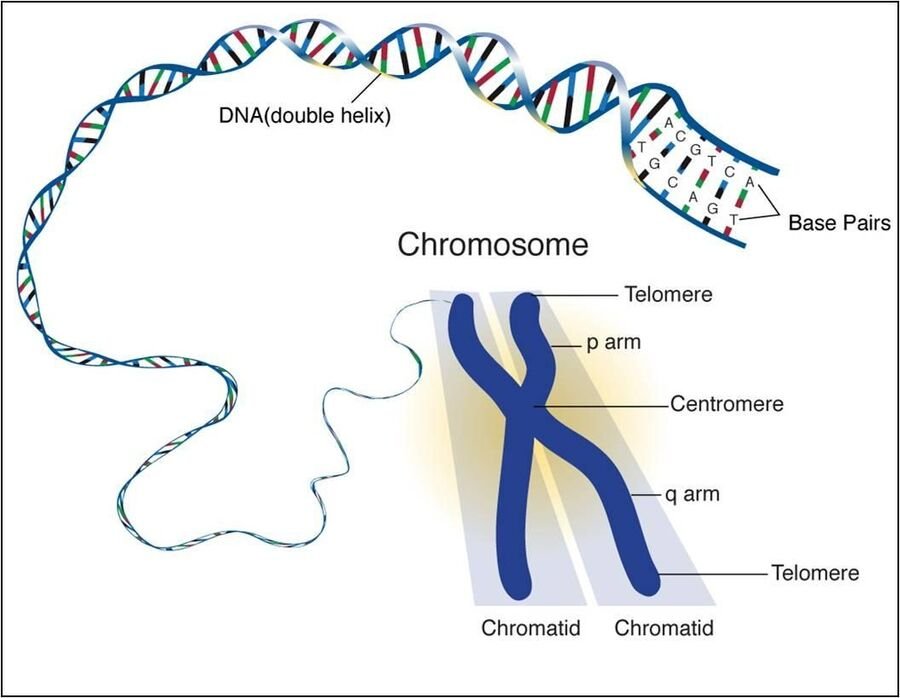
Here's the single most important fix to make before anything else in this unit will click. Genes code for proteins. That's it. A gene contains instructions for building a protein — a structural molecule, an enzyme, a receptor — and proteins build bodies and brains. No gene contains instructions for "shyness" or "intelligence" or "aggression." Those are behaviors, and behaviors emerge from entire networks of genes interacting with each other and with everything the environment throws at the organism across development.
This matters because pop-science headlines love the phrase "gene for." A gene for depression. A gene for risk-taking. It's a convenient shorthand, but it smuggles in a false picture — as if there's a single switch somewhere that flips a person into a behavioral category. The classic Mendelian model of dominant and recessive alleles works nicely for things like eye color, where one or two genes do most of the work in a fairly predictable pattern. It does not work for the vast majority of psychological traits. Those are polygenic — influenced by hundreds or thousands of genes, each contributing a tiny probabilistic nudge — and probabilistic, meaning genes shift the odds of an outcome rather than guaranteeing it.
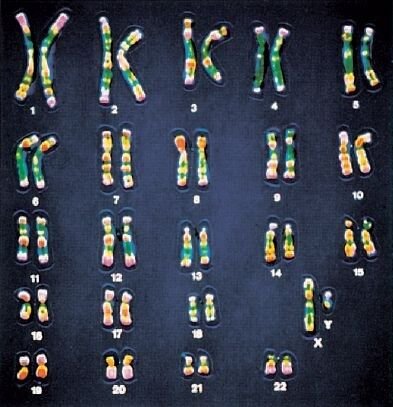
Two terms make this precise, and they're worth locking down now because the rest of the unit leans on them. Your genotype is your actual genetic makeup — the specific sequence of DNA you inherited. Your phenotype is the observable result — your traits as they actually turn out, from eye color to height to temperament. The gap between the two is where this whole unit lives: the very same genotype can yield different phenotypes depending on the environment it develops in. That's precisely why "a gene for X" talk misleads. Genes set out a range of possibilities; the phenotype is what those possibilities become once development, experience, and a fair amount of chance have all had their say.
◆ Key distinction
Genes influence the probability of a trait developing, given a particular environment. They almost never determine a psychological outcome outright the way they determine, say, blood type.
The logic of natural selection
Your slides covered natural selection, so you have the vocabulary already. What's worth slowing down on is the actual logical structure underneath it, because a lot of people carry around a mangled version of this idea for their entire lives without realizing it.
Step 1 · Variation exists
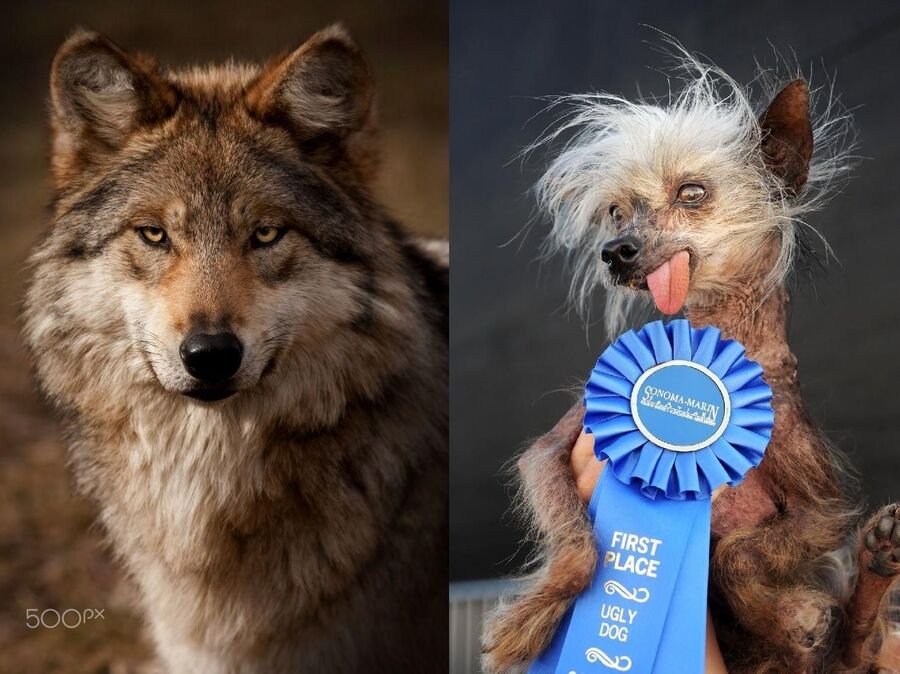
Within any population, individuals differ from one another — in size, coloration, behavior, physiology. This variation is the raw material selection has to work with. No variation, no evolution.
Step 2 · Some of that variation is heritable
Traits that are passed from parent to offspring — because they're rooted in genes — can be inherited. Traits acquired purely through experience, with no genetic basis, are not passed on in this way.
Step 3 · Some variants lead to differential reproductive success
Certain heritable traits happen to help individuals survive and reproduce more successfully in their particular environment than other variants do. Note: more successfully reproduce, not simply survive longer.
Step 4 · Those traits become more common over generations
If a heritable trait boosts reproductive success, copies of the genes underlying it show up more often in the next generation. Repeated over long stretches of time, the population's traits shift. That shift is adaptation.
Notice what's absent from that whole sequence: intention. Natural selection isn't goal-directed. Organisms aren't striving toward some ideal end state, and evolution isn't "trying" to produce anything. It's a mechanical, statistical consequence of variation plus heritability plus differential reproduction, playing out over time without anyone or anything steering it. There's also no ladder here — no "higher" or "more evolved" organisms. A bacterium is exquisitely well adapted to being a bacterium. It isn't a failed attempt at becoming a human.
The myth
"Survival of the fittest" means the strongest, toughest, most dominant individuals survive.
What's actually true
Fitness, in the evolutionary sense, means reproductive success — how many viable, reproducing offspring an individual leaves behind. Strength and toughness are sometimes relevant to that, but plenty of traits that look unimpressive or even risky by human standards are highly fit if they translate into more surviving offspring. A drab, easily overlooked animal that quietly out-reproduces a flashy, conspicuous rival is, by definition, the fitter one — even though it would lose a strength contest every time.
A worked example: why a "bad" gene can stick around
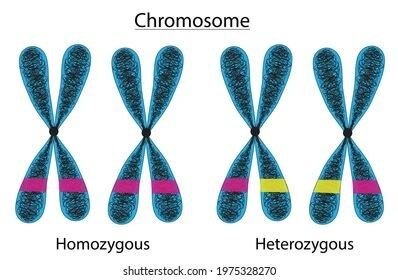
Here's a case that ties the vocabulary together and shows why "survival of the fittest" is more subtle than it sounds. Sickle-cell anemia is caused by a recessive allele: inherit two copies and your red blood cells deform into crescents that clog vessels and cause pain, organ damage, and often early death. Natural selection should be scrubbing that allele out of the population. Yet it remains common among people of African descent. Why? Because inheriting just one copy — being heterozygous, a carrier — produces no full-blown disease but does change the blood chemistry enough to protect against malaria, which kills hundreds of thousands of people a year in the tropics. In a malaria zone, the carrier out-survives and out-reproduces both the person with two normal alleles (who can die of malaria) and the person with two sickle alleles (who has the disease). Selection keeps the allele in circulation precisely because of the environment it operates in. Move that same allele to a place with no malaria and it's pure cost — same genotype, opposite fitness consequences. Adaptation is always adaptation to something (Spielman et al., 2020).
Two loose ends. First, where do new alleles like this come from in the first place? Mutation — a sudden, permanent change in a gene's sequence. Most mutations are neutral or harmful, but once in a while one hands its carrier an edge, and that, along with the reshuffling of existing genes every time sperm meets egg, is where the variation in Step 1 of natural selection ultimately originates. Second, don't take "recessive disease" to mean "environment doesn't matter." Phenylketonuria (PKU), another recessive condition, leaves a person unable to break down a common amino acid; untreated, it causes severe cognitive impairment. Managed from birth with a restricted diet, most of that damage never happens. The genotype is fixed at conception. The phenotype still depends on what happens next.
Evolutionary psychology and the mismatch problem
Evolutionary psychology takes the logic of natural selection and applies it to the mind: many of our psychological tendencies, the argument goes, are adaptations that were shaped because they solved recurring problems our ancestors faced — finding food, avoiding predators, choosing mates, cooperating with kin — in the environment they actually lived in, often referred to as the ancestral environment.
That last phrase is the whole ballgame for understanding why some of our instincts feel oddly out of step with modern life. Selection doesn't shape organisms for the environment they happen to live in today — it shapes them for the environment their ancestors lived in generation after generation. When the environment changes faster than genes can catch up, you get evolutionary mismatch: an adaptation that made excellent sense in the ancestral context but produces a poor or even harmful fit in the modern one.
Sugar and fat cravings are a textbook case. For most of human history, calorie-dense food was scarce and unpredictable, so a strong drive to seek out and consume it whenever available was a huge survival advantage. That same drive, dropped into a modern environment with 24-hour drive-throughs and vending machines on every floor, contributes to obesity and metabolic disease. The instinct hasn't changed; the food environment has changed completely.
Fear learning shows the same mismatch from a different angle. Humans (and other primates) learn to fear snakes and spiders remarkably fast, often after just one bad encounter or even just watching someone else react fearfully. Learning to fear cars, electrical outlets, or handguns takes deliberate, repeated teaching — despite the fact that, for anyone reading this today, cars and outlets are vastly more likely to kill you than a snake is. Snake and spider fear was adaptive and cheap to build into the nervous system across millions of years of primate evolution; cars have existed for barely a century, nowhere near enough time for a comparable instinct to evolve.
The puzzle of altruism
Natural selection seems, at first glance, to predict pure selfishness: if what spreads is whatever boosts an individual's own reproduction, how could genuinely self-sacrificing behavior — a ground squirrel giving an alarm call that draws a predator's attention to itself, or a worker bee that never reproduces at all — ever evolve? This was one of the sharpest early challenges to Darwin's theory, and resolving it reshaped how biologists think about behavior. William Hamilton (1964) supplied the key idea, inclusive fitness: because relatives share genes, helping a relative survive and reproduce also propagates copies of your own genes, just indirectly. A gene for helping can spread whenever the benefit to the recipient, weighted by how closely related they are, outweighs the cost to the helper — an idea captured in the famous quip that one might lay down one's life for two siblings or eight cousins. This is kin selection, and it explains why altruism in nature is so often aimed squarely at family.
But humans also cooperate with total strangers, which kin selection alone cannot explain. Robert Trivers (1971) filled that gap with reciprocal altruism: helping unrelated others can pay off if there's a decent chance the favor will come back around. In species that recognize individuals and interact repeatedly, a psychology of "I'll help you now, you help me later" can be evolutionarily stable — which may be part of why humans are so acutely, sometimes obsessively, attuned to fairness, cheating, and who owes whom. Taken together, kin selection and reciprocal altruism turned altruism from an embarrassment for evolutionary theory into one of its richest explanatory successes.
◆ Keeping evolutionary claims honest
It's tempting to reach for an evolutionary explanation for literally any trait or behavior — "why do we like gossip? Must be adaptive." Gould and Lewontin (1979) pushed back hard on this habit, calling overreaching adaptive explanations "just-so stories," after Rudyard Kipling's fanciful tales of how the leopard got its spots. Their point: not every trait is itself an adaptation. Some are byproducts — incidental side effects of other traits that were actually selected for — the way spandrels in a cathedral (the curved triangular spaces where two arches meet) aren't a purpose-built architectural feature but an unavoidable consequence of building domes on rounded arches. A good evolutionary hypothesis needs to do more than sound plausible after the fact — it should generate testable, falsifiable predictions.
Darwin's two struggles, and the conflicts that came after
Buss (2009) traces evolutionary psychology back to two "great struggles" Darwin identified. The first is the struggle for existence: competition with a hostile climate, with predators and parasites, with other species, and with other humans for food and safety. That's the struggle natural selection handles. The second is the struggle for mates, which Darwin realized required a separate theory — sexual selection — because plenty of traits that hurt survival (the peacock's tail is the standard example) spread anyway when they help an individual win mating opportunities. That struggle plays out through same-sex competition and through mate choice. In humans, male competition shows up as status striving, risk-taking, and derogating rivals; female choice shows up as preferences for resources, health cues, and protection; and because both sexes choose in our species, there's also mutual mate choice and a tendency to pair off with partners who match on many traits at once. The next unit takes all of this apart in detail.
What Darwin didn't foresee, and what the century after him added, is how much conflict lives inside the family that selection supposedly builds. Because parents and children share only half their genes, a child is selected to want more parental investment than the parent is selected to give — parent–offspring conflict — and siblings compete for the same finite pool, hence sibling rivalry. Stepfamilies, where a resident adult shares no genes with the child at all, show elevated conflict for the same reason. And the sexes themselves have partly divergent reproductive interests, producing sexual conflict over things like commitment and fidelity. Buss's larger point is that the field has grown well past mating: modern evolutionary psychology studies cooperation and altruism (you just read about both), borrows methods from neuroscience, and works with cultural psychology to ask how evolved mechanisms get expressed differently across societies (Buss, 2009).
Behavior genetics: twin and adoption studies
How do researchers actually estimate the genetic contribution to a trait, given that they can't ethically randomly assign people different genomes? Behavior geneticists lean on natural experiments. Twin studies compare identical twins (who share essentially 100% of their genes) with fraternal twins (who share about 50%, like any siblings) to see whether identical twins resemble each other more closely on a given trait. Adoption studies compare adopted children to both their biological relatives (genetic link, different environment) and their adoptive relatives (shared environment, no genetic link) to tease the two influences apart.
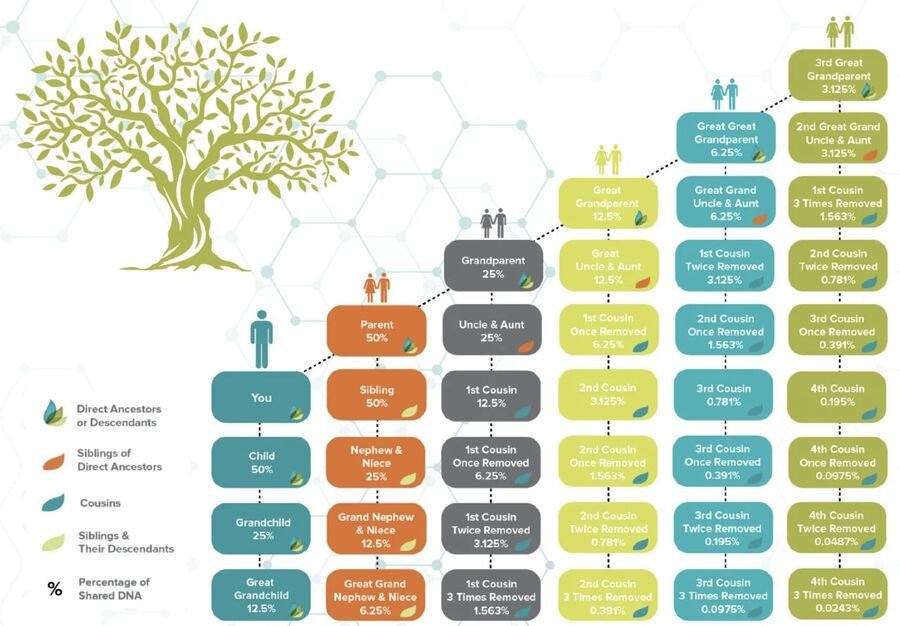
These designs let researchers calculate heritability — and this is where one of the most persistent misunderstandings in all of psychology tends to take root, so it's worth being very precise here.
◆ What heritability actually means
Heritability is a statistic about a population, describing the proportion of variance in a trait, within that population, that's associated with genetic differences among its members. A heritability of .50 for a trait does not mean "50% of you, personally, is genetic," and it does not mean any individual's trait is half genetic, half environmental. It's a population-level statistic about the sources of variation between people — it says nothing about the causes of any one person's score (Turkheimer, 2000). Heritability estimates can also shift if the environment changes, because heritability depends on how much environmental variability exists in the population being studied.
The myth
If a trait is highly heritable, it must be fixed, unchangeable, and not worth trying to intervene on.
What's actually true
Heritability does not equal immutability. Height is one of the most heritable traits psychologists study, yet average human height has increased substantially over the past century due to nutrition — a purely environmental change. A trait can be highly heritable within a population and still be highly responsive to environmental intervention. These are separate questions, and heritability estimates simply don't speak to whether a trait can change (Plomin et al., 2016; Turkheimer, 2000).
Nature and nurture don't sit in separate boxes
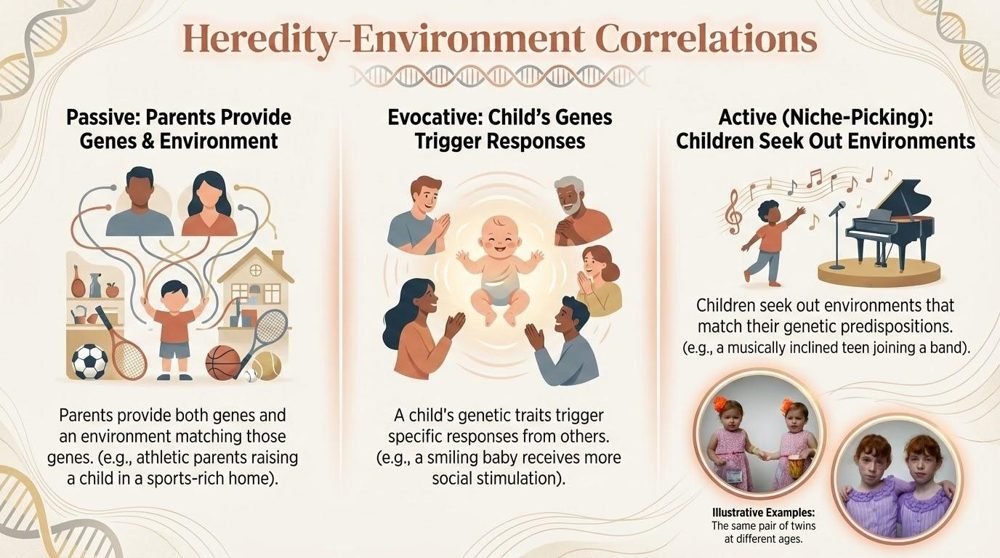
By now the theme should be clear: framing this as "nature versus nurture" misrepresents how development actually works. Genes and environment interact continuously, and one of the more elegant ideas behavior geneticists use to describe this is the gene-environment correlation — the ways your genetically influenced traits shape the environments you end up experiencing.
There are three flavors. A passive gene-environment correlation happens when parents pass along both genes and a matching environment — musically inclined parents might pass on genes related to musical aptitude and also fill the house with instruments and music lessons, so the child's genes and environment point the same direction without the child doing anything. An evocative gene-environment correlation happens when a child's genetically influenced traits evoke particular responses from others — a naturally sunny, easygoing infant draws out more warmth and engagement from caregivers than a difficult, colicky one, regardless of parenting style. An active gene-environment correlation, sometimes called niche-picking, happens as children get older and increasingly select and create environments that fit their own genetically influenced predispositions — the kid who's a bit more physically coordinated seeks out sports, gets more practice, and becomes still more skilled.
Behavior genetic research has also turned up a genuinely surprising finding that's worth sitting with. When researchers partition environmental influence, they distinguish shared environment (things that make siblings raised together more alike — same household, same neighborhood, same parenting philosophy) from nonshared environment (things that make siblings raised together different — different friend groups, different teachers, different birth-order experiences, even random chance). Across a huge range of psychological traits, shared environment tends to explain surprisingly little of the variation between people once they reach adulthood, while nonshared environment explains a great deal (Plomin et al., 2016; Turkheimer, 2000). Growing up in the same house with the same parents, in other words, doesn't make siblings nearly as psychologically similar as most people assume it would.
One more idea from this family, and then a study that shows it in action. The range of reaction is the notion that your genotype sets a range of possible outcomes and your environment determines where in that range you actually land. A child with a genetic predisposition toward high intellectual ability who grows up in a stimulating home is more likely to reach the top of that range than the same child raised in deprivation. Not everyone accepts that genes set hard ceilings — some researchers argue the boundaries themselves are set by the environment — but the core insight is uncontroversial: a genotype is a set of possibilities, not a result.
The cleanest demonstration in psychology comes from a Finnish adoption study of schizophrenia (Tienari et al., 2004). Adoptees whose biological mothers had schizophrenia carried high genetic risk; adoptees whose mothers did not carried low risk. Each group was then split by the quality of the adoptive home. Among high-risk adoptees raised in disturbed family environments, about 37% went on to develop schizophrenia or a related psychotic disorder. Among high-risk adoptees raised in healthy homes, the figure was about 6% — barely above the roughly 5% seen in low-risk adoptees regardless of their home environment. Neither the genetic risk nor the disturbed home produced much on its own. Together, they multiplied. That's gene–environment interaction in a single table, and it's a good template for how to think about the genetics of almost every psychological disorder.
Bodhi says
If you take one thing from the gene-environment correlation material, take this: asking "is it nature or nurture?" is often the wrong question entirely. A kid's genes can shape the environment they end up in, which then shapes them further. Nature and nurture aren't rivals splitting up the credit — they're tangled up in each other from day one.
Epigenetics: same DNA, different expression
◆ Current research
Epigenetics studies how gene expression — whether and how strongly a gene gets "read" and turned into protein — can change without any change to the underlying DNA sequence itself. Chemical tags, such as methyl groups attached to DNA, can turn genes up or down like a dimmer switch, and which tags get attached can depend heavily on environmental exposures.
One of the clearest early demonstrations came from agouti mice, a strain in which genetically identical mice can end up with strikingly different coat colors and body weights depending on the mother's diet during pregnancy — same gene sequence, different expression, different outcome, all attributable to methylation patterns set during early development.
In humans, the most compelling evidence comes from the Dutch Hunger Winter cohort. Near the end of World War II, a severe famine hit parts of the Netherlands for several months. Decades later, researchers examined adults who had been prenatally exposed to that famine and found measurable, lasting differences in DNA methylation compared to unexposed siblings — differences still detectable roughly six decades after the exposure (Heijmans et al., 2008). Prenatal environment had left a chemical mark on the genome that persisted across an entire lifetime.
The most provocative — and most contested — extension of this work concerns whether such epigenetic marks can be passed down to offspring who were never themselves exposed to the original environmental trigger. Dias and Ressler (2014) found that when male mice were conditioned to fear a particular odor, their offspring and even grand-offspring showed heightened sensitivity to that same odor, along with associated changes in the offspring's neural structure — despite having no direct exposure to the original conditioning.
Well-supported
Prenatal and early-life environments can produce lasting epigenetic changes within the exposed individual, detectable decades later (Heijmans et al., 2008).
Still debated
Whether such marks are reliably transmitted across generations in humans — true transgenerational epigenetic inheritance — remains an open, actively contested question, not settled science (Dias & Ressler, 2014, in mice).
One species, one race — genetically speaking
A final correction, because the unit on prejudice later this semester will lean on it. Biologically, "race" is a weak construct. Any two humans share about 99.9% of their DNA, and when researchers actually measure genetic variation, there turns out to be more of it within any conventional racial category than between categories. Skin tone, eye color, and hair texture are real and heritable, but they're a handful of traits that don't line up with deep genetic boundaries between groups. That's why, after the human genome was sequenced, many geneticists argued that race should be dropped as a variable in genetic research altogether and replaced with ancestry — where a person's recent forebears actually lived, which is a continuous, measurable biological variable rather than a social category. The stakes aren't merely academic: reasoning from racial categories has led to misdiagnoses and under-diagnoses of conditions from sickle-cell anemia to cystic fibrosis, because clinicians assumed a disease "belonged" to one group (Yudell et al., 2016). Human variation is real. Race is just a poor map of it.
Check yourself
The one thing to carry out of this unit
Genes don't script behavior — they build the biological machinery that interacts with everything a person experiences, from the womb onward, to produce it. Heritability tells you about variation across a population, not about any one person's fixed destiny, and it never tells you a trait can't change. Evolution shaped minds for ancestral problems, not modern ones, which is why some of your most powerful instincts feel strangely mismatched to the world you actually live in. And the boundary between "biological" and "environmental" is far blurrier than the phrase "nature versus nurture" lets on — genes and environment are in constant conversation, sometimes for an entire lifetime, sometimes, it appears, for more than one.
References
Buss, D. M. (2009). The great struggles of life: Darwin and the emergence of evolutionary psychology. American Psychologist, 64(2), 140–148. https://doi.org/10.1037/a0013207
Buss, D. M. (2019). Evolutionary psychology: The new science of the mind (6th ed.). Routledge.
Dias, B. G., & Ressler, K. J. (2014). Parental olfactory experience influences behavior and neural structure in subsequent generations. Nature Neuroscience, 17(1), 89–96.
Gould, S. J., & Lewontin, R. C. (1979). The spandrels of San Marco and the Panglossian paradigm: A critique of the adaptationist programme. Proceedings of the Royal Society of London B, 205(1161), 581–598.
Hamilton, W. D. (1964). The genetical evolution of social behaviour. I. Journal of Theoretical Biology, 7(1), 1–16. https://doi.org/10.1016/0022-5193(64)90038-4
Heijmans, B. T., Tobi, E. W., Stein, A. D., Putter, H., Blauw, G. J., Susser, E. S., Slagboom, P. E., & Lumey, L. H. (2008). Persistent epigenetic differences associated with prenatal exposure to famine in humans. Proceedings of the National Academy of Sciences, 105(44), 17046–17049.
Plomin, R., DeFries, J. C., Knopik, V. S., & Neiderhiser, J. M. (2016). Top 10 replicated findings from behavioral genetics. Perspectives on Psychological Science, 11(1), 3–23.
Spielman, R. M., Jenkins, W. J., & Lovett, M. D. (2020). Psychology 2e. OpenStax. https://openstax.org/details/books/psychology-2e
Tienari, P., Wynne, L. C., Sorri, A., Lahti, I., Läksy, K., Moring, J., Naarala, M., Nieminen, P., & Wahlberg, K.-E. (2004). Genotype–environment interaction in schizophrenia-spectrum disorder: Long-term follow-up study of Finnish adoptees. British Journal of Psychiatry, 184(3), 216–222. https://doi.org/10.1192/bjp.184.3.216
Trivers, R. L. (1971). The evolution of reciprocal altruism. The Quarterly Review of Biology, 46(1), 35–57. https://doi.org/10.1086/406755
Turkheimer, E. (2000). Three laws of behavior genetics and what they mean. Current Directions in Psychological Science, 9(5), 160–164.
Yudell, M., Roberts, D., DeSalle, R., & Tishkoff, S. (2016). Taking race out of human genetics. Science, 351(6273), 564–565. https://doi.org/10.1126/science.aac4951