EPA 2025
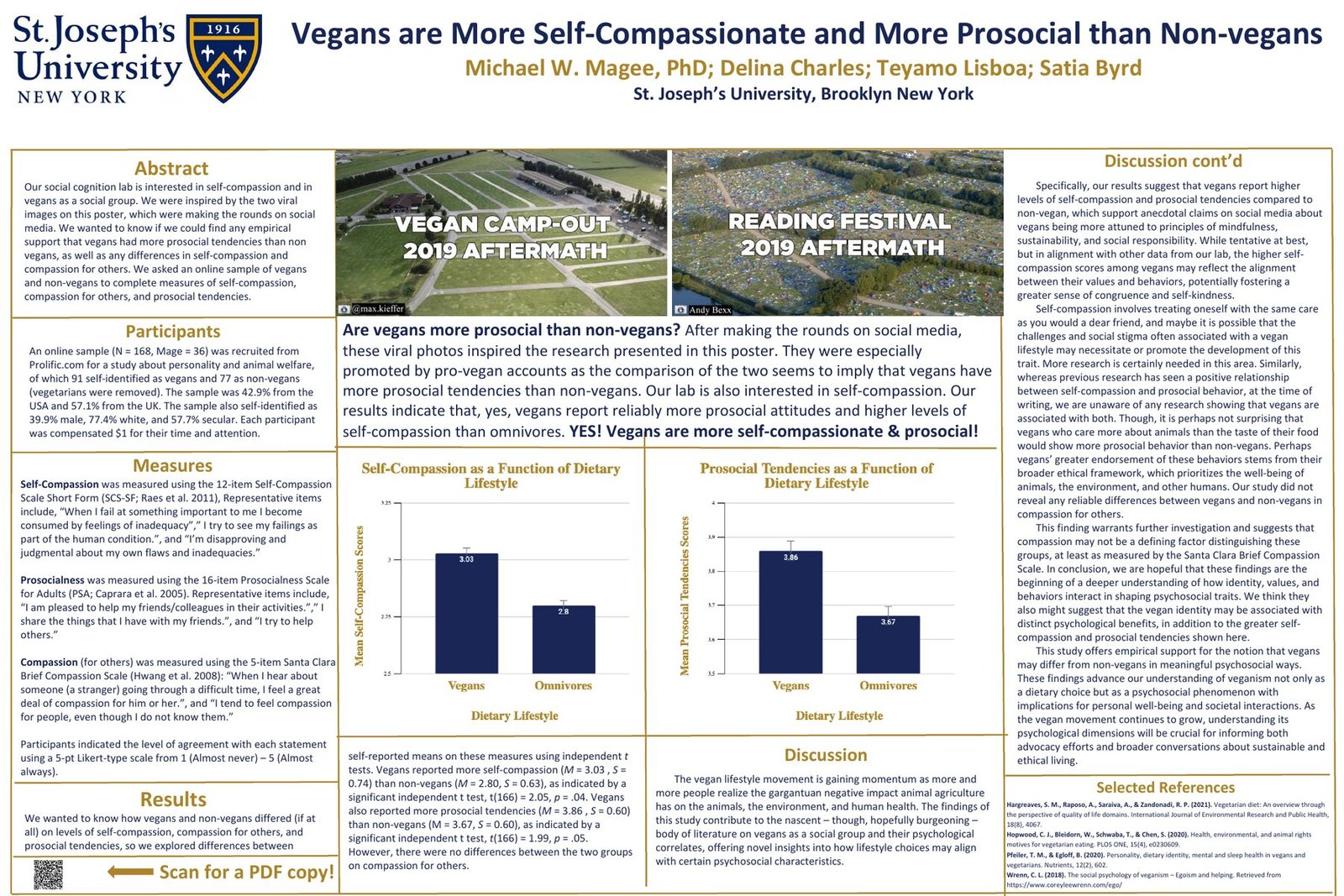
Vegans are more self-compassionate and more prosocial than non-vegans.
Magee, M. W., Charles, D., Lisboa, T., & Byrd, S. (2025). Eastern Psychological Association Annual Meeting.
In an online sample of vegans (n = 91) and non-vegans (n = 77), vegans reported reliably higher self-compassion and more prosocial tendencies. Compassion for others did not differ—suggesting it is the self-directed and behavioral correlates of vegan identity, not other-compassion, that distinguish the group.
View poster
EPA 2025
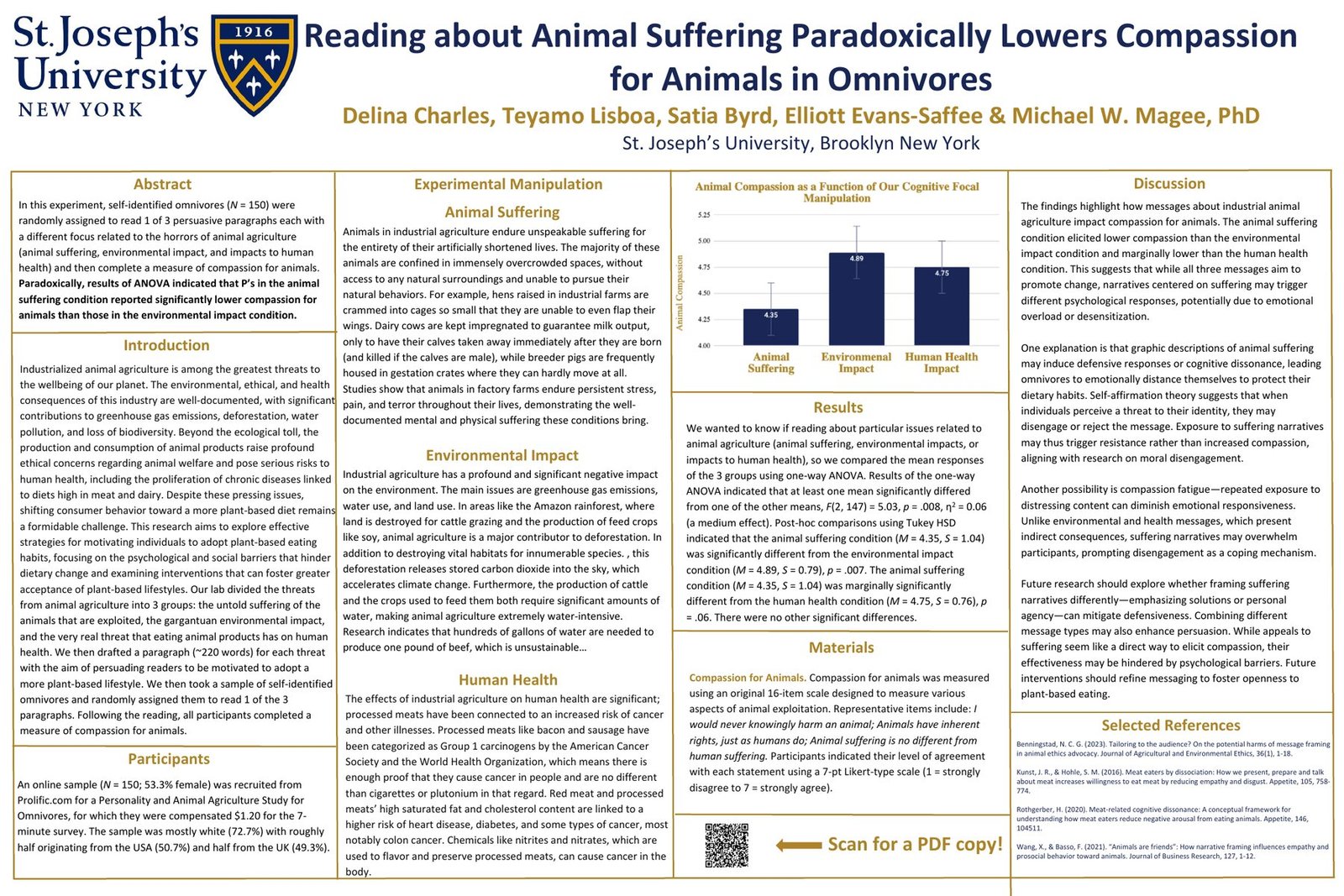
Reading about animal suffering paradoxically lowers compassion for animals in omnivores.
Charles, D., Lisboa, T., Byrd, S., Evans-Saffee, E., & Magee, M. W. (2025). Eastern Psychological Association Annual Meeting.
Omnivores (N = 150) were randomly assigned to read a persuasive paragraph emphasizing animal suffering, environmental impact, or human-health consequences of industrial agriculture. The suffering condition produced significantly lower compassion for animals than the environmental condition—consistent with defensive disengagement and compassion fatigue.
View poster
EPA 2024
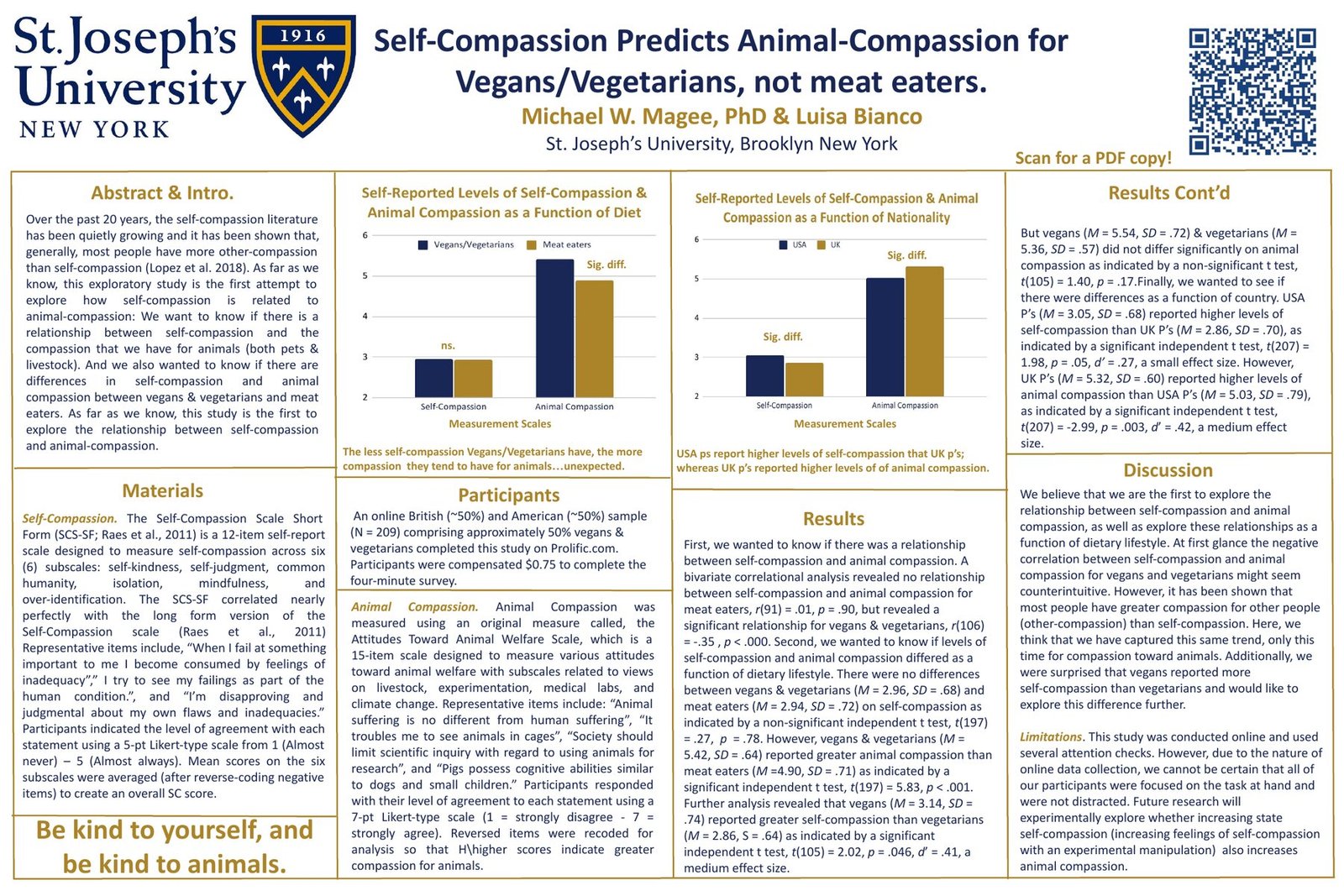
Self-compassion predicts animal-compassion for vegans/vegetarians, not meat eaters.
Magee, M. W., & Bianco, L. (2024). Eastern Psychological Association Annual Meeting.
The first test of the self-compassion–animal-compassion link. Among vegans and vegetarians (n = 106), the two correlate negatively, r = −.35; among meat-eaters (n = 91) there is no relationship—mirroring the broader pattern in which people extend more compassion to others than to themselves.
View poster
EPA 2024
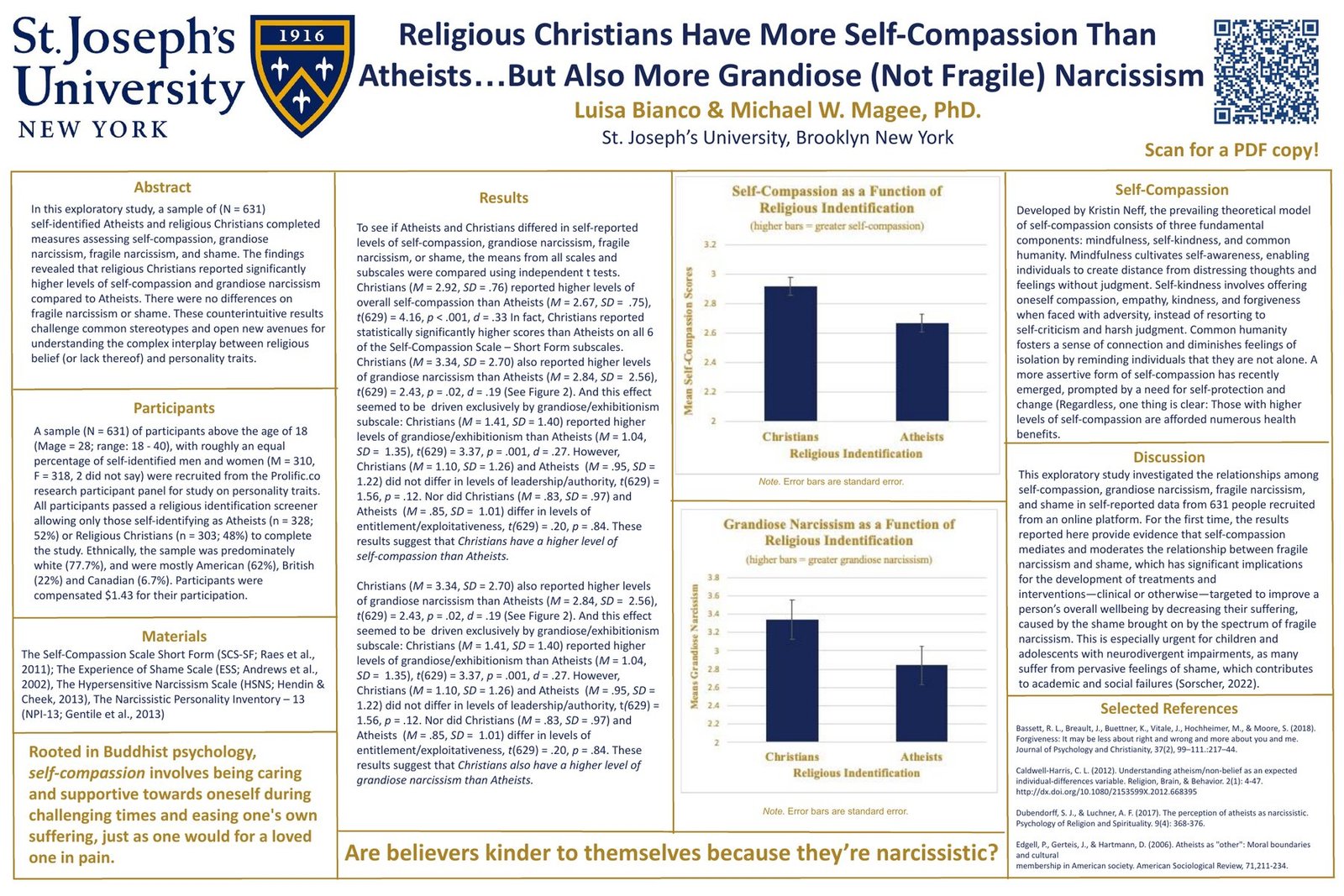
Religious Christians have more self-compassion than Atheists—but also more grandiose narcissism.
Bianco, L., & Magee, M. W. (2024). Eastern Psychological Association Annual Meeting.
Religious Christians (n = 303) reported higher self-compassion than Atheists (n = 328) on all six SCS-SF subscales. They also reported higher grandiose narcissism, driven almost entirely by the exhibitionism subscale. No differences emerged on fragile narcissism or shame.
View poster
EPA 2024
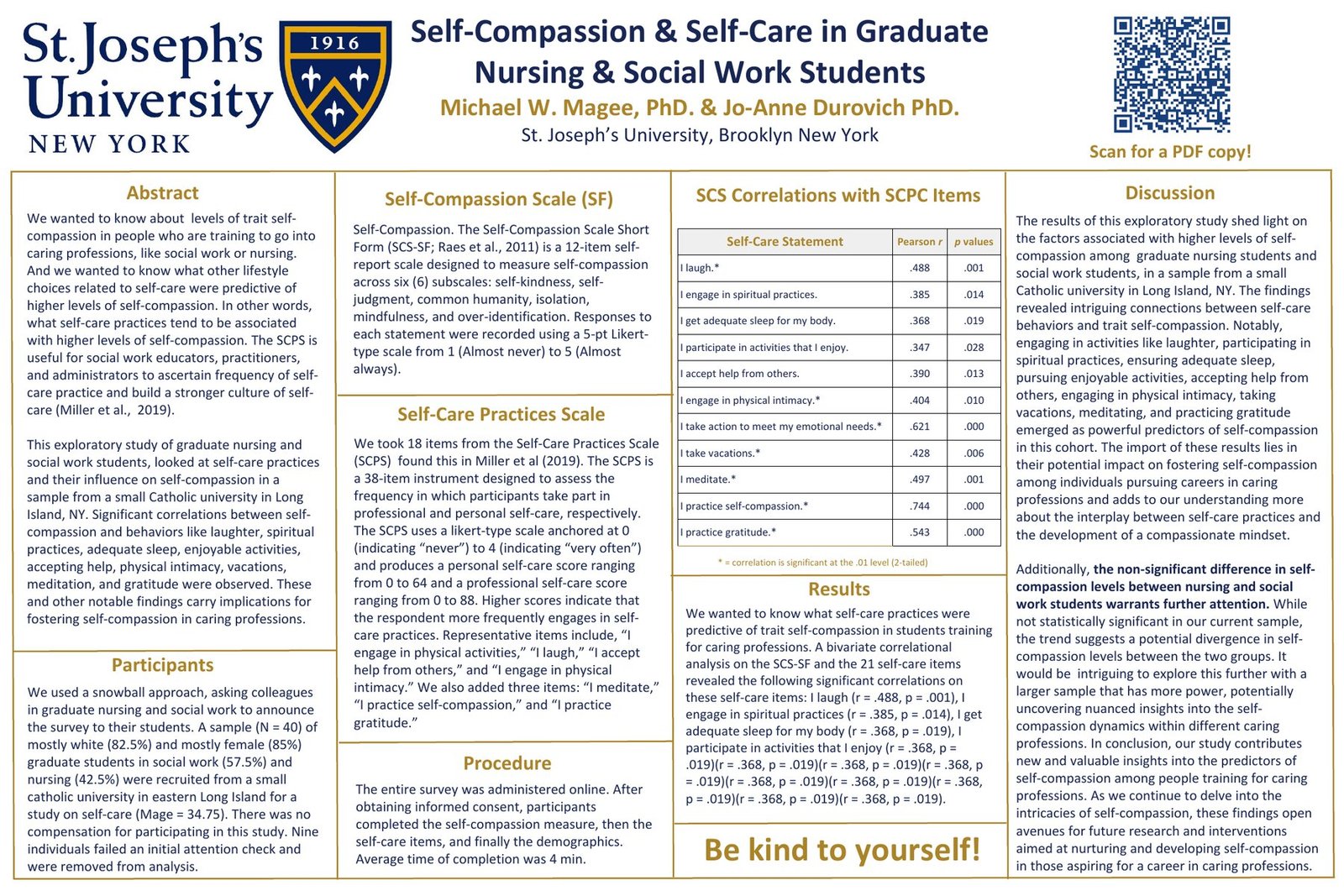
Self-compassion and self-care in graduate nursing and social-work students.
Magee, M. W., & Durovich, J.-A. (2024). Eastern Psychological Association Annual Meeting.
Among graduate trainees for caring professions, trait self-compassion correlated strongly with practicing self-compassion (r = .74), gratitude (.54), taking action on emotional needs (.62), and meditation (.50). The self-care behaviors that predict a compassionate stance toward oneself are the same ones trainees most need to sustain a career caring for others.
View poster
EPA 2022
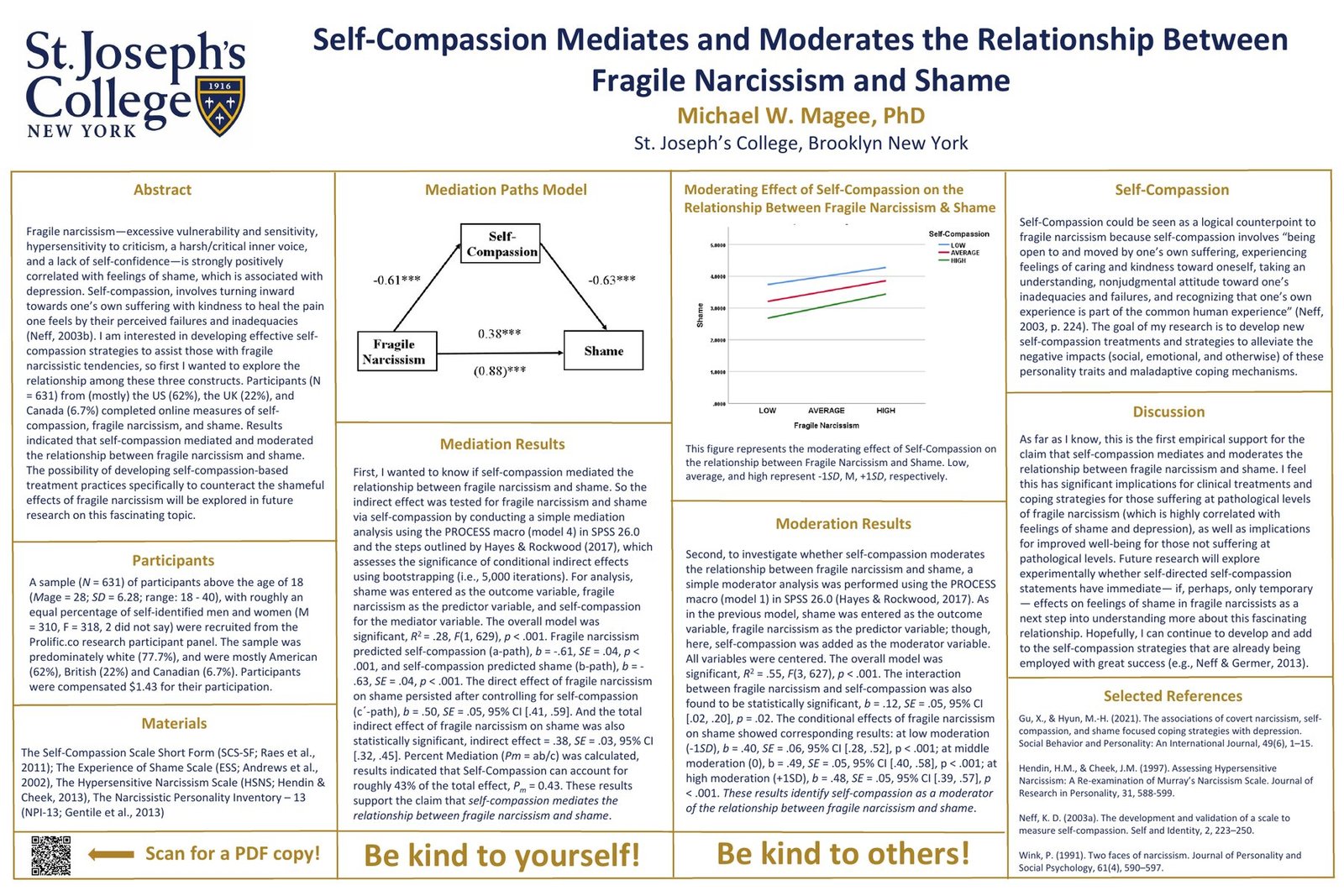
Self-compassion mediates and moderates the relationship between fragile narcissism and shame.
Magee, M. W. (2022). Eastern Psychological Association Annual Meeting.
In a sample recruited from Prolific (N = 631), self-compassion accounted for roughly 43% of the total effect of fragile narcissism on shame (mediation) and significantly moderated that relationship at low vs. high levels. First empirical support for self-compassion as a clinical lever against the shame component of fragile narcissism.
View poster
EPA 2020
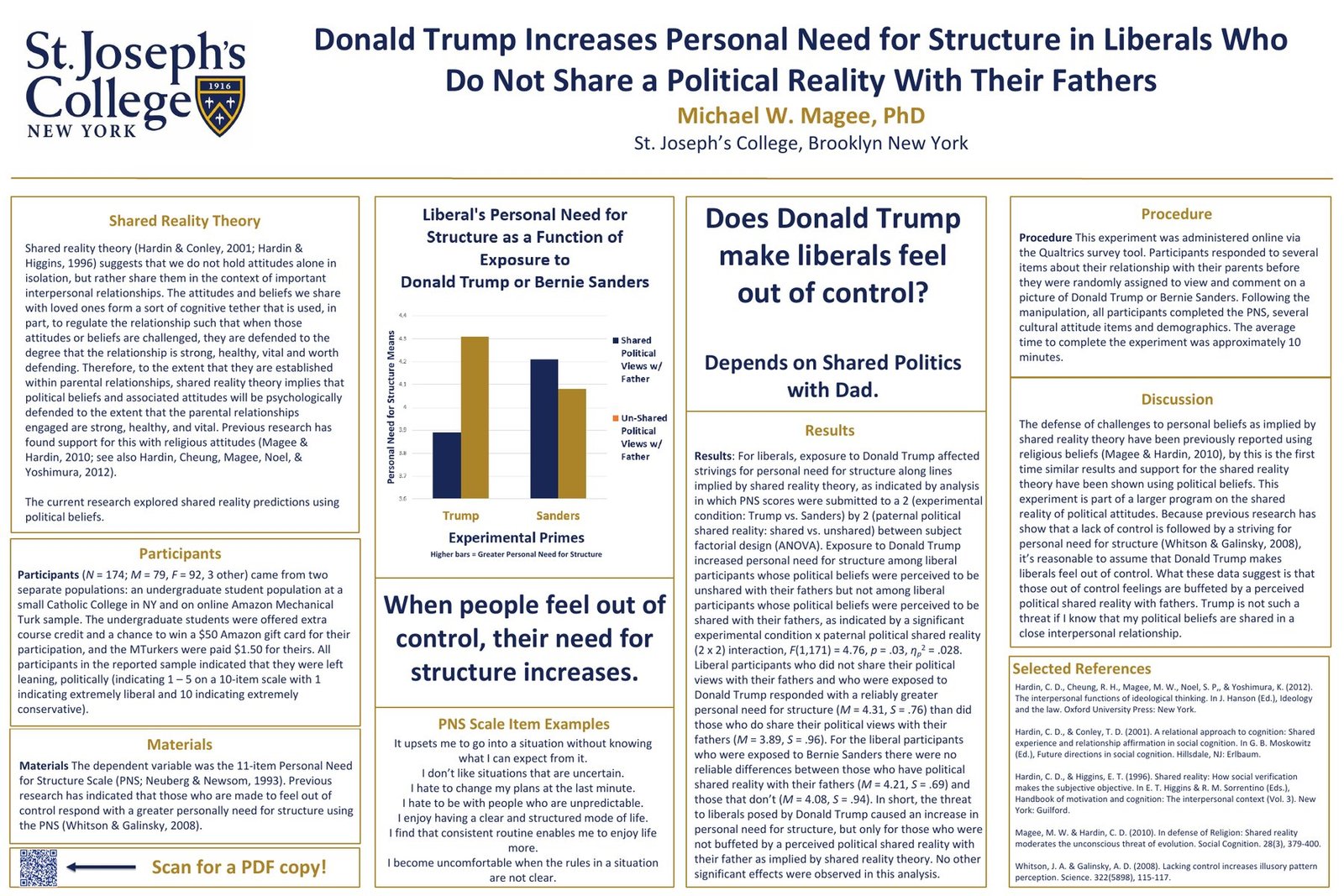
Donald Trump increases personal need for structure in liberals who do not share a political reality with their fathers.
Magee, M. W. (2020). Eastern Psychological Association Annual Meeting.
Liberal participants (N = 174) were randomly assigned to view either Donald Trump or Bernie Sanders. A significant 2×2 interaction emerged: exposure to Trump raised personal need for structure only among liberals whose political beliefs were unshared with their fathers. Extends shared-reality theory from religious to political beliefs.
View poster