This page previews a unit that many introductory courses touch only briefly, if at all. Social psychology asks a deceptively simple question — how does the presence, behavior, and mere expectation of other people change what we do? — and the answers it has found are some of the most replicated and most humbling in the entire field. None of this is required reading for your exams unless your instructor says otherwise. It is here because understanding how situations push on behavior will change how you read the news, how you judge other people's choices, and, if you are honest with yourself, how you judge your own.
The one idea that organizes everything else
Before getting into specific studies, it helps to name the theme that all of them share, because once you see it, you will see it everywhere in this unit. Social psychologists call it the power of the situation: the consistent finding that external circumstances — who else is present, what authority figures expect, how a group is behaving — predict behavior more powerfully than most people intuitively expect, often more powerfully than personality or character does.
◆ Why this matters
We are, as a species, bad at recognizing this about ourselves. When we explain someone else's behavior, we tend to reach first for their character — she's rude, he's lazy, they're heroic — and underweight the circumstances they were in. This is common enough, and misleading enough, that it has its own name: the fundamental attribution error, the tendency to overestimate the role of personal disposition and underestimate the role of situational forces when explaining other people's behavior (Ross, 1977). Curiously, we tend not to make the same error about ourselves. When we explain our own behavior, especially our failures, we lean on circumstance — I was tired, the traffic was bad, I wasn't given enough time — a pattern known as the self-serving bias. Put the two together and you get a strange asymmetry: other people's failures reflect who they are; our own failures reflect what happened to us.
Keep that asymmetry in mind as you read the rest of this page. Nearly every study below is, in one way or another, a demonstration that the situation was doing more work than it looked like it was doing.
When behavior changes the mind, not the other way around
You probably think of attitudes as the thing that drives behavior: you believe something, so you act on it. Cognitive dissonance theory complicates that picture. It proposes that when our actions and our attitudes don't line up, we experience genuine psychological discomfort — dissonance — and that we are strongly motivated to resolve it, often by quietly changing the attitude to match the behavior we already produced, rather than the other way around.

The classic demonstration is almost counterintuitive enough to sound backwards the first time you hear it. In a study by Festinger and Carlsmith (1959), participants completed a long, deliberately boring task. Afterward, researchers asked them to tell the next "participant" — actually a confederate — that the task had been interesting and enjoyable, essentially telling a small lie. Participants were paid either $1 or $20 for telling this lie. Common sense predicts that people paid more would come to believe the lie more, since a bigger reward should produce a stronger effect. The finding ran the other way. Participants paid only $1 rated the task as significantly more enjoyable afterward than participants paid $20 did.
◆ The logic behind the reversal
The $20 group had an easy, external justification available: "I said it was fun because I was paid a lot of money to say so." Their attitude and behavior could stay in conflict without much discomfort, because the money explained the gap. The $1 group had no such excuse — $1 wasn't enough to justify lying to a stranger, so the dissonance between "I said the task was fun" and "the task was actually boring" had to be resolved some other way. The easiest resolution was to genuinely revise the belief: maybe the task really was sort of enjoyable. We don't just act on our attitudes. Sometimes we quietly edit our attitudes to make sense of actions we've already taken (Festinger & Carlsmith, 1959).
How persuasion actually works
If attitudes can be nudged, how do persuasive messages do the nudging? Petty and Cacioppo's (1986) elaboration likelihood model proposes that persuasion travels two different routes. The central route works through careful, effortful thinking about the actual content of an argument — its logic, evidence, and merits. When people are both motivated and able to think it through, central-route persuasion produces attitude change that is durable and resistant to counterattack. The peripheral route works instead through superficial cues that have little to do with the argument's substance — the attractiveness or apparent expertise of the source, the sheer number of arguments regardless of their quality, slick production. Peripheral-route persuasion is easier to trigger but produces shallower, more fragile change. Most advertising deliberately aims at the peripheral route (the "Joe Camel" campaign above sold an image, not an argument), which is exactly why it can work on people who would reject the same product the moment they stopped to reason about it.
Beyond persuasive messages, social psychologists have catalogued specific compliance techniques that reliably raise the odds of getting someone to say yes. The best-studied is the foot-in-the-door technique: get a person to agree to a small request first, and they become substantially more likely to agree to a larger, related request later. Freedman and Fraser (1966) demonstrated it in the field — homeowners who first agreed to a trivial request (displaying a small "safe driving" sign) were far more willing, weeks later, to allow a large, unsightly billboard on their lawn than homeowners approached cold. The likely engine is consistency: having taken the first step, people quietly adjust their self-image to fit it ("I'm the kind of person who supports this") and then act to stay consistent with it. It's the cognitive dissonance from the start of this section, gently weaponized.
Bending to the group, and to authority
Two research programs, run just a few years apart, mapped out how far ordinary people will bend to match the people around them — first to a group's judgment, then to a single authority figure's instructions.
Solomon Asch's (1956) conformity studies used a task that should have been trivially easy: participants looked at a line and judged which of three comparison lines matched it in length, a call so obvious that people made it correctly almost every time when answering alone. The twist was that each real participant answered in a group of confederates who had been instructed to unanimously give the same wrong answer on certain trials. Faced with a group unanimously stating an answer that was plainly incorrect, a substantial proportion of participants went along with the group at least some of the time — denying the evidence in front of their own eyes rather than break from the group. Some conformed because they doubted their own perception; others conformed simply to avoid standing out, even while privately certain the group was wrong (Asch, 1956).
Milgram's obedience research pushed the same underlying question — how far will people go along with something they know is wrong? — into far higher-stakes territory, and you have likely already encountered it in the Ethics unit of this course. Ordinary participants, instructed by an experimenter in a position of authority, administered what they believed were increasingly severe electric shocks to another person simply because they were told to continue. The unsettling lesson from both Asch's and Milgram's work is not that some people are secretly cruel or weak-willed. It is that the situation — a unanimous group, a calm authority figure insisting the study must go on — exerts real pressure on nearly everyone, and that pressure is often strong enough to override what a person privately believes or sees.
Step 1 · The pressure is social, not personal
Neither Asch's confederates nor Milgram's experimenter used force. The pressure worked through social expectation — a unanimous group, an authority figure's calm insistence — not coercion in any physical sense.
Step 2 · Most people underestimate their own susceptibility
Before these studies ran, people predicted that they themselves, and others, would resist. The actual conformity and obedience rates surprised almost everyone, including the researchers.
Step 3 · The conclusion is about situations, not character flaws
The point of both lines of research isn't that participants were unusually weak or unethical people. It's that ordinary people, in these specific structured situations, behaved in ways that character alone would not have predicted.
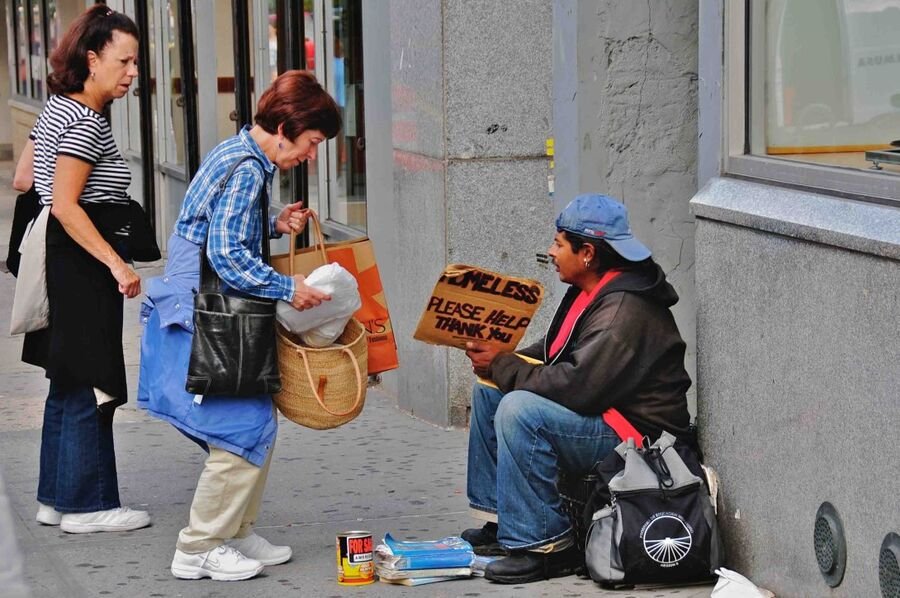
Why more witnesses can mean less help
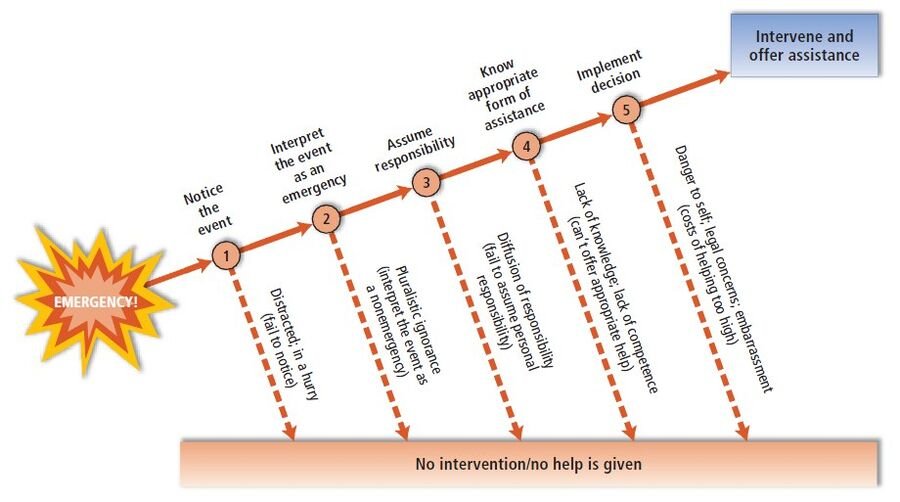
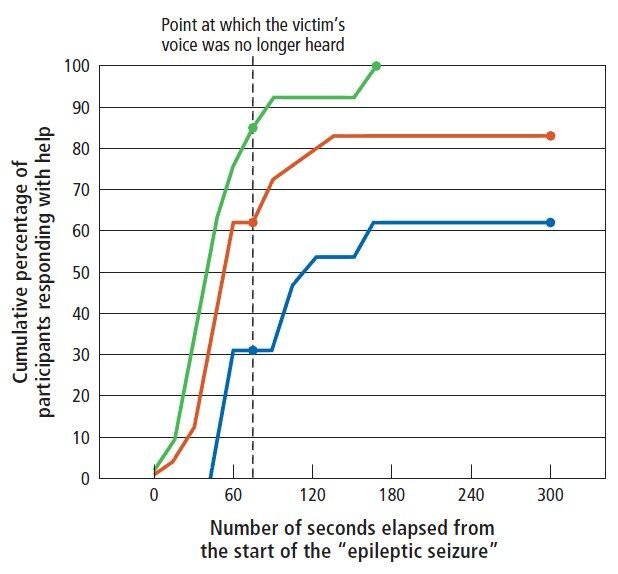
One of the more counterintuitive findings in this unit concerns what happens when someone needs help in front of a crowd. You might expect that more witnesses means a better chance that someone helps. Darley and Latané's (1968) research found close to the opposite: as the number of bystanders who witness an emergency increases, the likelihood that any single person intervenes tends to decrease. They attributed this to diffusion of responsibility — when many people are present, the sense of personal obligation to act gets spread thin across the group, and each individual bystander can quietly assume that someone else will step in, or already has (Darley & Latané, 1968).
The myth
The bystander effect was discovered because 38 witnesses watched Kitty Genovese be murdered in New York City and did nothing to help or even call the police — a case of mass, callous indifference.
What's actually true
The dramatic "38 witnesses who did nothing" version of the Genovese case that circulated in the press and inspired this line of research was substantially exaggerated. A later reexamination found the number of witnesses who directly saw the fatal attack, and the claim that none of them acted or called for help, does not hold up against the original case record (Manning, Levine, & Collins, 2007). The bystander effect itself is a real and well-replicated phenomenon — Darley and Latané's (1968) experimental research demonstrated it directly and repeatedly under controlled conditions. But the founding anecdote that made the effect famous is a good reminder to be skeptical of a dramatic story just because it's the one that launched a field.



What changes when you're in a group
Groups don't just change whether we help strangers. Being part of a group changes performance and decision-making in several distinct, well-documented ways, and it's worth being able to tell them apart rather than lumping them together as "group stuff."
Social facilitation describes the tendency for the presence of others to improve performance on simple or well-practiced tasks — you run a little faster with people watching. Social loafing describes something closer to the opposite: when individual effort within a group cannot be identified or evaluated separately, people tend to exert less effort than they would working alone, because personal accountability is diluted across the group. Groupthink refers to a breakdown in group decision-making where the desire for consensus and harmony overrides a realistic appraisal of alternatives, often producing worse decisions than any individual member would have made alone. Deindividuation describes the loss of individual self-awareness and personal accountability that can occur in a group or crowd, particularly when anonymity is high, sometimes loosening the normal restraints on behavior. And group polarization describes the tendency for group discussion to push the group's overall attitude toward a more extreme version of whatever position its members already leaned toward before the discussion began, rather than toward a moderate compromise.
Social facilitation
A practiced piano player performs a well-rehearsed piece more energetically in front of an audience than alone in a practice room. The task is familiar, and the presence of others sharpens performance.
Social loafing
Four students split a group project, and one student contributes noticeably less because their individual share of the work is hard for the professor to isolate and grade separately from the group's overall output.
Us versus them, and one documented way to soften it
People sort the social world into groups almost automatically — an in-group ("us") and an out-group ("them") — and that sorting alone, with no other information added, is often enough to produce favoritism toward the in-group and less favorable assumptions about the out-group. Stereotypes are the generalized beliefs we attach to members of a group; prejudice is the negative attitude that can follow from those beliefs, sometimes with little or no direct evidence about the specific individual being judged.
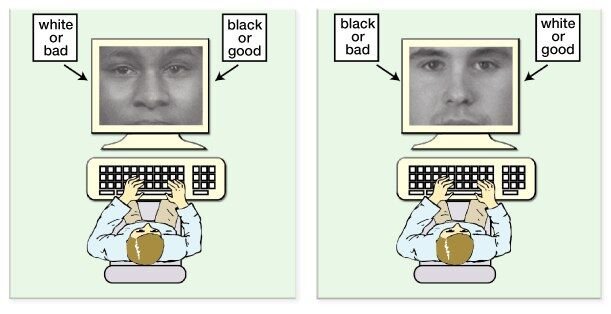
There is, encouragingly, real evidence about what reduces this. The contact hypothesis proposes that direct contact between members of different groups, under the right conditions, can reduce prejudice between them. A large-scale meta-analysis — a statistical synthesis pooling results across hundreds of individual studies — tested this proposition across an enormous body of existing research and found consistent support: intergroup contact reliably predicts lower prejudice, and the effect holds across a wide range of group types and contexts, not just in one narrow setting (Pettigrew & Tropp, 2006). Contact isn't a magic fix for prejudice on its own, and the conditions under which it works best — equal status, shared goals, cooperation, institutional support — matter a great deal. But the basic finding, replicated at this scale, is one of the more genuinely hopeful results in the whole field.
The most vivid early evidence for how to defuse group hostility came from Muzafer Sherif's Robbers Cave study. Sherif and colleagues (1961) took two groups of ordinary boys at a summer camp, deliberately generated fierce hostility between them through competition, and then tried to undo it. Simple contact — putting the groups together for meals and movies — didn't work, and often made things worse. What did work was introducing superordinate goals: problems neither group could solve alone, which forced them to cooperate, like restoring the camp's (secretly sabotaged) water supply. Working together toward shared goals steadily eroded the hostility. This is precisely why the modern contact hypothesis emphasizes conditions like shared goals and cooperation rather than mere proximity — Sherif had shown, decades earlier, that contact without a reason to cooperate isn't enough.
Bodhi says
Notice how many of these findings share the same shape: a force we don't notice — group unanimity, diffusion of responsibility, an authority figure's calm voice, a $1 justification instead of $20 — quietly outweighs what we'd expect our own character or beliefs to guarantee. That's not a reason for cynicism about people. It's a reason to design situations more carefully, whether you're running a study, managing a team, or just deciding whether to be the one person who steps up to help.
The myth
"I would definitely have helped." "Good, decent people simply can't be led to do something cruel or wrong." Most people are confident these statements are true of themselves.
What's actually true
Situational forces — diffusion of responsibility in a crowd, unanimous group pressure, a calm authority figure's insistence — reliably move the behavior of ordinary, decent people, not just a rare unethical few. That is precisely why this unit matters: knowing these mechanisms in advance is one of the few things that actually helps someone recognize and resist them in the moment, rather than assuming good character will automatically do the job.
Check yourself
The one thing to carry out of this unit
Every finding on this page points back to the same idea: the situation you're in shapes your behavior more than you'd guess, and it does this to everyone, not just to people you'd consider weak-willed or unkind. That is not a comfortable conclusion, because it complicates the story we like to tell about character determining conduct. But it is also a useful one. If situations can pull ordinary people toward silence, conformity, or harm, then understanding exactly how — a diffuse crowd, a unanimous group, an authority's calm voice, a too-small justification for a small lie — is one of the few real tools available for pulling the other way.
References
Asch, S. E. (1956). Studies of independence and conformity: A minority of one against a unanimous majority. Psychological Monographs: General and Applied, 70(9), 1–70.
Darley, J. M., & Latané, B. (1968). Bystander intervention in emergencies: Diffusion of responsibility. Journal of Personality and Social Psychology, 8(4), 377–383.
Festinger, L., & Carlsmith, J. M. (1959). Cognitive consequences of forced compliance. Journal of Abnormal and Social Psychology, 58(2), 203–210.
Freedman, J. L., & Fraser, S. C. (1966). Compliance without pressure: The foot-in-the-door technique. Journal of Personality and Social Psychology, 4(2), 195–202. https://doi.org/10.1037/h0023552
Manning, R., Levine, M., & Collins, A. (2007). The Kitty Genovese murder and the social psychology of helping: The parable of the 38 witnesses. American Psychologist, 62(6), 555–562.
Pettigrew, T. F., & Tropp, L. R. (2006). A meta-analytic test of intergroup contact theory. Journal of Personality and Social Psychology, 90(5), 751–783.
Petty, R. E., & Cacioppo, J. T. (1986). The elaboration likelihood model of persuasion. Advances in Experimental Social Psychology, 19, 123–205. https://doi.org/10.1016/S0065-2601(08)60214-2
Ross, L. (1977). The intuitive psychologist and his shortcomings: Distortions in the attribution process. Advances in Experimental Social Psychology, 10, 173–220.
Sherif, M., Harvey, O. J., White, B. J., Hood, W. R., & Sherif, C. W. (1961). Intergroup conflict and cooperation: The Robbers Cave experiment. University Book Exchange.