Your slides moved fast through a lot of anatomy — receptors, nerves, brain areas. This page slows down on the parts that tend to blur together after class: what sensation actually is as a process, why psychophysics matters more than it looks like it does on a slide, and why pain turns out to be one of the strangest and most instructive senses in the whole unit.
Sensation is not the same thing as perception
Sensation is the raw detection of physical energy — light hitting your retina, sound waves hitting your eardrum, molecules binding to receptors in your nose. It's a bottom-up process: energy comes in, receptors respond. Perception is what happens next — your brain organizing and interpreting that raw input, often influenced by expectation, context, and experience, which makes it more top-down. This page is mostly about the sensation half: the detecting, not yet the interpreting. Keep that distinction in mind, because it's easy to slide sensation and perception together in your head, and your exams won't.
Transduction: one universal translator
Every sense faces the same basic engineering problem. Light, sound, chemicals, and pressure are all physically different kinds of energy, but your brain only speaks one language: neural signals, action potentials traveling down axons. Transduction is the process of converting a physical stimulus into that neural signal. Your eyes transduce light, your ears transduce pressure waves, your nose and tongue transduce chemicals, your skin transduces pressure and temperature. Different receptors, different physical inputs, but the same output format — which is exactly why your brain can compare, combine, and store information from wildly different senses using one shared neural code.
Bodhi says
Whenever a question asks "how does the eye/ear/nose turn X into a nerve signal," the answer is always transduction — it's the same word for every sense, just a different receptor doing the converting.
Psychophysics: measuring the mind's fine print
Psychophysics is the study of the relationship between physical stimuli and the psychological experience of them — how much physical energy does it take before you notice something, and how much more does it take before you notice a change. Three core ideas build on each other here.
Step 1 · Absolute threshold
The minimum amount of stimulation needed to detect a stimulus at all, at least 50% of the time. Below it, the stimulus is (statistically) undetectable — a candle flame seen from 30 miles away on a clear night is the classic textbook benchmark for how sensitive human vision's absolute threshold really is.
Step 2 · Difference threshold and Weber's law
The difference threshold (or just-noticeable difference, JND) is the smallest change in a stimulus a person can detect. Weber's law makes a specific, testable claim about that threshold: the JND is not a fixed amount of physical change — it's a constant proportion of the original stimulus. That's why adding one lit candle to a dark room is obvious, but adding one lit candle to a room already blazing with a hundred candles is not — the absolute increase in light is identical in both cases, but the proportional increase is tiny in the second case.
Step 3 · Sensory adaptation
Once a stimulus stays constant, your sensitivity to it declines — you stop noticing it. This is why you stop feeling your clothes against your skin a few minutes after getting dressed, or stop smelling your own kitchen after being in it for an hour. Adaptation isn't laziness; it's efficient design, since a stimulus that isn't changing usually isn't carrying new information worth spending attention on.
Weber's insight was extended by his student Gustav Fechner, often credited as the founder of psychophysics as a formal discipline — and, with it, one of the first people to measure the mind with real mathematical precision. Fechner's law generalizes Weber's to describe the overall relationship between stimulus intensity and sensation: as a physical stimulus grows, the subjective sensation grows more slowly, roughly in proportion to the logarithm of the physical intensity (Fechner, 1860/1966). The practical upshot is that our senses compress an enormous physical range into a manageable perceptual one. A sound that is physically a thousand times more intense than another does not feel a thousand times louder — it feels only a few steps louder. That logarithmic compression is exactly why loudness is measured in decibels, a logarithmic scale, rather than in raw units of pressure: the scale was built to match how hearing actually behaves.
◆ The upgrade: signal detection theory
Classical psychophysics treats the absolute threshold as if it's a fixed line in the sand — below it, nothing; above it, detection. Signal detection theory (Green & Swets, 1966) complicates that picture in an important way: there is no single fixed threshold. Whether you detect a faint stimulus depends on both the strength of the signal and your own response criterion — how cautious or liberal you are about saying "yes, I detected something," which shifts with expectation, motivation, and context. That's why a radiologist scanning for tumors, a parent listening for a baby's cry, and a soldier on watch at night can all have the same sensory equipment but very different detection behavior. Signal detection theory sorts responses into four outcomes: hits (correctly detecting a real signal), misses (failing to detect a real signal), false alarms (reporting a signal that wasn't there), and correct rejections (correctly saying nothing was there). The same physical stimulus can produce different outcomes in different people, or in the same person on different days, because the criterion — not just the sensitivity — is doing real work.
◆ What about subliminal messages?
The idea of an absolute threshold raises a natural question: can stimuli presented below it — too faint or too brief to consciously notice — still influence you? The honest answer is "a little, but far less than the legend claims." The famous 1950s story that a movie theater boosted Coke and popcorn sales by flashing subliminal ads was later admitted by its own promoter to have been fabricated. Controlled research does show that briefly, subliminally presented stimuli can produce small priming effects — nudging which word comes to mind next, for instance — but there is no credible evidence that subliminal messages can implant complex desires or override your decisions. Detection is probabilistic and the response criterion is movable, but a stimulus your nervous system barely registers has correspondingly little power over what you do.
Smell: the sense with a direct line to emotion
Olfaction has an unusual wiring quirk that makes it worth its own callout. Almost every other sense routes through the thalamus — the brain's relay station — before reaching the cortex for further processing. Smell mostly skips that stop. Olfactory signals project nearly directly to limbic and olfactory brain areas, the same general territory involved in emotion and memory. That anatomical shortcut is very likely why smells trigger emotional memories so suddenly and vividly — a whiff of a particular perfume or a dish cooking can drop you straight back into a specific moment years ago, with more emotional force than a photo of the same moment usually manages. This is sometimes called the Proust effect, after the novelist's famous description of a childhood memory flooding back at the taste and smell of a madeleine cookie, and there's real empirical support behind it (Herz, 2016).
Smell also relies on combinatorial coding: you have roughly 400 different types of olfactory receptors, and any given odor activates a distinct pattern across many of them at once. Instead of needing a separate receptor for every possible smell — which would be a biological impossibility given how many odors exist — your brain reads the combination, the same way a relatively small set of piano keys can produce an enormous range of chords.
It helps to be able to trace the actual route, because exam questions like to ask for it in order. Odor molecules ride the air up through the nostrils and dissolve in the mucus coating the olfactory epithelium, a patch of membrane at the roof of the nasal cavity. There they bind to receptors on tiny hair-like extensions of the olfactory sensory neurons — this is the transduction step. Those neurons send their axons straight up through a perforated bit of skull (the cribriform plate) into the olfactory bulb, a structure sitting just under the frontal lobe where the olfactory nerves begin, and where inputs from all the neurons carrying the same receptor type converge into little clusters called glomeruli. From the bulb, the signal fans out to the limbic system and the primary olfactory cortex — with, as noted above, no mandatory stop at the thalamus. Human noses, working with those roughly 400 receptor types, can tell apart something on the order of ten thousand odors; a dog, carrying two to three times as many functional receptor genes, does considerably better.
Taste: fewer qualities than you'd think, and mostly borrowed from smell
Gustation is built from a small set of basic qualities: sweet, sour, salty, bitter, and umami (a savory, brothy quality — think broth, aged cheese, or soy sauce). That's a short list. Most of what you'd casually call "flavor," though, isn't taste at all — it's smell arriving through the back of your throat and up into the nasal cavity, a pathway called retronasal olfaction. This is why the classic demo of pinching your nose while eating a jelly bean makes it nearly impossible to tell the flavors apart, even though the sweetness or sourness on your tongue is unchanged — you've cut off the retronasal smell signal that was doing most of the identifying.
There are also real individual differences in taste sensitivity. Supertasters have a higher density of taste buds and experience tastes — especially bitterness — much more intensely than average, which can shape food preferences (and picky eating) in ways that aren't just about willpower or exposure.
A word on the hardware. Taste molecules dissolve in saliva and bind to receptor cells bundled into taste buds — a few thousand of them, and not only on the tongue but scattered across the roof of the mouth and down the throat. (Children have more; the count thins with age, which is part of why the bitter vegetables you hated at six are tolerable at twenty.) Taste receptor cells are also unusually disposable: a bud lives roughly ten days to two weeks and is replaced, which is why scalding your tongue on coffee costs you nothing long-term. And here is the myth you were probably taught in grade school: the "tongue map," with sweet at the tip, bitter at the back, sour and salty along the sides. It's wrong. Every basic taste can be detected anywhere there are taste buds, and the map traces back to a mistranslated German paper from the early 1900s. If it survives in your notes, cross it out.
The myth
Humans have exactly five senses.
What's actually true
Vision, hearing, smell, taste, and touch are the five most commonly named, but they're not the whole list. You also have a vestibular sense (balance, tied to structures in the inner ear), proprioception or kinesthesis (sense of your own body position and movement), a distinct sense of temperature, and pain. That's easily eight or more distinguishable sensory systems, not five.
The senses you forgot you had: balance and body position
Two of the sensory systems named in that myth box deserve a real explanation, because they run constantly and you tend to notice them only when they fail. The vestibular sense — your sense of balance and head position — arises from structures in the inner ear sitting right beside the cochlea: the fluid-filled semicircular canals, which register rotation of the head, and the otolith organs, which register gravity and straight-line acceleration. When the fluid in these structures moves in ways that don't match what your eyes are reporting — below deck on a boat, reading in the back seat of a moving car — that sensory mismatch is a leading explanation for motion sickness. The proprioceptive sense (also called kinesthesis) tracks where your body parts are and how they're moving, drawing on receptors in your muscles, tendons, and joints. It's what lets you touch your nose with your eyes closed or walk across a room without staring at your feet. Together these two quiet senses do an enormous amount of work; we leave them off the "five senses" list precisely because they run so smoothly in the background that we forget they're senses at all.
Hearing: pressure waves turned into pitch and loudness
Sound is physically just pressure waves traveling through air (or another medium). Two physical properties map onto two psychological experiences: frequency (how many wave cycles per second) determines pitch (how high or low a sound seems), and amplitude (the height of the wave) determines loudness, measured in decibels.
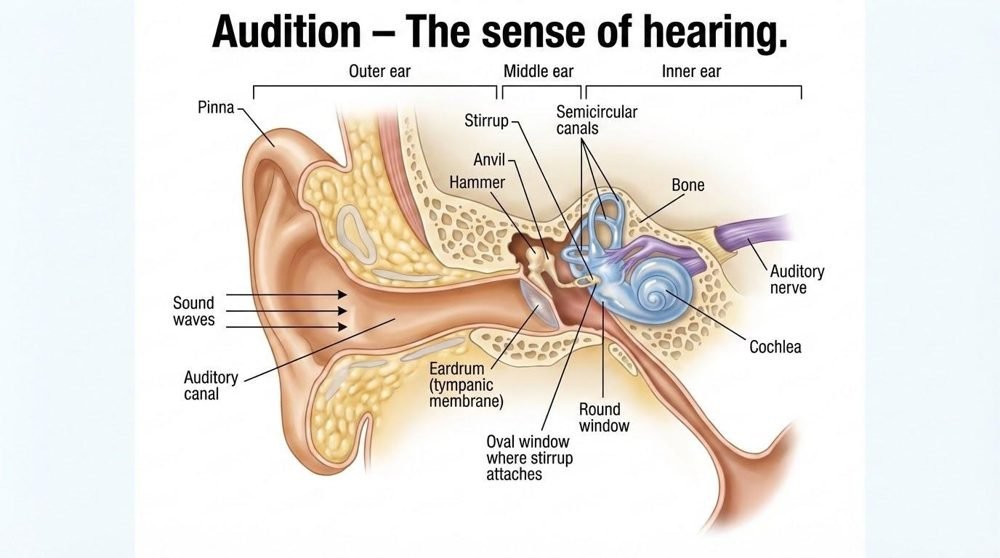
Sound travels through three main regions on its way to becoming a neural signal. The outer ear funnels sound waves to the eardrum. The middle ear contains three tiny bones — the ossicles — that mechanically amplify the vibration and pass it along. The inner ear houses the cochlea, a fluid-filled, coiled structure containing the basilar membrane and its hair cells, which is where transduction for hearing actually happens: fluid movement bends the hair cells, and that bending gets converted into neural signals.
Here's the same trip with every stop named, since that's the version the exam wants. Sound is collected by the pinna — the visible flap of ear — and funneled down the auditory canal to the tympanic membrane, the eardrum, which vibrates. That vibration is passed along the three ossicles, the smallest bones in your body: the malleus (hammer), incus (anvil), and stapes (stirrup). Together they act as a lever-and-piston system that concentrates the pressure roughly thirtyfold, which is what it takes to push sound from air into liquid. The stapes presses on the oval window, a membrane on the cochlea, setting the fluid inside in motion; that motion ripples the basilar membrane and bends its roughly 16,000 hair cells. Their signals travel up the auditory nerve, through brainstem relays and the thalamus, to the auditory cortex in the temporal lobe. One line to remember: the outer ear collects, the middle ear amplifies, the inner ear transduces. The system works over a frequency range of roughly 20 to 20,000 Hz, with peak sensitivity in the middle — the band where speech lives — and the top of that range quietly shrinks as you age.
How the brain encodes pitch specifically involves two complementary mechanisms: place coding, where different frequencies peak at different locations along the basilar membrane (better for high frequencies), and temporal coding, where neurons fire in sync with the frequency of the sound wave itself (better for low frequencies). Most everyday hearing likely uses both, handing off depending on the frequency range involved. Temporal coding runs into a physical ceiling, though: a single neuron can't fire fast enough to match high-frequency sounds spike-for-spike. The nervous system's workaround is the volley principle — groups of neurons take turns firing, so that even if no single cell can keep up, the group collectively "votes" out a firing pattern that tracks the sound wave. It's a nice example of the nervous system solving a hardware limit with a bit of clever teamwork.
Conduction hearing loss
A problem in the outer or middle ear that prevents sound vibrations from being conducted properly to the inner ear — for example, damaged eardrums or ossicles. Sound is blocked or dampened before it ever reaches the receptors.
Sensorineural hearing loss
Damage to the cochlea's hair cells or to the auditory nerve itself. This is the kind caused by prolonged exposure to loud noise, and it is permanent — hair cells in humans do not regenerate once destroyed.
◆ Why this is worth caring about, not just memorizing
Noise-induced sensorineural hearing loss is entirely preventable and completely permanent once it happens — there's no reversing damaged hair cells. Concerts, headphones at high volume, and power tools are common everyday sources of exposure well past safe levels. This is the kind of applied point that shows up on exams as a definition, but it's worth carrying with you well past the final.
The two kinds of loss also call for two kinds of fix, and the logic follows directly from where the breakdown is. Conduction loss is a delivery problem — the eardrum or ossicles aren't moving sound along — so a hearing aid, which simply amplifies incoming sound until the mechanics get going again, often works. Sensorineural loss is a transduction problem: the hair cells or the nerve are gone, so making the sound louder does nothing. The workaround there is a cochlear implant, which bypasses the dead receptors entirely — a microphone and processor convert sound into electrical pulses that an electrode array delivers straight to the auditory nerve. It's a striking piece of engineering, and it's also the subject of real debate within Deaf culture, where many people see signing as a complete language and identity rather than a deficit to be corrected.
Where did that come from? Locating sound
Knowing what a sound is matters less, evolutionarily, than knowing where it's coming from, and your two ears solve that problem the way your two eyes solve depth. A sound off to your right reaches the right ear slightly earlier — an interaural timing difference measured in fractions of a millisecond — and slightly louder, an interaural level difference, because your head casts a small acoustic shadow over the far ear. Brainstem circuits compare the two ears on both counts and triangulate a position along the left–right axis (Grothe et al., 2010). Those binaural cues fail, though, for anything straight ahead, straight behind, or directly overhead, where both ears get an identical signal; there the folds of the pinna help by filtering sound differently depending on elevation, a weaker monaural cue. That's why a bird calling from directly above is so hard to pin down, and why you tilt your head to find it — you're turning an overhead sound into a left–right one your ears can actually solve.
Pain: a protective signal your brain constructs, not a damage readout
Pain is easy to think of as a simple gauge — tissue gets damaged, a "pain signal" travels up to the brain and registers how bad the damage is. The real picture is stranger and more interesting than that, and it's worth sitting with.
Start with what pain is for. Unlike the other senses, it has no dedicated organ — free nerve endings throughout the skin and body (the receptors of nociception) fire in response to potential harm — and it comes bundled with emotion and motivation in a way that vision and hearing do not. That bundle is the point: pain alerts you to injury, drives you to get away from the cause, and makes you guard the injured part so it can heal. The cleanest evidence that pain is useful is what happens to people born without it. Congenital insensitivity to pain is a rare genetic disorder in which touch and temperature work normally but pain never registers. Affected children chew through their own tongues and lips, walk on broken bones, and press hands to hot stoves without flinching; the injuries and the infections that follow shorten their lives. A sense that feels like nothing but a nuisance turns out to be one you would not survive long without.
◆ Gate control theory
Melzack and Wall (1965) proposed gate control theory: pain signals traveling up the spinal cord pass through a kind of neurological "gate" that can be opened wider or closed down, rather than pain simply flowing through at a fixed rate proportional to tissue damage. Other incoming signals can close that gate. This is why rubbing or shaking out a stubbed toe actually helps — competing touch and pressure signals traveling up the same spinal pathways can partially close the gate, reducing how much pain signal gets through. It also explains why attention and emotion modulate pain from the top down: focusing intensely on pain (or being anxious about it) tends to open the gate wider, while distraction, a competing stimulus, or a difference in emotional state can close it. Pain is not a fixed, bottom-up-only signal — it's actively regulated by the nervous system in real time.
The most dramatic evidence that pain is constructed rather than simply transmitted comes from phantom-limb pain: patients who have had a limb amputated frequently continue to feel vivid pain — sometimes severe — in the limb that is no longer there. There is no tissue left to be damaged and no nerve endings at the site of the pain to be signaling anything. The brain is generating the experience of pain in a limb it still expects to be present. That single fact is hard to reconcile with the idea that pain is a direct, one-to-one readout of bodily damage — it's better understood as the brain's best protective guess, built from expectation, prior wiring, and whatever signal is actually available, which is not always much.
Check yourself
The one thing to carry out of this unit
Every sense you have — smell, taste, hearing, pain, and the ones from the myth box you probably forgot you had — starts with the same basic move: transduction, converting some form of physical energy into the shared neural code your brain runs on. But detection was never a simple fixed threshold, and pain, the sense that feels most like a direct readout of the physical world, turns out to be one of the most actively constructed experiences of all. What reaches your awareness, and how intensely, depends as much on your nervous system's ongoing regulation as it does on what's actually happening to your body.
References
Fechner, G. T. (1966). Elements of psychophysics (H. E. Adler, Trans.). Holt, Rinehart and Winston. (Original work published 1860)
Goldstein, E. B., & Cacchione, T. (2021). Sensation and perception (11th ed.). Cengage.
Green, D. M., & Swets, J. A. (1966). Signal detection theory and psychophysics. Wiley.
Grothe, B., Pecka, M., & McAlpine, D. (2010). Mechanisms of sound localization in mammals. Physiological Reviews, 90(3), 983–1012. https://doi.org/10.1152/physrev.00026.2009
Herz, R. S. (2016). The role of odor-evoked memory in psychological and physiological health. Brain Sciences, 6(3), 22.
Melzack, R., & Wall, P. D. (1965). Pain mechanisms: A new theory. Science, 150(3699), 971–979.