Unit 14 was about getting information in. This one is about what happens to it once it's there — and the honest answer is: it moves. Every time you pull a memory up, you don't press play on a recording, you rebuild it from fragments, plus whatever you now expect it to contain. That rebuilding is mostly invisible to you, which is exactly what makes it dangerous in a courtroom, a therapy office, or your own head.
◆ The core idea: memory is reconstructive, not a recording
Your brain doesn't file memories away intact and pull them back out unchanged. Each retrieval is an act of construction — assembling fragments of the original experience together with your existing knowledge, beliefs, and expectations about how things "should" have gone. That construction process can quietly add details, drop details, or reshape the whole event, and you won't feel it happening. Bartlett (1932) demonstrated this directly: he had British participants read an unfamiliar Native American folktale, "The War of the Ghosts," and recall it repeatedly over time. People didn't reproduce the story — they reshaped it, dropping the parts that didn't fit their own cultural expectations and adding details that made the story feel more sensible to them. He called the underlying structures schemas: organized packets of knowledge and expectation that shape what you encode and what you "remember" later, whether or not it happened.
This is the thread that runs through the whole unit. Schemas distort memory toward what's expected; strong emotion can make a memory feel unshakably vivid without making it more accurate; a single leading question can rewrite a detail after the fact; and in the most striking demonstrations, whole events that never happened can be planted as memories that feel completely real. None of this means memory is useless. It means confidence and vividness are not the same thing as accuracy, and treating them as interchangeable is where things go wrong.
Schema-consistent bias: remembering what should have been there
Schemas earn their keep by saving attention: you don't have to inspect every library to know it has shelves, tables, and a librarian. The cost shows up later. Brewer and Treyens (1981) had people wait briefly in a graduate student's office, then unexpectedly asked them to recall what was in it. Almost everyone remembered the desk and the chair. Nearly a third "remembered" books — there were none — because an office should have books. Meanwhile, items that didn't fit the office schema, like a picnic basket, were far more likely to be missed. This is schema-consistent bias: at encoding, the schema tells you what not to bother noticing; at retrieval, it fills the gaps with its default values — the generic contents an office, a library, or a robbery is supposed to have. The result is a memory that feels complete and detailed precisely where nothing was ever recorded.
Bias toward consistency
Schemas don't just distort memory for stories about ghosts. They also bend memory toward consistency — including consistency with who you are now. People reliably misremember their own past attitudes, habits, and feelings to better match their present ones. If your opinion on something has shifted, you're likely to "recall" having always felt roughly the way you feel today, even when records show otherwise. It's not dishonesty; it's the same reconstructive process Bartlett found, just aimed at your own biography instead of a folktale.
Why we forget
Distortion is one failure mode; outright forgetting is another, and it turns out to be more orderly than it feels. Hermann Ebbinghaus, painstakingly testing his own memory for nonsense syllables in the 1880s, mapped what's now called the forgetting curve: most forgetting happens rapidly at first — much of it within the first hours and days — and then levels off, with whatever survives that steep initial drop proving relatively stable afterward (Ebbinghaus, 1885/1913). This is also, incidentally, why the spaced practice from the previous unit works so well: reviewing material just as a memory begins to fade resets the curve and flattens it a little more each time.
Why does the forgetting happen at all? Several mechanisms contribute. Decay is the simple fading of an unused memory trace over time. Interference is competition between memories: in proactive interference, older learning disrupts newer (last year's locker combination intruding on this year's), while in retroactive interference, newer learning disrupts older (the new combination overwriting your memory of the old one). Frequently, though, the memory isn't gone at all — it's a retrieval failure, where the information is still stored but you lack the right cue to reach it. The tip-of-the-tongue phenomenon — sensing a word's first letter or its number of syllables while the word itself stays maddeningly just out of reach — is the everyday proof that "I can't remember it" and "it isn't in there" are two very different situations. This ties directly back to the encoding-specificity principle: forgetting is often less about losing the memory than about losing the path back to it.
Emotion, the amygdala, and flashbulb memories
Strong emotional arousal recruits the amygdala, and that involvement can enhance memory for the general gist of an emotional event (Cahill & McGaugh, 1995). This is part of why memories tied to a strong emotional jolt — a scare, a loss, a shock — tend to feel unusually sharp and durable compared to your memory of an ordinary Tuesday.
That enhancement effect is the setup for one of the most-cited phenomena in the chapter: flashbulb memories. These are vivid, high-confidence memories of the moment you learned about some shocking, emotionally significant piece of news — where you were, who told you, what you were doing. They feel almost photographic, like your brain hit "record" the instant the news landed.
The term comes from Brown and Kulik (1977), who studied people's memories of hearing about the Kennedy assassination and proposed a special mechanism: a shocking, consequential event issues a "Now print!" command that captures the whole scene at once, like a flashbulb going off. The intuition is powerful. It's also testable, and here's a data point that should give you pause. On more than one occasion, President George W. Bush described having watched the first plane hit the World Trade Center on television before walking into that Florida classroom on 9/11. No live footage of the first crash existed; the only video of it surfaced later (Greenberg, 2004). A vivid, confident, sincerely held memory of the most flashbulb-worthy morning of his presidency — and it could not have happened that way.
The myth
Because flashbulb memories feel so vivid and you're so confident in them, they must be unusually accurate — essentially a snapshot your brain preserved perfectly.
What's actually true
Talarico and Rubin (2003) tracked people's memories for learning about a shocking public event and compared them to everyday memories over time. Accuracy for flashbulb memories decayed at basically the same rate as ordinary memories — but confidence in the flashbulb memories stayed high the entire time. The vividness and the confidence are real. The accuracy guarantee is not.
◆ Update: vividness and confidence are not evidence of accuracy
This is the single most important takeaway from the flashbulb memory research, and it generalizes past flashbulb memories specifically: how vivid a memory feels, and how confident you are in it, tell you almost nothing about whether it's correct. That disconnect between subjective certainty and objective accuracy is the thread connecting flashbulb memories to the misinformation effect, false memories, and eyewitness testimony below — all of it.
Bodhi says
Notice what didn't happen in the flashbulb studies: memory didn't collapse into randomness. People still remembered the gist. What eroded was the fine detail, while confidence just... didn't erode with it. That gap between "I remember this clearly" and "this is correct" is the whole unit in one sentence.
The misinformation effect: a question can rewrite what you saw
If memory can be distorted by your own expectations from the inside, it can also be distorted from the outside — by information you're exposed to after the fact. Loftus and Palmer (1974) showed people film clips of car collisions, then asked how fast the cars were going when they "___" each other, swapping in different verbs: "contacted," "hit," "bumped," "collided," or "smashed." The verb alone shifted the speed estimates — "smashed" produced faster estimates than "hit," even though everyone watched the identical footage. More strikingly, a week later, people asked with the word "smashed" were also more likely to falsely "remember" seeing broken glass in the film — there wasn't any.
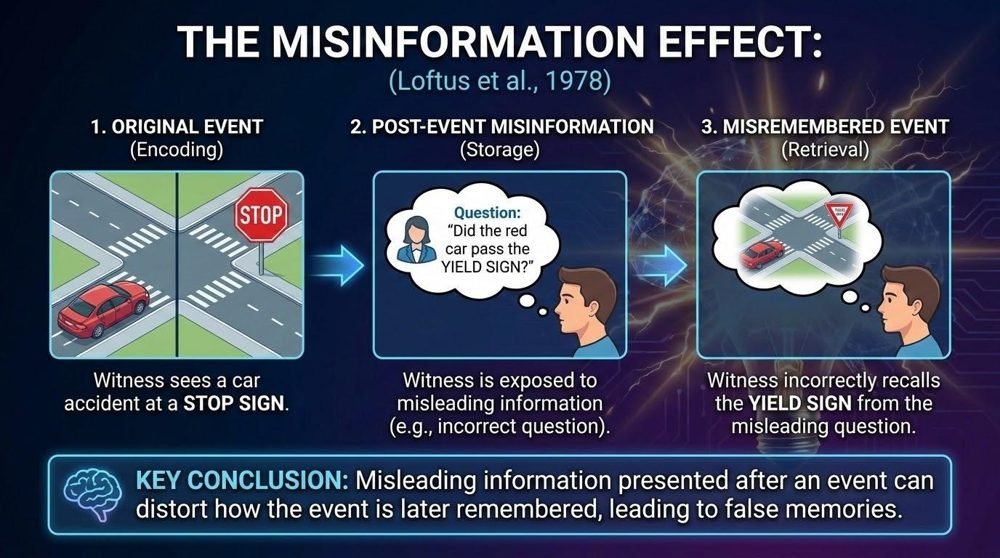
This is the misinformation effect: post-event information, even something as small as one word in a question, can be woven into the original memory and change it going forward. The person doesn't experience this as being misled. They experience it as remembering.
The cleanest demonstration came a few years later. Loftus, Miller, and Burns (1978) showed people a slide sequence of a red car pausing at an intersection with a stop sign, then hitting a pedestrian. Afterward, some participants got a question that casually mentioned "the yield sign." At test, everyone chose between the original stop-sign slide and an otherwise identical yield-sign slide. Those who'd received the misleading question were markedly more likely to pick the yield sign — to "recognize" a slide they had never seen. Hundreds of studies since have planted everything from a perpetrator's hair color to an entire barn. And the misinformation doesn't have to come from an interrogator. Co-witnesses who compare notes after an event reliably absorb each other's errors, confidently reporting details they could only have heard about from someone else (Gabbert et al., 2003). Talking it over feels like verifying. It's contaminating.
False memories can be built from nothing
If a single word can distort a detail, can a whole event be implanted that never happened at all? Loftus and Pickrell (1995) tested this directly with the "lost in the mall" paradigm: researchers, working with family members, suggested a false childhood memory (getting lost in a shopping mall as a young child) alongside a few true ones. A meaningful proportion of participants came to "remember" the fabricated event — sometimes elaborating on it with their own invented details — and had no way to distinguish it from their genuine memories. Later work in this same tradition pushed the demonstration further, implanting even impossible memories, such as "remembering" meeting Bugs Bunny at Disneyland — impossible because Bugs Bunny is a Warner Bros. character and would never appear at a Disney park. People still reported the memory, complete with sensory detail.
◆ What this does and doesn't show
False-memory research shows that entirely fabricated events can come to feel like genuine memories, under the right suggestive conditions. It does not show that all memories are unreliable, or that people are constantly inventing their pasts. Most everyday memory is reasonably accurate for the gist of what happened. The finding is narrower and more useful than that: memory is vulnerable to suggestion, in predictable, well-studied ways, and that vulnerability matters most in exactly the settings — courtrooms, therapy, repeated interviews — where the stakes are highest.
Source confusion: the right memory, the wrong address
A quieter distortion runs underneath all of these. Every memory carries a tag for where it came from — you saw it, someone told you, you dreamed it, you read it — and that tag is fragile. Source confusion (also called source amnesia, or what Schacter, 2001, calls misattribution) is remembering the content correctly while getting its source wrong. The misinformation effect is one version: the yield sign came from the question, not the slides, but the tag got lost. The most unnerving case is Donald Thomson's. An Australian memory researcher, Thomson was picked out of a lineup by a rape victim and charged — for an assault that occurred while he was appearing live on television, discussing eyewitness fallibility. The victim had been watching that broadcast when she was attacked. His face was in her memory of the event, accurately, but attached to the wrong role. She wasn't lying. Her memory had simply misfiled the source.
Eyewitness testimony and wrongful convictions
Nowhere does that vulnerability matter more than in the courtroom. A confident eyewitness pointing at a defendant is, to a jury, close to the gold standard of evidence — it feels like watching someone play back a recording. But eyewitness identification is also a leading contributor to wrongful convictions: DNA-based exonerations, tracked by organizations like the Innocence Project, have repeatedly overturned convictions built on eyewitnesses who were completely confident and completely wrong.
This research didn't stay academic — it changed procedure. Wells and Olson (2003) reviewed the eyewitness literature and the reforms it motivated: double-blind lineups, where the administrator doesn't know who the suspect is and so can't nudge the witness, even unconsciously; and collecting a witness's confidence statement at the moment of the first identification, before any feedback ("Good, that's who we thought it was") can inflate that confidence artificially. Confidence recorded immediately, before contamination, is far more diagnostic than confidence recorded later.
The Ronald Cotton case shows why each step matters. In 1984, Jennifer Thompson, a college student in North Carolina, was raped at knifepoint and deliberately studied her attacker's face so she could identify him. Shown six photos, she deliberated for several minutes and said, "I think this is the guy" — then asked the detective whether she'd done well, and was told she had. By the live lineup her tentative pick had become certainty, and by trial it was absolute. Cotton served more than ten years before DNA evidence proved another man had committed the crime. Nothing about her memory was unusual; the procedure was — a photo array, confirming feedback, and repeated identifications, each one rehearsing her memory of the photo rather than of the attacker.
Wells's framework separates estimator variables — conditions the justice system can't control, like poor lighting, extreme stress, a brief glimpse, a long delay, or a perpetrator of a different race than the witness — from system variables, the ones it can (Wells & Olson, 2003). The system variables are where reform lives. Witnesses shown a simultaneous lineup tend to make a relative judgment: they pick whoever looks most like the perpetrator compared with the others, which all but guarantees a pick even when the real culprit isn't there. A sequential lineup, one face at a time with a yes or no on each, pushes the witness toward an absolute judgment — does this face match my memory? — and cuts false picks. Fair lineups use foils who all match the witness's description so the suspect doesn't stand out; unbiased instructions warn that the perpetrator may not be present; and double-blind administration plus an immediate confidence statement do the rest (Laney & Loftus, 2026).
◆ Why this is a real-world stakes issue, not just a lab curiosity
Everything earlier in this unit — reconstruction, schema-driven distortion, the misinformation effect, the confidence–accuracy gap — converges here. An eyewitness isn't lying when their memory is wrong. Their memory has genuinely been reconstructed, possibly by a leading question during an interview, possibly by seeing a photo of a suspect beforehand, possibly just by the passage of time and the retelling. Their conviction that they're right can be total. That combination — total confidence, imperfect accuracy — is precisely the pattern the flashbulb memory research predicts, and it has sent innocent people to prison.
The repression debate: handle with care
No honest treatment of this material can skip the most contentious chapter in memory science: the so-called "memory wars" over repressed memory — the idea that the mind can bury traumatic memories entirely, outside conscious awareness, only to have them resurface later, sometimes with therapeutic help.
◆ Where the science actually stands
Two things are true at once here, and the responsible position holds both. First, trauma is real, and so is ordinary forgetting — people absolutely can fail to think about or mention a genuinely traumatic event for years without any exotic mechanism being involved. Second, the research reviewed in this unit — on suggestibility, the misinformation effect, and the ease of implanting entire false memories — has made the broader scientific community skeptical of claims involving massive, wholesale repression of trauma and its later "recovery," and specifically wary of therapeutic techniques (repeated suggestive questioning, guided imagery, hypnosis aimed at "recovering" memories) that are known, from the same research base, to be capable of creating convincing false memories. Being skeptical of a recovery technique is not the same as being dismissive of a survivor. The fair-minded position is that some recovered memories may be accurate, some recovery techniques carry real risk of manufacturing false ones, and the honest, difficult part is that from the inside, a person often cannot tell which is which — which is exactly why this remains a live, carefully argued debate rather than a closed question.
The rare opposite extreme: HSAM
Before closing, it's worth naming the other tail of the distribution. A small number of people have highly superior autobiographical memory (HSAM) — an unusual capacity to recall an enormous number of specific personal dates and daily details with high accuracy. HSAM doesn't mean immunity from distortion altogether, but it's a useful reminder that the reconstructive, gap-filling memory described throughout this unit is the typical human pattern, not a universal law with no exceptions.
Check yourself
The one thing to carry out of this unit
Every memory you have was rebuilt the last time you thought about it, using both what actually happened and what you expected, were told, or now believe should have happened — and the confidence you feel in a memory tells you nothing reliable about whether that rebuild was accurate. That's not a reason to distrust your memory constantly. It's a reason to treat "I clearly remember it" as the start of a question, not the end of one — especially when the stakes are high enough that being wrong has consequences for someone else.
References
Bartlett, F. C. (1932). Remembering: A study in experimental and social psychology. Cambridge University Press.
Brewer, W. F., & Treyens, J. C. (1981). Role of schemata in memory for places. Cognitive Psychology, 13(2), 207–230. https://doi.org/10.1016/0010-0285(81)90008-6
Brown, R., & Kulik, J. (1977). Flashbulb memories. Cognition, 5(1), 73–99. https://doi.org/10.1016/0010-0277(77)90018-X
Cahill, L., & McGaugh, J. L. (1995). A novel demonstration of enhanced memory associated with emotional arousal. Consciousness and Cognition, 4(4), 410–421.
Ebbinghaus, H. (1913). Memory: A contribution to experimental psychology (H. A. Ruger & C. E. Bussenius, Trans.). Teachers College, Columbia University. (Original work published 1885)
Gabbert, F., Memon, A., & Allan, K. (2003). Memory conformity: Can eyewitnesses influence each other's memories for an event? Applied Cognitive Psychology, 17(5), 533–543. https://doi.org/10.1002/acp.885
Greenberg, D. L. (2004). President Bush's false "flashbulb" memory of 9/11/01. Applied Cognitive Psychology, 18(3), 363–370. https://doi.org/10.1002/acp.1016
Laney, C., & Loftus, E. F. (2026). Eyewitness testimony and memory biases. In R. Biswas-Diener & E. Diener (Eds.), Noba textbook series: Psychology. DEF Publishers. http://noba.to/uy49tm37
Loftus, E. F., Miller, D. G., & Burns, H. J. (1978). Semantic integration of verbal information into a visual memory. Journal of Experimental Psychology: Human Learning and Memory, 4(1), 19–31. https://doi.org/10.1037/0278-7393.4.1.19
Loftus, E. F., & Palmer, J. C. (1974). Reconstruction of automobile destruction: An example of the interaction between language and memory. Journal of Verbal Learning and Verbal Behavior, 13(5), 585–589.
Loftus, E. F., & Pickrell, J. E. (1995). The formation of false memories. Psychiatric Annals, 25(12), 720–725.
Schacter, D. L. (2001). The seven sins of memory: How the mind forgets and remembers. Houghton Mifflin.
Talarico, J. M., & Rubin, D. C. (2003). Confidence, not consistency, characterizes flashbulb memories. Psychological Science, 14(5), 455–461.
Wells, G. L., & Olson, E. A. (2003). Eyewitness testimony. Annual Review of Psychology, 54, 277–295.