Most units are about understanding the mind. This one is also a set of instructions for using yours. Underneath the terms — encoding, consolidation, the spacing effect — is a short list of study habits that decades of research say work, and a longer list that feel productive but don't. Let's separate them, because almost everyone studies the wrong way.
The modal model, in one pass
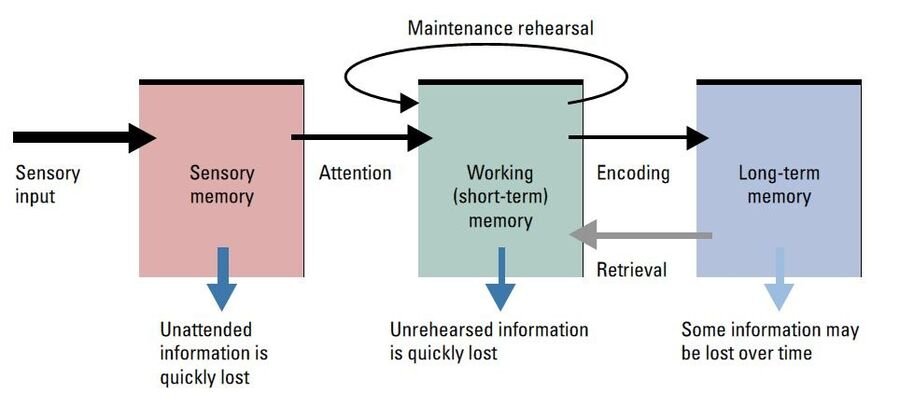
The framework behind the whole unit is the modal model (sometimes "the current working-memory theory"): information flows through stages, and it can drop out at any one of them.
Stage 1 · Sensory memory
A brief, high-capacity snapshot — iconic (visual, ~¼ second) and echoic (auditory, a few seconds). Almost all of it vanishes. The gatekeeper to the next stage is attention: what you don't attend to, you never had.
Stage 2 · Short-term / working memory
Small and brief: about 7 ± 2 chunks for 20–30 seconds unless you rehearse. Think of it as your mind's RAM. Chunking — grouping items into meaningful units — is how you smuggle more through a narrow door.
Stage 3 · Long-term memory
Effectively unlimited and durable — but you only get here through depth of processing, not repetition. This is where "memory is the residue of thought" lives: you remember what you thought about, and the more meaningfully, the better.
The two kinds of long-term memory
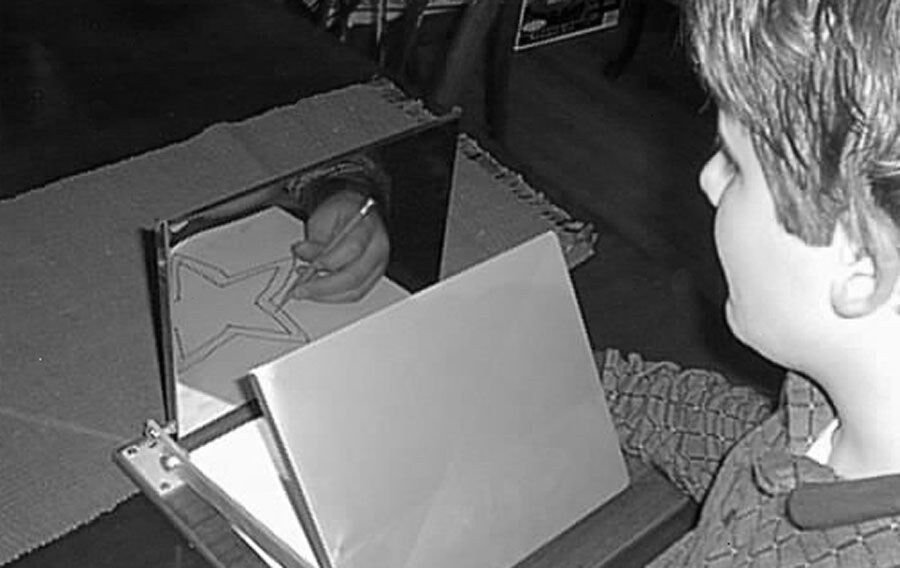
Declarative / explicit = things you can state: episodic (your 10th birthday) and semantic (Paris is the capital of France). Nondeclarative / implicit = things you show but can't narrate: riding a bike, mirror tracing. Keep this split — H.M. is about to make it matter.
Bodhi says
Re-reading and highlighting live at the shallow, structural end of processing — they feel like studying but leave almost no residue. Every technique below works by forcing deep, meaningful processing. That's the whole trick: not more time, more thought.
One more note on the implicit side, because it's broader than "skills." Nondeclarative memory also includes priming — exposure to one stimulus quietly changes how you respond to a later one. Read a paragraph about a picnic and then unscramble AETPL, and you'll almost certainly get plate; read about a garden first and the same letters become petal. Nothing was consciously recalled, yet memory did the steering. Classical conditioning and simple habituation belong in the same family. Because none of this can be reported, researchers measure implicit memory indirectly: word-stem completion (fill in "mo___" after seeing motel earlier), fragment identification, and motor tasks like mirror tracing. The signature in every case is the same: performance improves with no accompanying sense of "I've seen this before." Hold onto that phrase — it's exactly what H.M. will show.
From short-term store to working memory
The modal model's "short-term store" was originally imagined as a simple holding tank, but that picture proved too passive. Baddeley and Hitch (1974) reconceived it as working memory: not a single box where information sits, but an active workspace made of several specialized components. A central executive serves as the attentional controller, directing focus and coordinating everything else. It commands two short-term "slave" systems — the phonological loop, which holds and silently rehearses verbal and acoustic information (the little voice in your head repeating a phone number), and the visuospatial sketchpad, which holds visual and spatial information (picturing the layout of your room). Baddeley (2000) later added a fourth component, the episodic buffer, which binds information from the different systems — and from long-term memory — into unified, coherent episodes. The upshot for studying is that working memory isn't just storage; it's where thinking actually happens, which is exactly why genuinely working with material — reorganizing it, connecting it, quizzing yourself on it — does so much more than passively holding it in mind.
This also sharpens what "rehearsal" really means. Simply repeating something over and over to keep it active — maintenance rehearsal — holds information in working memory but does surprisingly little to move it into durable long-term storage. What builds lasting memories is elaborative rehearsal: connecting new material to what you already know, asking what it means, generating your own examples. This is the levels-of-processing idea in action (Craik & Lockhart, 1972) — the deeper and more meaningfully you process something, the better it sticks, more or less regardless of how many times you repeat it. That principle is the engine behind everything in the next section.
The classic demonstration is Craik and Tulving (1975). They showed people words and asked one of three kinds of question: about the word's appearance ("Is it in capital letters?" — shallow, structural), about its sound ("Does it rhyme with train?" — intermediate, acoustic), or about its meaning ("Would it fit in the sentence 'She met a ___ on the street'?" — deep, semantic). Nobody was told a memory test was coming. Words processed for meaning were remembered far better than words processed for sound, which beat words processed for looks — the three levels laid out in one experiment. One step deeper still is the self-reference effect: asking whether a word describes you produces better memory than asking what it means (Rogers et al., 1977). Which is a strong argument for rewriting definitions in your own words and attaching them to your own life.
The study methods that actually work
Three findings from your notes are, quietly, the most useful sentences in the course. Here's each one translated into what to do.
The generation effect
You remember information you generate from memory far better than information you re-read. Do this: close the notes and try to recall/explain a concept before checking. Use flashcards as a test, not a reading. Struggling to retrieve is the learning.
The spacing effect
Distributed practice beats massed practice (cramming) for long-term retention — same total time, better results. Do this: four 30-minute sessions across four days > one two-hour night-before. Space it, and let yourself slightly forget between sessions.
◆ The testing effect (the big one)
Combine the two above and you get the single most robust finding in the science of studying: testing yourself is a more powerful way to learn than restudying. The act of retrieval doesn't just measure memory — it strengthens it. The self-checks on this site aren't decoration; they're the method. Practice questions > re-reading, every time.
Why sleep is part of studying
Encoding isn't the end — a memory has to consolidate to become stable, and much of that happens while you sleep, especially within the first 24 hours after learning. Practically: an all-nighter doesn't just make you tired for the exam, it skips the step that files what you studied. Study, then sleep on it. (You'll see the full mechanism in the Sleep unit.)
Encoding specificity: study like you'll be tested
The encoding specificity principle says retrieval works best when the cues at test match the cues at encoding. Two flavors:
- Context-dependent memory — Godden & Baddeley (1975) had divers learn word lists on land or underwater; recall was best when the environment matched. Practically: some matching of study and test conditions helps, so practicing under test-like conditions (quiet, timed, no notes) pays off.
- State-dependent memory — your internal state is a cue too. Eich et al. (1975): people who studied while high recalled best while high again. But note the real headline your notes flag: the best performance of all came from staying sober for both. Matching your state helps a little; being impaired hurts a lot.
Mnemonics: engineering the cues on purpose
If retrieval lives or dies on cues, why not build the cues yourself? That's what a mnemonic is — a deliberate device that organizes information for encoding and hands you a retrieval hook later (Bellezza, 1981). Most of them exploit the principles above: they force meaningful processing, add vivid imagery, and chunk. The common ones: visual imagery (picture a hippopotamus with a flawless memory — hippocampus); acronyms (HOMES for the Great Lakes, FACE for the treble-clef spaces); acrostics (Please Excuse My Dear Aunt Sally for the order of operations); rhyme and alliteration ("i before e, except after c"); humor and odd associations (the sillier the link, the stickier it is); chunking (520-555-0467, not 5205550467); and the oldest trick of all, the method of loci.
The method of loci — the "memory palace" — works like this: pick a route you know cold (your walk from the front door to your bedroom), then place each item you need to remember at a landmark along it as a vivid, exaggerated image. To recall the list, walk the route in your head and look at what you left there. It works because it converts an arbitrary list into something memory is very good at — spatial layout plus striking images — and the route supplies the retrieval cues in order, which is why it shines for long lists and speeches. Joshua Foer used exactly this method to go from science writer to U.S. Memory Champion in a year; his TED talk on it is linked in the study guide.
The serial position curve
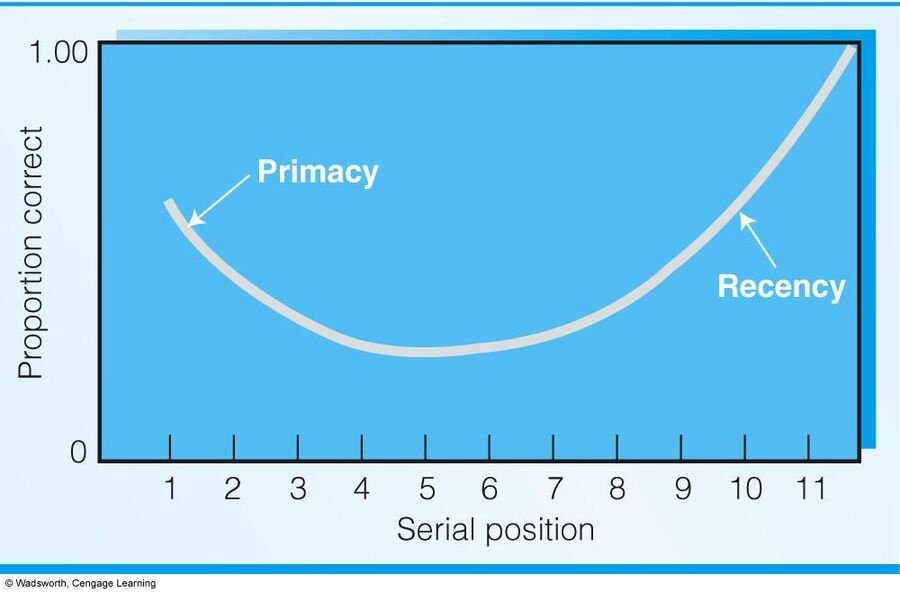
Give people a list and they remember the start (primacy — rehearsed into long-term memory) and the end (recency — still sitting in short-term memory), and drop the middle. It's a clean, visible fingerprint of the modal model in action.
Why we forget: a first pass
Memory has three jobs — encoding (getting information in), storage (keeping it), and retrieval (getting it back out) — and forgetting can happen at any of them. The first failure is the sneakiest: encoding failure, where the memory was never made. You have handled thousands of pennies, yet most people can't pick the real one out of a set of near-copies (Nickerson & Adams, 1979) — you never attended to the details, so there was nothing to lose. (This is what "you never had it" meant back at Stage 1.) The second is decay: unrehearsed traces fade with time, on the steep-then-flat curve Ebbinghaus (1885/1913) mapped by testing himself on nonsense syllables. The third is interference — other memories crowd out the one you want. In proactive interference, old blocks new: you call your new partner by your ex's name. In retroactive interference, new blocks old: once you've learned this year's locker combination, last year's is gone.
But most everyday forgetting is none of those. It's retrieval-cue failure: the memory is still in there; you just lack the path back to it. The evidence is that the "forgotten" thing comes back the instant the right cue appears. People decades out of high school do poorly at recalling classmates' names but excellently at recognizing them and matching names to faces (Bahrick et al., 1975) — the name is the cue that unlocks the face. That's why recognition (multiple choice) is easier than recall (an essay question), and why encoding specificity mattered so much above: forgetting is usually a lost cue, not an erased memory. The next unit picks this up, along with the ways memories don't just fade but change.
H.M. — the case that split memory in two
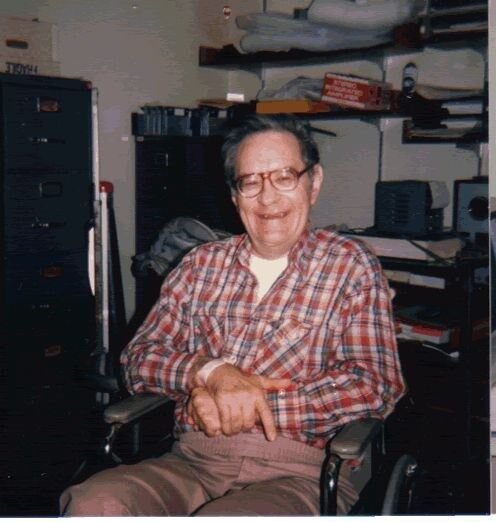
In 1953, surgery for severe epilepsy removed much of Henry Molaison's hippocampus on both sides. The result was profound anterograde amnesia — he could no longer form new conscious (declarative) memories. He'd re-read the same magazine as new; he never learned the names of the researchers who worked with him for decades.
Some vocabulary before the twist. Amnesia is memory loss well beyond ordinary forgetting, usually from damage to the medial temporal lobes — surgery, head injury, stroke, or the thiamine deficiency of chronic alcoholism (Korsakoff's syndrome). It comes in two directions. Anterograde amnesia is the inability to form new memories after the damage; retrograde amnesia is the loss of memories from before it. Contrary to the movies, retrograde amnesia on its own is rare; the usual picture is anterograde loss plus a temporally graded retrograde loss — the years just before the injury are gone, but childhood is intact (Dudukovic & Kuhl, 2026). That was H.M. exactly: he could not remember the few years before his surgery, yet his childhood memories, his intelligence, his personality, and his short-term memory were all preserved. He could hold a conversation; he just couldn't keep it once his attention moved on. The temporal gradient is itself a clue about consolidation: a memory depends on the hippocampus until it has been transferred to more durable cortical storage, and only the memories that had finished the transfer survived his surgery.
◆ Why H.M. is one of the most important patients in psychology
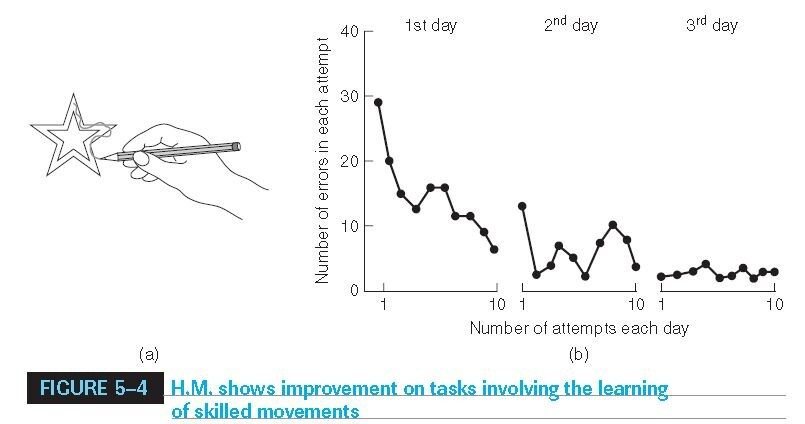
Here's the twist that made him priceless: taught the mirror-tracing task (drawing while looking only at a mirror image of your hand), H.M. got better day by day — improving at the same rate as people without amnesia — while swearing each morning he'd never done it before. His skill (implicit/procedural) memory was intact; his conscious (explicit/declarative) memory was gone. That dissociation proved memory is not one thing but several separate systems, and it pinned declarative memory formation to the hippocampus. One patient, a whole architecture revealed.
Check yourself
The one thing to carry out of this unit
Memory rewards effortful, spaced, meaningful retrieval and punishes passive re-exposure. So the studying that feels hardest — closing the book and struggling to recall — is the studying that works, and the studying that feels smooth and productive usually isn't. Test yourself, space it out, sleep on it. That's not a life hack; it's the unit.
References
Atkinson, R. C., & Shiffrin, R. M. (1968). Human memory: A proposed system and its control processes. In K. W. Spence & J. T. Spence (Eds.), The psychology of learning and motivation (Vol. 2, pp. 89–195). Academic Press.
Baddeley, A. D. (2000). The episodic buffer: A new component of working memory? Trends in Cognitive Sciences, 4(11), 417–423. https://doi.org/10.1016/S1364-6613(00)01538-2
Baddeley, A. D., & Hitch, G. (1974). Working memory. In G. H. Bower (Ed.), The psychology of learning and motivation (Vol. 8, pp. 47–89). Academic Press.
Bahrick, H. P., Bahrick, P. O., & Wittlinger, R. P. (1975). Fifty years of memory for names and faces: A cross-sectional approach. Journal of Experimental Psychology: General, 104(1), 54–75. https://doi.org/10.1037/0096-3445.104.1.54
Bellezza, F. S. (1981). Mnemonic devices: Classification, characteristics, and criteria. Review of Educational Research, 51(2), 247–275. https://doi.org/10.3102/00346543051002247
Cepeda, N. J., Pashler, H., Vul, E., Wixted, J. T., & Rohrer, D. (2006). Distributed practice in verbal recall tasks: A review and quantitative synthesis. Psychological Bulletin, 132(3), 354–380.
Corkin, S. (2002). What's new with the amnesic patient H.M.? Nature Reviews Neuroscience, 3(2), 153–160.
Craik, F. I. M., & Lockhart, R. S. (1972). Levels of processing: A framework for memory research. Journal of Verbal Learning and Verbal Behavior, 11(6), 671–684.
Craik, F. I. M., & Tulving, E. (1975). Depth of processing and the retention of words in episodic memory. Journal of Experimental Psychology: General, 104(3), 268–294. https://doi.org/10.1037/0096-3445.104.3.268
Diekelmann, S., & Born, J. (2010). The memory function of sleep. Nature Reviews Neuroscience, 11(2), 114–126.
Dudukovic, N., & Kuhl, B. (2026). Forgetting and amnesia. In R. Biswas-Diener & E. Diener (Eds.), Noba textbook series: Psychology. DEF Publishers. http://noba.to/m38qbftg
Ebbinghaus, H. (1913). Memory: A contribution to experimental psychology (H. A. Ruger & C. E. Bussenius, Trans.). Teachers College, Columbia University. (Original work published 1885)
Eich, J. E., Weingartner, H., Stillman, R. C., & Gillin, J. C. (1975). State-dependent accessibility of retrieval cues in the retention of a categorized list. Journal of Verbal Learning and Verbal Behavior, 14(4), 408–417.
Godden, D. R., & Baddeley, A. D. (1975). Context-dependent memory in two natural environments: On land and underwater. British Journal of Psychology, 66(3), 325–331.
Miller, G. A. (1956). The magical number seven, plus or minus two: Some limits on our capacity for processing information. Psychological Review, 63(2), 81–97.
Nickerson, R. S., & Adams, M. J. (1979). Long-term memory for a common object. Cognitive Psychology, 11(3), 287–307. https://doi.org/10.1016/0010-0285(79)90013-6
Roediger, H. L., III, & Karpicke, J. D. (2006). Test-enhanced learning: Taking memory tests improves long-term retention. Psychological Science, 17(3), 249–255.
Rogers, T. B., Kuiper, N. A., & Kirker, W. S. (1977). Self-reference and the encoding of personal information. Journal of Personality and Social Psychology, 35(9), 677–688. https://doi.org/10.1037/0022-3514.35.9.677
Scoville, W. B., & Milner, B. (1957). Loss of recent memory after bilateral hippocampal lesions. Journal of Neurology, Neurosurgery, and Psychiatry, 20(1), 11–21.
Slamecka, N. J., & Graf, P. (1978). The generation effect: Delineation of a phenomenon. Journal of Experimental Psychology: Human Learning and Memory, 4(6), 592–604.
Tulving, E., & Thomson, D. M. (1973). Encoding specificity and retrieval processes in episodic memory. Psychological Review, 80(5), 352–373.