The Stroop demo below lets you feel your own mind betray you. This page goes one level deeper on the theory — why the brain builds shortcuts in the first place — and then does something most textbooks avoid: it tells you honestly which of these dazzling priming studies survived the last decade of replication tests, and which quietly fell apart. Both stories matter. The autopilot is real; some of its most famous demonstrations were not.
Bodhi says
Hold two ideas at once and you'll ace this topic. One: most of your social thinking really does happen automatically, below awareness — that's not pop psychology, that's the Stroop effect you just felt in your own hands. Two: "automatic" doesn't mean "any clever prime can secretly puppeteer your behavior." Some priming results are rock-solid; others became the poster children of the replication crisis. Knowing the difference is the whole skill.
What social cognition is, and why perception beats reality
Social cognition is how we think about ourselves and the social world — how we select, interpret, remember, and use social information to make judgments and decisions. The first principle sounds almost mystical and is entirely practical: what matters for behavior is rarely the objective situation but our perception of it. Two people get the same curt text message; one reads it as busy, the other as angry, and they act on their readings, not the text. This is the construal idea from the history unit wearing its working clothes. It also explains why so much of this topic is about the machinery that builds those perceptions, mostly without asking us.
Why the brain runs on autopilot at all
Start with the deep reason, because most treatments list the what and skip the why. Your brain is metabolically expensive and the social world throws far more information at it than conscious attention could ever chew through. So evolution and learning solved the problem the same way any good engineer would: automate whatever can be automated, and reserve the slow, expensive, deliberate machinery for the cases that genuinely need it. Automatic thinking is nonconscious, unintentional, involuntary, effortless — and, crucially, often emotional. It's the mind's cruise control, built for cognitive efficiency. Controlled thinking is conscious, intentional, voluntary, deliberate, and effortful — the mind's hands back on the wheel.
This is what psychologists call a dual-process view of the mind: two systems, one fast and cheap and automatic, one slow and expensive and controlled, trading off constantly (Kahneman, 2011). Most of the time the fast system is a gift — you couldn't function if you had to consciously plan every step to class. But the same shortcuts that get you there also produce stereotypes, memory errors, and snap judgments you never chose. That trade-off is the through-line of this whole unit.
Automatic processing
Fast, cheap, unconscious. Nonconscious, unintentional, involuntary, effortless, and often emotional. Reading the word in the Stroop task. Sizing up a stranger in a fraction of a second. Runs whether you asked it to or not.
Controlled processing
Slow, expensive, conscious. Intentional, voluntary, deliberate, effortful. Naming the ink color despite the word. Overriding a first impression. Limited — you only have so much of it, so you can't run everything this way.
The Stroop effect: automaticity you can feel
Ninety years ago J. R. Stroop published "Studies of Interference in Serial Verbal Reactions" (Stroop, 1935). It went on to become the most-cited paper in the history of the Journal of Experimental Psychology, spawning thousands of follow-up studies (MacLeod, 1992) — an astonishing afterlife for such an elegant little study. The setup is almost embarrassingly simple: name the ink color of a word while the word itself spells a different color. Reading is so overlearned it's automatic, so it barges in and fights the controlled task of color-naming. You know the instruction and your brain reads the word anyway. That interference — measured in milliseconds — is automaticity made visible.
It's worth feeling for yourself now that you have the theory. Do the congruent block first, then the hard incongruent one, and watch your own reaction times climb.
That slowdown isn't you being bad at the task. It's the cost of a controlled process having to override an automatic one — the two systems from the comparison box above, caught in the act. Unlike a lot of what's coming on this page, the Stroop effect is about as replicable as findings get: it works across languages, decades, and thousands of labs. When we later hit the fragile studies, keep Stroop as your benchmark for what a robust effect looks like.
Semantic networks: why NURSE follows DOCTOR
Here's a clue about how knowledge is stored. In a lexical decision task — decide fast whether a letter string is a real word — people recognize NURSE faster if they just saw DOCTOR than if they just saw BREAD (Meyer & Schvaneveldt, 1971). The leading explanation is that concepts live in semantic networks: webs of meaningful relatedness where related ideas sit close together and activating one sends a ripple of activation to its neighbors. DOCTOR is wired near NURSE; BREAD is off in a different neighborhood. The response latency — how much faster the second word is retrieved — is treated as a proxy for how tightly the two concepts are linked in your mind.
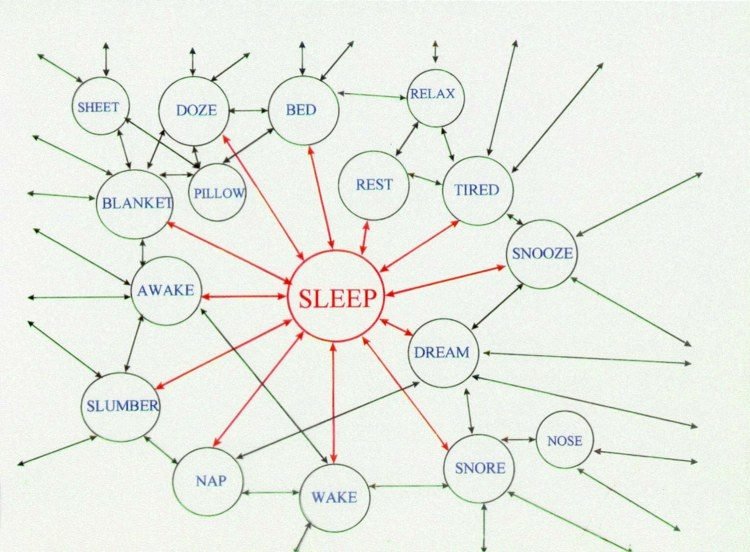
Scale that idea up from single words to whole packages of knowledge and you get a schema: a mental structure that organizes what you know about a theme — a person, a role, an event — and steers what you notice, think about, and remember. Sir Frederic Bartlett (1932) brought the term into psychology, borrowing it from the neurologist Henry Head. Two features matter most: a schema is general (it describes a type of event, not one specific memory) and it carries related facts bundled together. When schemas get applied to whole groups of people, they become stereotypes — same cognitive machinery, higher stakes.
Schemas come in flavors. Person schemas hold what you expect of an individual or a type ("librarian"); self-schemas hold what you believe about you; event schemas, or scripts, hold the expected sequence of a situation — wait to be seated, order from the menu, pay at the end. Scripts are why a first visit to a new kind of place (a dim-sum cart, a sauna, a country where you don't tip) feels so effortful: there's no script to coast on. Where do schemas come from? From the ordinary engines of learning — the consequences of our own actions, associations we absorb (the brand paired with the cheerful music), and watching other people. And once built, they resist revision. New information can force accommodation, where the schema itself changes, but the far more common move is assimilation: the schema bends the information to fit, which is why a stereotype can survive a stack of counterexamples.
Schemas fill in the blanks — for better and worse
The most important thing a schema does is fill in what you didn't actually observe. That's a feature, not a bug: you can't perceive everything, so your mind quietly supplies the missing pieces from the relevant schema. Kelley's classic warm/cold study (1950) shows how powerfully this works. Students got a short bio of a guest lecturer, identical except for one word — "very warm person" versus "very cold person." Same lecturer, same twenty-minute class. Yet the "warm" group rated him meaningfully more favorably afterward. One word set the schema; the schema filled in the rest of the ambiguous experience.
The blank-filling reaches into memory, too. Carli (1999) had people read a story about Barbara and Jack; for some it ended with Jack proposing, for others with Jack assaulting her. Afterward, people "remembered" schema-consistent details that were never in the story — roses and meeting the parents in the proposal version, warning signs in the assault version. Bartlett's own "War of the Ghosts" work showed the same thing decades earlier: recall isn't playback, it's reconstruction, and the schema does much of the rebuilding. Sulin and Dooling (1974) made the mechanism unmistakable: people read a short passage about a ruthless dictator named either "Gerald Martin" or "Adolf Hitler." A week later, those who'd read the Hitler version confidently "recognized" a sentence about hating Jews that had never appeared in the passage. The name activated a schema, and the schema wrote itself into memory. You do a small version of this every time you quote a movie: "Luke, I am your father" and "Play it again, Sam" are lines nobody in those films ever says — your schema of the scene has quietly rewritten the script. Schemas shape both encoding and retrieval, which is exactly why eyewitness memory is so much shakier than it feels.
Often left out of the short version
Korsakoff patients are usually mentioned only in passing, but the point is profound. When brain damage strips away the ability to use schemas, the world doesn't become more accurate — it becomes incoherent and overwhelming, because there's no framework to organize the flood of incoming information. Schemas can mislead you, yes. But the alternative isn't crisp objectivity; it's chaos. That's the honest cost-benefit: the same shortcuts that distort your memory are what make experience navigable at all.
Accessibility and priming: which schema fires first?
If you've got thousands of schemas, which one gets used in the moment? Whichever is most accessible — at the forefront of the mind. A schema can be accessible three ways: chronically (from a lifetime of experience), because of a current goal, or temporarily, because something you just encountered stirred it up. That last route is priming: recent experience raising the accessibility of a schema, trait, or concept — sometimes explicitly, sometimes below awareness.
The foundational study here is Higgins, Rholes, and Jones (1977) — the "Donald" study — and it teaches a subtlety students love to skip. Participants first memorized words in what they thought was a separate color-perception task; some got positive trait words (adventurous, self-confident, independent, persistent), others negative ones (reckless, conceited, aloof, stubborn). Then they read a deliberately ambiguous paragraph about a man named Donald and rated him. Those primed with positive words judged Donald more favorably; those primed with negative words judged him more harshly. Priming steered the interpretation of an ambiguous person.
But here's the part that matters most, and it's easy to miss. When Higgins used primes that were evaluatively loaded but irrelevant to Donald's behavior — positive words like "neat," negative ones like "disrespectful," none of which fit what Donald actually did — the priming did nothing. The lesson, worth committing to memory: a prime only works if the schema is both accessible AND applicable. Making a concept handy isn't enough; it has to actually fit the target. That single qualifier is load-bearing and, as we're about to see, helps explain why some flashier priming claims later crumbled.
Priming also shows where stereotypes live. Devine (1989) flashed words linked to the stereotype of Black Americans (basketball, blues, and worse) too quickly to be read consciously, then had participants judge a man's ambiguous behavior. Primed participants rated him as more hostile — and, crucially, this happened for low-prejudice participants just as much as high-prejudice ones. Her conclusion split social cognition in two: the stereotype is activated automatically in nearly everyone who has grown up in the culture, while rejecting it is a controlled act that takes attention and effort. Low-prejudice people aren't people without the stereotype; they're people who keep overriding it. Automaticity is not only in the head, either. In the chameleon effect, people unconsciously mirror the posture, foot-tapping, and face-touching of whoever they're talking to, and being mirrored makes them like their partner more (Chartrand & Bargh, 1999) — a behavioral prime that has held up far better than the ones in the next section.
Bodhi says
There are really two families of priming here, and it's easy to blur them at your peril. Perceptual / interpretive priming — nudging how you read an ambiguous person (the Donald study) — is on solid ground. Behavioural priming — a subtle cue silently changing what your body does, like walking speed — is where the replication trouble lives. Same word, very different track records.
The famous behavioral primes — and the reckoning
A set of studies here is genuinely fun to encounter, so let's lay them out fairly, then see what happened next. Bargh, Chen, and Burrows (1996) had participants unscramble sentences seeded with words stereotypically linked to the elderly — Florida, grey, bingo — and reported that these participants then walked more slowly down the hall afterward, with no awareness of why. Holland, Hendriks, and Aarts (2005) reported that a faint citrus cleaning scent led people to eat more tidily, leaving fewer crumbs. Shariff and Norenzayan (2007) reported that unscrambling God-related words (spirit, divine, sacred) made people more generous in an anonymous economic game. And Bateson, Nettle, and Roberts (2006) found that simply posting a picture of eyes above an honesty box — versus flowers — nearly tripled the money people paid for their coffee.
These are captivating, and for years they were textbook staples of "the automatic mind." Then, starting around 2011, social psychology hit its replication crisis — a hard, healthy reckoning about which classic findings actually reproduce when you run them again with bigger samples and stricter methods. Behavioural social priming turned out to be one of the epicentres.
Where the science stands now
The Bargh elderly-walking effect is the most famous casualty: a large, carefully controlled replication with automated timing failed to reproduce it, and suggested the original may have been driven partly by experimenter expectations (Doyen et al., 2012). Several money- and cleanliness-priming effects have also replicated poorly, and Daniel Kahneman — no skeptic of the automatic mind — publicly urged the behavioral-priming field to clean up its methods. This does not mean priming is fake: interpretive priming (the Donald study) and the Stroop effect are robust. It means the specific claim that subtle cues reliably steer complex behaviors is fragile, and much of it hasn't survived. That's not scandal — it's science correcting itself, exactly the process the whole site tracks on the Science Corrects Itself page. Treat the eyes-honesty-box and God-prime results as "interesting but contested," not settled fact.
So how should you hold all this? Sort the studies by how well they've held up rather than by how good the story sounds. The robust core — Stroop, semantic priming, schema-driven interpretation and memory — is safe to build on. The behavioral-priming showpieces are exactly the kind of "too neat" result the replication era taught us to double-check. And notice the tell: the fragile studies often ask a barely-applicable cue to produce a big, specific behavior — which is precisely the accessible-and-applicable line the Donald study warned us about.
Self-fulfilling prophecy: expectations that come true
Now for a schema effect that has earned support, and it's a little unsettling. A self-fulfilling prophecy is when your expectation about a person changes how you treat them, which changes how they behave, until they end up confirming the very expectation you started with. The classic is Rosenthal and Jacobson's (1968) "Pygmalion" study. They tested elementary students, then told teachers that certain randomly chosen kids were about to "bloom" academically. It wasn't true — the "bloomers" were picked at random. Yet by year's end, those students showed real gains on IQ tests.
What makes this so instructive is the mechanism, not magic. Teachers who expected a child to bloom unconsciously created a warmer emotional climate for that student, gave them more challenging material, offered more and better feedback, and gave them more chances to respond and more time to answer. The expectation became a schema that reshaped the teacher's behavior, and that behavior produced the outcome. Unlike the fragile behavioral primes, expectancy effects in classrooms and workplaces have accumulated a genuine body of supporting evidence — which is why this one stays in the robust column. The honest footnote: the effects are usually small (the original study's IQ gains were driven mostly by the youngest grades, and later reviews put typical expectancy effects at modest sizes). Real, and replicated — just not the mind control of the pop version.
Embodied cognition: when the body writes metaphors into judgment
Finally, the strangest corner: embodied cognition, the idea that physical sensations quietly activate the metaphors we use for social judgment. We say warm people and cold people; we say a weighty argument; we talk about washing away our sins. Embodied-cognition research asks whether the literal sensation nudges the metaphorical judgment. In the best-known study, people holding a cup of hot coffee rated a stranger as friendlier — "warmer" — than people holding iced coffee (Williams & Bargh, 2008). In another, filling out a survey on a heavy clipboard made people judge an issue as weightier and more important (Jostmann, Lakens, & Schubert, 2009). In a third, a clean citrus scent made people more trusting and more generous (Liljenquist, Zhong, & Galinsky, 2010).
These are elegant — but by now your critical reflex should be firing. Embodied-cognition effects sit close to the fragile behavioral-priming family, and several have had a bumpy replication record too. So enjoy them as vivid illustrations of how metaphor might reach into cognition, hold the specific findings loosely, and check the Science Corrects Itself page before treating any single result as bedrock. That posture — curious about the idea, cautious about the effect size — is exactly the scientific maturity this topic is trying to build.
Check yourself
The one thing to carry out of this topic
Your mind is mostly on autopilot, and that autopilot is guided by schemas that fill in the blanks — that part is real, and the Stroop effect lets you feel it in your own hands. But "automatic" was never a license to believe every clever priming study; the last decade taught the field to sort robust effects from fragile ones, and honest students learn to do the same. Carry out both halves: respect how much of your social thinking happens without you, and stay skeptical enough to ask, of any dazzling result, did it replicate? That double move — humble about your own mind, rigorous about the evidence — is the mark of someone who actually gets social cognition.
References
Bargh, J. A., Chen, M., & Burrows, L. (1996). Automaticity of social behavior: Direct effects of trait construct and stereotype activation on action. Journal of Personality and Social Psychology, 71(2), 230–244. https://doi.org/10.1037/0022-3514.71.2.230
Bartlett, F. C. (1932). Remembering: A study in experimental and social psychology. Cambridge University Press.
Bateson, M., Nettle, D., & Roberts, G. (2006). Cues of being watched enhance cooperation in a real-world setting. Biology Letters, 2(3), 412–414. https://doi.org/10.1098/rsbl.2006.0509
Carli, L. L. (1999). Cognitive reconstruction, hindsight, and reactions to victims and perpetrators. Personality and Social Psychology Bulletin, 25(8), 966–979. https://doi.org/10.1177/01461672992511005
Chartrand, T. L., & Bargh, J. A. (1999). The chameleon effect: The perception–behavior link and social interaction. Journal of Personality and Social Psychology, 76(6), 893–910. https://doi.org/10.1037/0022-3514.76.6.893
Devine, P. G. (1989). Stereotypes and prejudice: Their automatic and controlled components. Journal of Personality and Social Psychology, 56(1), 5–18. https://doi.org/10.1037/0022-3514.56.1.5
Doyen, S., Klein, O., Pichon, C.-L., & Cleeremans, A. (2012). Behavioral priming: It's all in the mind, but whose mind? PLoS ONE, 7(1), Article e29081. https://doi.org/10.1371/journal.pone.0029081
Higgins, E. T., Rholes, W. S., & Jones, C. R. (1977). Category accessibility and impression formation. Journal of Experimental Social Psychology, 13(2), 141–154. https://doi.org/10.1016/S0022-1031(77)80007-3
Holland, R. W., Hendriks, M., & Aarts, H. (2005). Smells like clean spirit: Nonconscious effects of scent on cognition and behavior. Psychological Science, 16(9), 689–693. https://doi.org/10.1111/j.1467-9280.2005.01597.x
Jostmann, N. B., Lakens, D., & Schubert, T. W. (2009). Weight as an embodiment of importance. Psychological Science, 20(9), 1169–1174. https://doi.org/10.1111/j.1467-9280.2009.02426.x
Kahneman, D. (2011). Thinking, fast and slow. Farrar, Straus and Giroux.
Kelley, H. H. (1950). The warm–cold variable in first impressions of persons. Journal of Personality, 18(4), 431–439. https://doi.org/10.1111/j.1467-6494.1950.tb01260.x
Liljenquist, K., Zhong, C.-B., & Galinsky, A. D. (2010). The smell of virtue: Clean scents promote reciprocity and charity. Psychological Science, 21(3), 381–383. https://doi.org/10.1177/0956797610361426
MacLeod, C. M. (1992). The Stroop task: The "gold standard" of attentional measures. Journal of Experimental Psychology: General, 121(1), 12–14. https://doi.org/10.1037/0096-3445.121.1.12
Meyer, D. E., & Schvaneveldt, R. W. (1971). Facilitation in recognizing pairs of words: Evidence of a dependence between retrieval operations. Journal of Experimental Psychology, 90(2), 227–234. https://doi.org/10.1037/h0031564
Rosenthal, R., & Jacobson, L. (1968). Pygmalion in the classroom: Teacher expectation and pupils' intellectual development. Holt, Rinehart & Winston.
Shariff, A. F., & Norenzayan, A. (2007). God is watching you: Priming God concepts increases prosocial behavior in an anonymous economic game. Psychological Science, 18(9), 803–809. https://doi.org/10.1111/j.1467-9280.2007.01983.x
Stroop, J. R. (1935). Studies of interference in serial verbal reactions. Journal of Experimental Psychology, 18(6), 643–662. https://doi.org/10.1037/h0054651
Sulin, R. A., & Dooling, D. J. (1974). Intrusion of a thematic idea in retention of prose. Journal of Experimental Psychology, 103(2), 255–262. https://doi.org/10.1037/h0036846
Williams, L. E., & Bargh, J. A. (2008). Experiencing physical warmth promotes interpersonal warmth. Science, 322(5901), 606–607. https://doi.org/10.1126/science.1162548