Here's the through-line for this whole topic: the presence of other people is never neutral. It raises your arousal, it changes whether your effort can be seen, and it can loosen the grip of your own private standards. Nearly every phenomenon below — facilitation, loafing, deindividuation, groupthink, polarization — is one of those three levers being pulled. Learn the levers and you won't have to memorize the effects; you'll be able to predict them.
Bodhi says
The two most confusable terms in this whole topic are social facilitation and social loafing, and students swap them constantly. Here's the one-line rescue: facilitation is about whether arousal helps or hurts a task; loafing is about whether your individual effort can be seen. Different lever, different phenomenon. Keep them on separate shelves in your head.
Social facilitation: it started with a cyclist and a stopwatch
Norman Triplett (1898) noticed that cyclists rode faster with a pacer than alone, and — with no lab, no funding, just neighborhood kids and fishing reels — ran what's usually counted as social psychology's first experiment: kids wound the reels faster side-by-side than solo. Social facilitation, the effect that the presence of others can boost performance, was born. But the story got complicated fast. Sometimes an audience made people worse. For sixty years the field had a contradiction it couldn't resolve: the same crowd that lifts one performer sinks another.
Zajonc's resolution — the idea most summaries gloss over
Robert Zajonc (1965) supplied the elegant fix, and it is the single most important mechanism in this topic — so read this paragraph twice. His claim: the presence of others raises physiological arousal, and arousal doesn't help or hurt in general — it strengthens whatever your dominant response is. Your dominant response is simply your most likely, most practiced reaction to a task. On an easy or well-learned task, the dominant response is the correct one, so arousal pushes you toward it and you do better. On a hard or novel task, the dominant response is usually a wrong one (the obvious-but-mistaken move), so arousal pushes you toward the error and you do worse. The audience never changed; the difficulty of the task decided which way the arousal cut. Zajonc even showed it in cockroaches (Zajonc, Heingartner, & Herman, 1969): roaches ran a straight runway faster with an audience of other roaches, but ran a maze slower. No ego, no evaluation anxiety — just arousal amplifying the dominant response.
The load-bearing idea in this topic
Arousal strengthens the dominant response. That one sentence resolves the entire facilitation-vs-impairment puzzle. Easy task → dominant response is right → arousal helps. Hard task → dominant response is wrong → arousal hurts. If a case describes an audience and asks whether performance goes up or down, don't guess — ask "is this task easy/well-learned or hard/novel for this person?" and the answer falls out. This is the mechanism most people can't reproduce from memory, and it's exactly what separates a shallow grasp from a real one here.
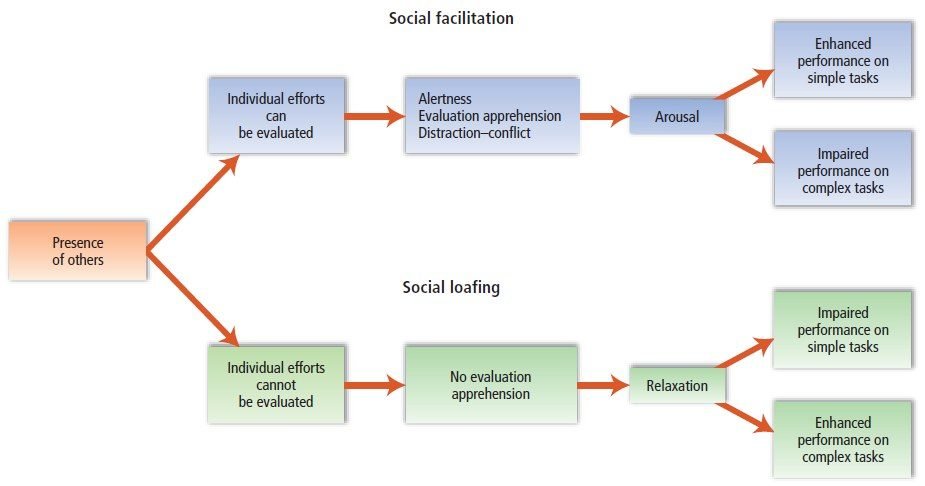
Later work added texture to why presence is arousing, and there are three main candidates: mere alertness (others are unpredictable, so we stay vigilant), evaluation apprehension (we're anxious about being judged), and distraction (others compete for our attention). You don't have to pick a winner — all three probably operate — but notice that evaluation apprehension is the one that becomes the hinge for the next phenomenon.
Social loafing: the mirror image of facilitation
Flip evaluation on its head and you get social loafing — the tendency to exert less effort on a task when you're pooled into a group and your individual contribution can't be identified. The classic demonstration is Ringelmann's rope-pulling data, collected in the 1880s and rediscovered for psychology decades later (Kravitz & Martin, 1986): the more people pulling together, the less each individual pulled — total force grew, but per-person effort dropped. Same finding for shouting, clapping, brainstorming (Latané et al., 1979): hide the individual in the pool and effort leaks out. This is why "free-riding" happens in group projects, and Karau and Williams (1993), in a meta-analysis, found loafing runs somewhat stronger in men than in women.
Here's the payoff worth spelling out: loafing and facilitation are two sides of the same evaluation coin. When your individual performance can be evaluated, you get the arousal and vigilance of facilitation. When it can't — you're anonymous in the pool — that pressure evaporates and effort sags into loafing. So the practical fix for loafing is to make individual contributions visible again: assign named roles, grade components separately, keep groups small. Restore evaluation and you convert a loafer back into a facilitated performer.
Social facilitation
Your individual effort can be seen and judged. Presence raises arousal → helps easy/well-learned tasks, hurts hard/novel ones. Lever: evaluation is ON.
Social loafing
Your effort is pooled and anonymous. Accountability drops → people coast, especially on simple, poolable tasks. Lever: evaluation is OFF.
Deindividuation: losing yourself in the crowd
Now the third lever — the loosening of your own standards. Gustave Le Bon (1895/1896) watched the mobs of his era and argued that a crowd develops a "collective mind": people become anonymous, suggestible, and subject to contagion, and the group's average intelligence seems to drop. Modern social psychology renamed and sharpened the idea as deindividuation — the loosening of normal constraints on behavior when people can't be individually identified, leading to more impulsive and deviant acts. The evidence is unsettling. Mullen (1986) content-analyzed sixty American lynchings and found that the larger the mob, the more savage the killing. Watson (1973), across 23 cultures, found warriors who disguised themselves (face paint, masks) before battle were far more likely to kill, torture, or mutilate captives than warriors who went in bare-faced.
Why does anonymity do this? Three reasons worth memorizing: it lowers accountability (no one can single you out to blame), it raises obedience to the group's momentary norm (the mob's "now" becomes the rule), and it reduces self-awareness (attention flows outward to the crowd, so you stop consulting your own inner values as a guide). In lecture you'll hear the ingredients named as anonymity, arousal, and diffusion of responsibility — same machinery, different labels: anonymity kills accountability, the noise and press of a crowd raise arousal (which, as Zajonc taught us, amplifies whatever response is dominant), and responsibility spread across a hundred bodies feels like no responsibility at all. Add Le Bon's emotional contagion — feeling and action spreading person to person faster than anyone deliberates — and you have the full recipe for what people loosely call "mob mentality." And here's the crucial caveat: deindividuation isn't inherently evil. It amplifies whatever the local norm is. An anonymous crowd at a candlelight vigil gets more tender, not more violent. The classic modern case study is the internet: the anonymous comment section, the faceless troll — same three mechanisms, new venue, and a measurable drop in ordinary civility.
A subtlety worth knowing
The usual telling lists Le Bon, Zimbardo, and the mob studies but leaves the crucial qualifier implicit: deindividuation doesn't create aggression — it releases whatever norm is salient. Miss this and you'll wrongly predict that every anonymous crowd turns violent. It doesn't. A masked warrior mutilates because the war-band's norm is violence; an anonymous relief crew works itself to exhaustion because the norm is care. The variable that decides the direction isn't the anonymity — it's the norm the anonymity unleashes. This is now formalized as the SIDE model (the social identity model of deindividuation effects): anonymity doesn't erase identity so much as shift it, from personal to group identity, so behavior conforms more tightly to whatever group norm is salient (Reicher et al., 1995). A meta-analysis of the deindividuation literature backs this up — weak support for the classic "loss of self" story, much stronger support for norm-following (Postmes & Spears, 1998). Always name the norm.
When groups decide: process loss and groupthink
Conventional wisdom says groups decide better than individuals — more heads, more balance. Fifty years of research says not reliably. The first culprit is process loss: any feature of group interaction that gets in the way of good problem-solving. Groups often fail to identify their most competent member, that member finds it socially costly to contradict everyone, communication breaks down, and one loud voice dominates while the rest tune out. (Groups do have one genuine cognitive advantage — transactive memory, the shared, divided-up remembering of a well-practiced pair or team that outperforms either person alone. But that's an exception that has to be earned.)
The most famous failure mode is groupthink (Janis, 1972): a style of thinking in which a cohesive group prizes harmony and consensus over a realistic look at the facts. Janis built the concept by studying foreign-policy fiascos — the Bay of Pigs invasion is his flagship case, and analysts later applied the same frame to the Challenger launch decision, where engineers' warnings about the O-rings in the cold were overridden under schedule pressure. A more recent case you'll hear in lecture is Boeing's 737 MAX: an organization under intense schedule and cost pressure, insulated from dissenting engineers and regulators, that rationalized away warning signs about a flight-control system until two crashes made the pattern undeniable — a textbook set of symptoms, with the usual caution that "groupthink" is a diagnosis applied after the fact. Janis catalogued eight symptoms; step through them below.
1 · Illusion of invulnerability
The group grows overconfident and takes excessive risks — a shared "we can't fail" mood that silences the little voice asking what if we're wrong?
2 · Collective rationalization
Warnings and disconfirming feedback get explained away rather than taken seriously. The O-ring data was there; it got rationalized into "acceptable risk."
3 · Belief in the group's inherent morality
Members assume the rightness of their cause, which quietly excuses the ethical costs of the plan and shuts down moral second-guessing.
4 · Stereotyping outsiders
Opponents and critics are dismissed as too weak, too biased, or too uninformed to matter — so their objections never get a fair hearing.
5 · Self-censorship
Members who privately doubt the consensus keep quiet, talking themselves out of rocking the boat. The doubt exists but never reaches the table.
6 · Direct pressure on dissenters
The few who do speak up get leaned on to fall in line — disagreement gets reframed as disloyalty rather than useful friction.
7 · Illusion of unanimity
Because dissent is censored and pressured, silence looks like agreement. Everyone assumes everyone else is on board, so no one checks.
8 · Mindguards
Some members appoint themselves protectors of the group's mood, filtering out inconvenient information before it ever reaches the leader.
Bodhi says
Don't memorize all eight symptoms as a flat list — that's how they blur together. Cluster them by what they protect: symptoms 1–3 protect the group's rosy self-image (invulnerable, always rational, always moral); 4 protects it from outside threat; and 5–8 manufacture a false appearance of agreement (self-censorship, pressure, illusion of unanimity, mindguards). Three buckets are far easier to hold than eight items.
Janis paired the diagnosis with a cure. A wise leader can immunize a group by staying impartial (not signaling a preferred answer up front), inviting outside opinions from people with no stake in group harmony, splitting into subgroups that deliberate separately and then reconcile, and collecting opinions anonymously (a secret ballot or written notes) so people voice true views without fear of recrimination. Notice each fix targets a specific symptom: outsiders break the stereotyping, anonymity defeats self-censorship, an impartial leader deflates the false unanimity.
Where the field is now — read groupthink fairly
Groupthink is one of psychology's most famous ideas and also one of its most contested, and an honest course says both. Janis built the model by reasoning backward from disasters he already knew were disasters — a method that risks seeing symptoms because you went looking for them. When researchers tested the pieces prospectively, the support came out mixed: some antecedents (like directive leadership) hold up better than others, and cohesion by itself often doesn't produce bad decisions. Baron (2005) went further, arguing that the ingredients Janis flagged are so ubiquitous in ordinary groups that they can't be what makes rare fiascos special — his "ubiquity model." And later scholars of political decision-making have pushed for treating groupthink as one possible pathway among several, not the automatic story behind every failure. None of this means the concept is worthless — the symptoms are real and the prevention advice is genuinely useful. It means you should reach for groupthink as a hypothesis to test, not a verdict to stamp on any decision that aged badly.
Group polarization: the risky shift and the echo chamber
Here's a result that surprised everyone: groups don't average out to the middle — they tend to become more extreme in whatever direction they were already leaning. Early researchers called it the risky shift because groups often made riskier choices than their members had individually. But it cuts both ways: a cautious-leaning group gets more cautious. The general phenomenon is group polarization — discussion pushes a group's average position further out along the direction it already favored.
Two mechanisms drive it, and both matter. The first is persuasive arguments (an informational process): in discussion you hear new arguments for the side you already lean toward — reasons you hadn't personally thought of — and each novel argument nudges you further out. The second is social comparison (a normative process): once you see where the group stands, you want to be a good group member, and often a slightly-more-than-average good one, so you shift toward — and a little past — the perceived norm to fit in and look good. This isn't a dusty lab curiosity. Group polarization is the engine of the online echo chamber: a feed that shows you people who already agree with you supplies a steady stream of one-sided persuasive arguments and a visible norm to out-signal, and the predictable result is that opinions drift toward the extremes. The lab discovered the mechanism decades before the platforms industrialized it.
Social dilemmas: when individual sense makes collective nonsense
The last piece is where individual rationality and group welfare come apart. A social dilemma is a situation in which the action that's most rewarding for you, if everyone chooses it, leaves everyone worse off. The archetype is the tragedy of the commons: villagers share a pasture; each gains by adding one more cow, but if everyone follows that individually sensible logic the grass is destroyed and all the herds starve. Clean air, fisheries, a shared kitchen, the climate — same structure. Its cousin is the public-goods dilemma, where everyone benefits from a shared resource but each person's contribution feels negligible, so people free-ride and hope others pay (vaccination and climate mitigation live here — and notice free-riding is just social loafing wearing a civic coat). The most-studied version is the prisoner's dilemma, where mutual distrust drives two people to betray each other even though mutual cooperation would have served them both better.
The hopeful footnote is Axelrod's (1984) tournament finding: across repeated rounds of the prisoner's dilemma, the winning strategy was the almost embarrassingly simple tit-for-tat — start by cooperating, then just copy whatever your partner did last time. It won because it was nice (never defected first), provocable (answered a betrayal immediately), forgiving (returned to cooperation the moment the partner did), and transparent (easy to read, so partners quickly learned cooperation was safe). The social-psychological translation: in relationships that repeat, reciprocity-with-accountability beats clever exploitation. Start generous, respond firmly, forgive fast, keep your intentions legible.
Check yourself
The one thing to carry out of this topic
Other people are never a neutral backdrop. Their mere presence raises your arousal and can help or wreck your performance depending on the task; their pooling can hide your effort and let it leak away; their anonymity can loosen your grip on your own standards; and their agreement can, paradoxically, make a group both dumber (groupthink) and more extreme (polarization) than the individuals inside it. The unifying lesson — the one worth carrying into every later topic — is that the group is not just the sum of its members. Something new emerges from the arrangement itself, and if you know which lever is being pulled, you can predict which way it will move.
References
Axelrod, R. (1984). The evolution of cooperation. Basic Books.
Baron, R. S. (2005). So right it's wrong: Groupthink and the ubiquitous nature of polarized group decision making. Advances in Experimental Social Psychology, 37, 219–253. https://doi.org/10.1016/S0065-2601(05)37004-3
Janis, I. L. (1972). Victims of groupthink: A psychological study of foreign-policy decisions and fiascoes. Houghton Mifflin.
Karau, S. J., & Williams, K. D. (1993). Social loafing: A meta-analytic review and theoretical integration. Journal of Personality and Social Psychology, 65(4), 681–706. https://doi.org/10.1037/0022-3514.65.4.681
Kravitz, D. A., & Martin, B. (1986). Ringelmann rediscovered: The original article. Journal of Personality and Social Psychology, 50(5), 936–941. https://doi.org/10.1037/0022-3514.50.5.936
Latané, B., Williams, K., & Harkins, S. (1979). Many hands make light the work: The causes and consequences of social loafing. Journal of Personality and Social Psychology, 37(6), 822–832. https://doi.org/10.1037/0022-3514.37.6.822
Le Bon, G. (1896). The crowd: A study of the popular mind. T. Fisher Unwin. (Original work published 1895)
Mullen, B. (1986). Atrocity as a function of lynch mob composition: A self-attention perspective. Personality and Social Psychology Bulletin, 12(2), 187–197. https://doi.org/10.1177/0146167286122005
Postmes, T., & Spears, R. (1998). Deindividuation and antinormative behavior: A meta-analysis. Psychological Bulletin, 123(3), 238–259. https://doi.org/10.1037/0033-2909.123.3.238
Reicher, S. D., Spears, R., & Postmes, T. (1995). A social identity model of deindividuation phenomena. European Review of Social Psychology, 6(1), 161–198. https://doi.org/10.1080/14792779443000049
Triplett, N. (1898). The dynamogenic factors in pacemaking and competition. American Journal of Psychology, 9(4), 507–533. https://doi.org/10.2307/1412188
Watson, R. I., Jr. (1973). Investigation into deindividuation using a cross-cultural survey technique. Journal of Personality and Social Psychology, 25(3), 342–345. https://doi.org/10.1037/h0034218
Zajonc, R. B. (1965). Social facilitation. Science, 149(3681), 269–274. https://doi.org/10.1126/science.149.3681.269
Zajonc, R. B., Heingartner, A., & Herman, E. M. (1969). Social enhancement and impairment of performance in the cockroach. Journal of Personality and Social Psychology, 13(2), 83–92. https://doi.org/10.1037/h0028063