A gentle heads-up. This unit covers adolescent mental health — including anxiety, depression, disordered eating, and self-harm. If any of it lands close to home, that's normal; take it at your own pace. Everything below is kept non-graphic and describes how to recognize distress and where help lives, never methods. Help lines are collected at the bottom of the page.
The brain, correctedThe teen brain isn't broken — it's mismatched by design
It's easy to say adolescents are risk-takers and leave it there. The theory that explains it is Laurence Steinberg's dual systems model. The point isn't that teens have a bad brain; it's that two brain systems mature on different timetables, and the gap between them is the whole story.
Adolescence is best defined not by a birthday but as the developmental bridge between the onset of puberty and the assumption of stable adult roles — a stretch that has grown longer over the last century as puberty has arrived earlier and full economic independence has arrived later. Across this bridge the brain undergoes its second great wave of reorganization, the first having occurred in the earliest years of life. Two changes dominate. Gray matter, which had over-produced synapses in childhood, is pruned back along a use-it-or-lose-it logic, so that circuits practiced in adolescence are strengthened while unused ones are eliminated; at the same time, white-matter tracts are progressively myelinated, speeding the long-range communication that lets distant regions coordinate. Both processes advance last in the prefrontal cortex, the seat of deliberate control — a timetable that sets up the imbalance at the center of the dual-systems account (Steinberg, 2008).
A fast-maturing socioemotional / reward system (limbic — amygdala, ventral striatum) comes online hard at puberty, cranked up by a flood of dopamine that makes rewards, novelty, and especially peers feel intensely salient. Meanwhile the cognitive control system (the prefrontal cortex — planning, impulse-braking, weighing consequences) matures slowly, into the mid-20s. For a few years the accelerator is floored while the brakes are still being installed. Risk-taking during this window is therefore developmentally normal and adaptive — it pushes teens toward independence, exploration, and new social bonds — not a sign of a defective or "immature-adult" brain.
Teens can reason about risk as well as adults do in the cool of a testing room. The difference shows up in hot, emotionally-charged, peer-present situations, where the reward system dominates the still-developing control system. Steinberg's group showed teens take far more risks in a driving game when friends are watching — adults don't. So it isn't a deficit of knowledge or logic; it's a temporary imbalance between two systems, amplified by peers. "Irrational" is the wrong frame; "differently weighted" is the right one.
The evidence for the peer effect is unusually clean. In a now-classic experiment, early adolescents, late adolescents, and adults played a computerized driving game either alone or while two friends watched from an adjoining room; the mere presence of peers roughly doubled risky driving among the teenagers while leaving adults essentially unmoved, an age-by-context interaction that is hard to explain by any simple story about immaturity or ignorance (Gardner & Steinberg, 2005). Later neuroimaging by the same program found that watching peers selectively lit up the ventral striatum — a core node of the reward circuit — during risky choices in adolescents but not adults, locating the effect in the brain's valuation machinery rather than in faulty reasoning. The picture that emerges is of a reward system exquisitely tuned, for a few years, to the social rewards of peer approval.
A complementary account, sometimes called the imbalance model, makes the same point in developmental-neuroscience terms: subcortical limbic regions that assign value to rewards mature earlier than the prefrontal control regions that regulate them, so that the relative strength of "go" over "stop" peaks in mid-adolescence and only later comes back into balance as the cortex catches up (Casey et al., 2008). It is worth stressing what this does not claim. The adolescent brain is not a deficient adult brain waiting to be finished; it is a system optimized for the tasks of its stage — leaving the family, forming new bonds, taking the chances that independence requires. Eveline Crone and Ronald Dahl reframed the whole enterprise along exactly these lines, arguing that the flexible, reward-sensitive, socially attuned adolescent brain is better understood as a period of heightened social-affective engagement and goal flexibility than as a window of pure vulnerability — a brain built to be moved by what matters to it, which in adolescence means status, belonging, and the future self (Crone & Dahl, 2012).
Four forces shaping the adolescent years. Tap one.
Timing & biologyTwo things the risk story leaves out
Puberty is not a single switch but a coordinated cascade. It begins invisibly, in the brain, when the hypothalamus resumes pulsing gonadotropin-releasing hormone and reawakens a system that had gone quiet after infancy; this drives the pituitary and gonads to raise the sex hormones that in turn produce the visible secondary sexual characteristics. A separate and earlier process, adrenarche, ramps up adrenal androgens years before, and appears to underlie the first stirrings of sexual attraction. What people usually call "puberty" — the growth spurt, breast development or voice change, menarche or first ejaculation — is therefore the late, public phase of a process that started long before. Across the industrialized world the whole sequence has been trending earlier for over a century, a secular shift usually attributed to better nutrition and lower infection burden, with rising rates of childhood obesity now implicated in the continuing decline of the age at which girls, in particular, begin to mature.
Puberty timing matters — especially for girls
It's not just whether puberty happens but when. Early-maturing girls carry elevated risk: they look adult before they feel adult, draw older peers and adult sexual attention, and face body-image pressure sooner. Meta-analytic work links early female maturation to higher rates of depression, anxiety, disordered eating, and earlier substance use and sexual activity (Mendle et al., 2007). The mechanism is a mismatch — physical maturity outrunning emotional and social readiness — which loops right back to the dual-systems idea.
The sleep phase & school-start mismatch
At puberty the circadian clock shifts later (a "delayed sleep phase") — melatonin releases later, so teens genuinely can't fall asleep at 10 p.m. even when they try. Then early bell schedules force a wake-up hours before their biology is ready. The result is chronic sleep restriction that degrades mood, attention, memory consolidation, and impulse control. This is why the AAP and sleep scientists back later high-school start times — it's a structural fix, not a discipline problem.
The timing effect on maturation is not a matter of vanity or reputation alone; the leading explanation is a genuine developmental mismatch. When an early-maturing girl reaches an adult body at eleven or twelve, she carries an adult appearance into a child's social and emotional world, drawing attention and expectations she has neither the experience nor the neural control system to manage. Meta-analytic evidence ties early female maturation to a broad band of poorer outcomes — depression, anxiety, disordered eating, delinquency, and earlier substance use and sexual activity — with effects that are modest in size but consistent across studies (Mendle et al., 2007). The picture for boys is more mixed and historically was thought to favor early maturers, though early-maturing boys, too, show elevated rates of some externalizing and mood problems. The through-line is the same imbalance the dual-systems model describes, now written across the timeline of an individual life: bodies that outrun their brains, and social demands that outrun both.
The complete sleep reading lives on its own page. The two clocks, stages and EEG, chronotypes across the lifespan, learning and consolidation, school start times, screens, sleeping with a partner, sleep paralysis, and sleep disorders — is in Unit 12b · Sleep. What follows is the short version.
Sleep deserves its own emphasis because the mismatch there is so easily mistaken for a character flaw. Mary Carskadon has described adolescent sleep loss as a "perfect storm" in which two forces converge: an intrinsic biological delay — a slower build-up of sleep pressure across the waking day and a later-shifting circadian timing system that pushes the whole sleep window back by an hour or two — and a set of psychosocial and institutional pressures, from homework and jobs and screens to early school bells, that all pull in the direction of less sleep (Carskadon, 2011). The consequence is that a large share of teenagers run a chronic sleep debt during the school week, and that debt is not benign: it degrades attention and mood, weakens the overnight consolidation of newly learned material, and — because sleep loss falls especially hard on the prefrontal control system — erodes exactly the impulse regulation that is already the developmental bottleneck. The policy implication, that high schools should start later, follows directly from the biology rather than from indulgence.
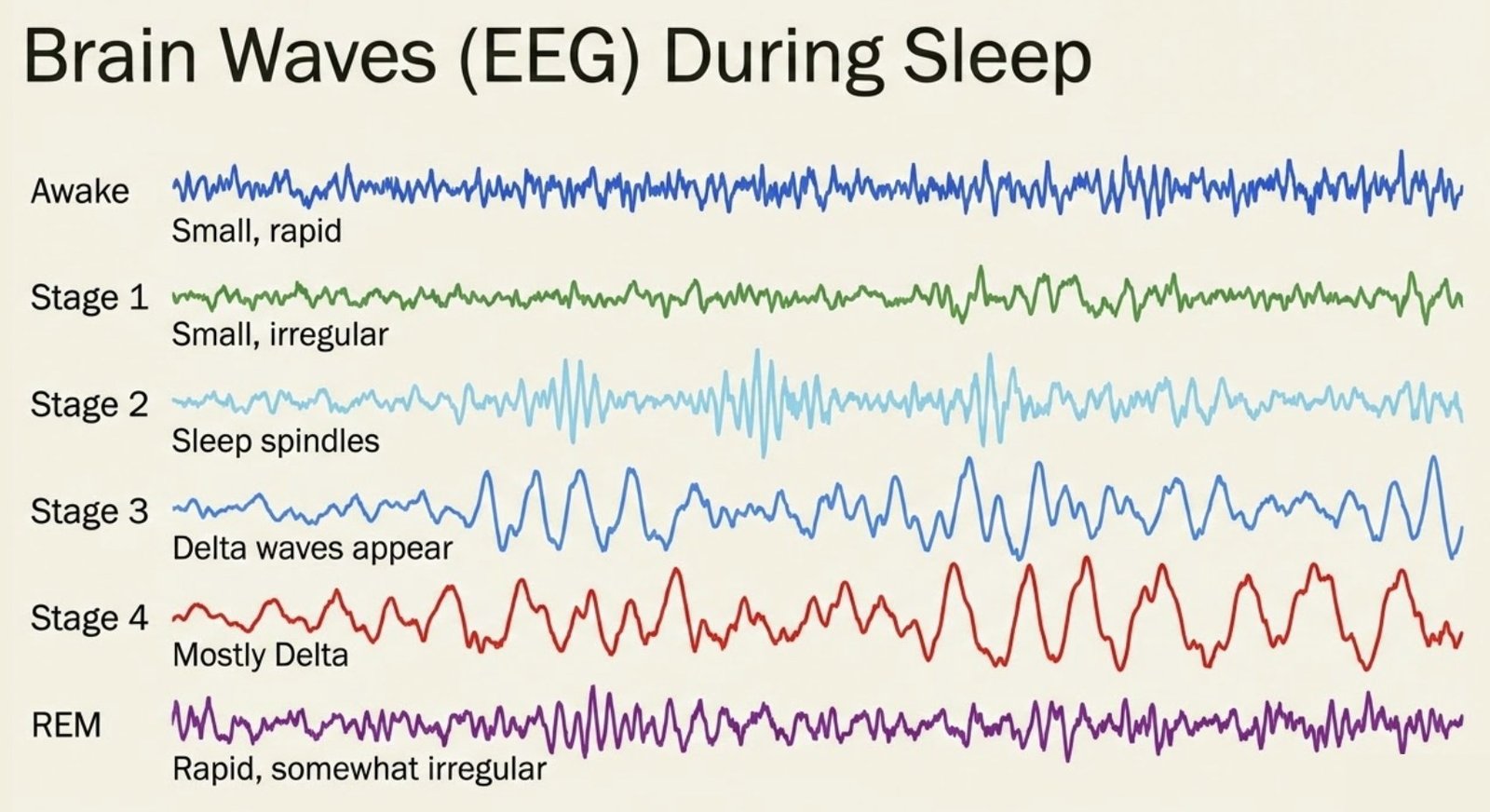
One vivid marker of that sleep debt deserves a mention, because it typically makes its first appearance in exactly these years: sleep paralysis. On waking (or falling asleep), consciousness returns while the muscle shutdown of REM sleep — and sometimes its dream imagery — is still running, leaving the person briefly awake, aware, and unable to move, often with a frightening sensed presence or pressure on the chest. Roughly 8% of people experience it at least once, but the lifetime rate approaches 28% in student samples, and its best-documented triggers are the adolescent trifecta of sleep deprivation, irregular schedules, and stress (Denis et al., 2018; Sharpless & Barber, 2011). It is benign and self-terminating — but for a teenager who doesn't know what it is, it can be terrifying, which makes it one more reason the sleep mismatch is worth taking seriously.
A new kind of thinkingFormal operations: reasoning about the possible, not just the real
Alongside the changes in the brain and body runs a change in the very shape of thought. In Piaget's account, the concrete-operational child of middle childhood can reason logically but stays tethered to the tangible — to objects, examples, and situations that are actually present. The adolescent, entering the stage of formal operations, gains the ability to reason about the hypothetical and the abstract: to hold a possibility in mind that is contrary to fact, to reason from premises regardless of whether they are true, and to think about thinking itself (Inhelder & Piaget, 1958). The signature of the new stage is hypothetico-deductive reasoning — the capacity to generate a set of possible explanations for a problem and then test them systematically, one variable at a time.
Piaget and Inhelder demonstrated it with tasks that look deceptively like science-fair experiments. In the classic pendulum problem, a young person is given strings of different lengths and weights and asked to discover what determines how fast the pendulum swings. The concrete-operational child changes several things at once and draws a muddled conclusion; the formal-operational adolescent isolates variables — holding weight constant while varying length, then the reverse — and arrives at the correct answer that only the string's length matters. What the task reveals is not knowledge of physics but a method: the deliberate, exhaustive testing of possibilities that also underwrites the adolescent's new appetite for argument, idealism, and the questioning of authority. Once you can imagine how things could be, the way things are becomes something to critique.
Piaget's own later writing conceded that formal-operational reasoning is not universal and not all-or-none. Adults deploy it inconsistently, reaching for it readily in domains where they have training and expertise and abandoning it in unfamiliar ones. Cross-cultural work shows that performance on formal-operational tasks depends heavily on schooling and the particular content at hand. The better modern reading is that adolescence makes abstract, hypothetical reasoning available — a new tool in the kit — rather than installing it as a uniform mode that governs all of a person's thinking.
The audience in your headAdolescent egocentrism: the imaginary audience and the personal fable
The new power to think about thinking has a curious side effect. David Elkind proposed that as adolescents become able to consider others' perspectives, they at first fail to distinguish their own preoccupations from what everyone else is thinking about — a distinctively adolescent form of self-centered reasoning he called adolescent egocentrism (Elkind, 1967). Because the teenager is intensely focused on the self, and now able to imagine what is going on in other minds, the two collapse together: everyone else must be as absorbed in me as I am.
Elkind gave the phenomenon two faces. The imaginary audience is the felt sense of being perpetually on stage, watched and evaluated by an audience that exists mainly in one's own mind — the mechanism behind the excruciating self-consciousness of early adolescence, the conviction that a single blemish or wrong word will be noticed and remembered by everyone. The personal fable is the complementary belief in one's own uniqueness and specialness: the sense that no one has ever felt this deeply, that one's experiences are without precedent, and — in its most consequential form — that the ordinary rules of risk do not apply to me. That feeling of invulnerability has an obvious bearing on the risk-taking the dual-systems model describes, and researchers have linked personal-fable beliefs to greater willingness to take risks in early adolescence. Both constructs typically peak in early adolescence and recede as perspective-taking matures and the audience, so to speak, disperses. Later theorists have debated whether these patterns are truly a byproduct of formal operations or better explained by the ordinary development of social cognition, but the descriptive phenomena Elkind named remain among the most recognizable features of the adolescent inner world.
Identity, operationalizedMarcia turned Erikson's crisis into something you can measure
For Erik Erikson, adolescence sits at the fifth of his eight psychosocial stages, and its defining crisis is identity versus role confusion (Erikson, 1968). The task is to forge a coherent, continuous sense of self — a felt answer to "who am I, and where am I going?" — that integrates one's traits, values, sexuality, and social roles into something that holds together across situations and time. Erikson thought this work is aided by a psychosocial moratorium, a socially sanctioned pause — often supplied by college or other role-experimentation — in which young people may try on possibilities without yet bearing the full weight of adult commitments. Failure to resolve the crisis leaves role confusion: a diffuse, uncertain sense of self, or a premature foreclosing on an identity handed down by others. Erikson gave us this framework as a broad clinical narrative, rich but hard to test.
James Marcia (1966) made it empirical by crossing two dimensions: exploration (have you actively tried on alternatives?) and commitment (have you settled on values, goals, a direction?). Using a semi-structured interview covering domains such as occupation, religion, and politics, he showed that Erikson's single continuum was better captured as a two-by-two, yielding four identity statuses. Crucially, these are statuses, not stages — you can be in different ones for different domains (career vs. politics vs. religion), and you can cycle back.
Marcia's four identity statuses. Read each as exploration × commitment. Tap one.
When Marcia's statuses are tracked over time, the tidy march from diffusion to achievement turns out to be slower and messier than the textbook version suggests. A meta-analysis of more than a hundred longitudinal and cross-sectional studies found that most identity development happens in the late teens and twenties, not early adolescence, and that only about a third of young people move in the "progressive" direction over any given interval; a substantial share stay put and some move backward (Kroger et al., 2010). This dovetails with the modern concept of emerging adulthood as the true theater of identity exploration, and it reframes the statuses as positions a person can occupy and re-occupy across years rather than rungs climbed once. The healthiest pattern is not a single achievement but a capacity to revisit and rework commitments as life demands.
Weighing the evidenceSocial media & teen mental health: a real debate, not a settled fact
The 2020s crisis is real, but its cause is genuinely contested in the science — and learning to hold two well-argued positions at once is exactly the skill worth building here. So here it is, evenhandedly.
Start with what both camps accept, because it is not in dispute. Multiple national datasets show that depression, anxiety, self-harm, and suicidal ideation among U.S. adolescents rose markedly beginning in the early 2010s, with the increase falling hardest on adolescent girls. One widely cited analysis of two long-running national surveys, together sampling over half a million teenagers, documented rising depressive symptoms and suicide-related outcomes after 2010 and noted that these increases coincided with the years in which smartphone ownership and social-media use became near-universal (Twenge et al., 2018). The trends themselves — the rise, its timing, its gendered shape — are about as solid as population mental-health data get. The fight is over what the co-occurrence means.
The "rewiring" thesis (Haidt; Twenge)
Jonathan Haidt (The Anxious Generation) and Jean Twenge (2017) argue the timing is too clean to be coincidence: teen anxiety, depression, and self-harm turned sharply upward around 2012, just as smartphones and Instagram saturated adolescent life. The proposed mechanism — a "great rewiring" of childhood: a play-based, in-person social world replaced by a phone-based one, hitting early-adolescent girls hardest via social comparison, curated perfection, and sleep loss. Their prescription is structural: delay smartphones and social media, phone-free schools.
The "small & mixed" counter (Orben; Odgers)
Amy Orben & Przybylski (2019) re-analyzed the big datasets with rigorous methods and found the association between screen time and adolescent well-being is tiny — on the order of the effect of wearing glasses or eating potatoes. Candice Odgers and others note the evidence is largely correlational (distressed teens may use phones more as a symptom, not a cause), effects vary by child, and blaming phones can distract from drivers like economic stress, loneliness, and reduced independence.
The methodological objection deserves to be spelled out, because it is the crux. Working with the same large, publicly available datasets that fuel the alarm, Orben and Przybylski applied a technique called specification-curve analysis, which runs not one analysis but the thousands of defensible analyses a researcher might have chosen, and reports the whole distribution rather than a single hand-picked result. Across those specifications, digital-technology use explained on the order of 0.4% of the variance in adolescent well-being — a negative association so small that they memorably benchmarked it against everyday variables, noting that regularly eating potatoes or wearing glasses was associated with comparably sized decrements (Orben & Przybylski, 2019). Their point was not that screens are harmless but that effects this small, drawn from correlational data, cannot bear the weight of a moral panic, and that the choice of which analysis to publish can swing the headline more than the data do.
A broader review of the field reaches a similarly measured verdict: the average association between the sheer quantity of digital-technology use and adolescent mental health is small and inconsistent, the evidence is dominated by cross-sectional correlations that cannot settle causal direction, and the most promising path forward is to stop asking whether "screens" are bad in general and start asking which children, using technology in which ways, for what purposes, are helped or harmed (Odgers & Jensen, 2020). Reverse causation is a live possibility throughout — anxious or depressed teenagers may retreat into their phones as much as phones make teenagers anxious — and displacement, where screen time crowds out sleep, exercise, and face-to-face contact, may matter more than screen content itself. None of this denies that a real crisis is underway; it insists that a real crisis deserves better than a single-cause story the data do not yet support.
Don't pick a team — hold the tension. Both sides agree the rise in distress is real. They disagree on causation and effect size, and both are working from imperfect (mostly correlational, self-reported) data. The defensible summary: "The correlation between social-media use and teen distress is robust but small, its direction and mechanism are contested, and current evidence can't yet establish that phones caused the crisis — though the precautionary case for limiting early use is reasonable." That's what it looks like to reason under uncertainty rather than reach for a headline.
Recognizing distressWhat the warning signs look like — and where help lives
The developmental goal here isn't diagnosis; it's recognition and pathways. Disordered eating and self-harm are, at their core, ways of coping with unbearable feelings or a sense of lost control — understanding that matters more than any behavioral detail (which we deliberately don't cover).
Signs that someone may be struggling
Withdrawal from friends and activities once enjoyed; sharp changes in mood, sleep, or appetite; a preoccupation with body, weight, or food that crowds out everything else; secrecy, or covering the body in warm weather; expressions of hopelessness, worthlessness, or being a burden; giving away meaningful possessions. You don't need to be certain to reach out. Ask directly and without judgment, listen, and connect the person to an adult, counselor, or a help line below — asking about suicidal feelings does not plant the idea; it opens a door.
SourcesCited in APA 7
Carskadon, M. A. (2011). Sleep in adolescents: The perfect storm. Pediatric Clinics of North America, 58(3), 637–647.
Casey, B. J., Jones, R. M., & Hare, T. A. (2008). The adolescent brain. Annals of the New York Academy of Sciences, 1124(1), 111–126.
Crone, E. A., & Dahl, R. E. (2012). Understanding adolescence as a period of social–affective engagement and goal flexibility. Nature Reviews Neuroscience, 13(9), 636–650.
Denis, D., French, C. C., & Gregory, A. M. (2018). A systematic review of variables associated with sleep paralysis. Sleep Medicine Reviews, 38, 141–157.
Elkind, D. (1967). Egocentrism in adolescence. Child Development, 38(4), 1025–1034.
Erikson, E. H. (1968). Identity: Youth and crisis. Norton.
Gardner, M., & Steinberg, L. (2005). Peer influence on risk taking, risk preference, and risky decision making in adolescence and adulthood: An experimental study. Developmental Psychology, 41(4), 625–635.
Inhelder, B., & Piaget, J. (1958). The growth of logical thinking from childhood to adolescence: An essay on the construction of formal operational structures. Basic Books.
Kroger, J., Martinussen, M., & Marcia, J. E. (2010). Identity status change during adolescence and young adulthood: A meta-analysis. Journal of Adolescence, 33(5), 683–698.
Marcia, J. E. (1966). Development and validation of ego-identity status. Journal of Personality and Social Psychology, 3(5), 551–558.
Mendle, J., Turkheimer, E., & Emery, R. E. (2007). Detrimental psychological outcomes associated with early pubertal timing in adolescent girls. Developmental Review, 27(2), 151–171.
Odgers, C. L., & Jensen, M. R. (2020). Annual research review: Adolescent mental health in the digital age — Facts, fears, and future directions. Journal of Child Psychology and Psychiatry, 61(3), 336–348.
Orben, A., & Przybylski, A. K. (2019). The association between adolescent well-being and digital technology use. Nature Human Behaviour, 3(2), 173–182.
Sharpless, B. A., & Barber, J. P. (2011). Lifetime prevalence rates of sleep paralysis: A systematic review. Sleep Medicine Reviews, 15(5), 311–315.
Steinberg, L. (2008). A social neuroscience perspective on adolescent risk-taking. Developmental Review, 28(1), 78–106.
Twenge, J. M. (2017). iGen: Why today's super-connected kids are growing up less rebellious, more tolerant, less happy. Atria Books.
Twenge, J. M., Joiner, T. E., Rogers, M. L., & Martin, G. N. (2018). Increases in depressive symptoms, suicide-related outcomes, and suicide rates among U.S. adolescents after 2010 and links to increased new media screen time. Clinical Psychological Science, 6(1), 3–17.
If any of this feels heavy, or if you're worried about yourself or someone else — help is available, free and confidential.
988 Suicide & Crisis Lifeline — call or text 988 anytime in the US, 24/7.
National Alliance for Eating Disorders — helpline at 1-866-662-1235 (weekdays), a clinician-staffed line for eating-disorder support and referrals; details at allianceforeatingdisorders.com.
This unit is academic material, not a substitute for professional support. Reaching out is a sign of strength, not weakness.