Most intro courses touch stress briefly — a definition, maybe fight-or-flight, and on to the next unit. What usually gets left out is the fuller picture: how psychologists actually define stress, what chronic stress does to the body over time, why the classic "fight-or-flight" story doesn't describe everyone equally well, and one of the more practically useful findings in the whole field — that how you relate to your own stress and your own struggles changes the outcome. This is also a topic I research directly, so consider this page a slightly deeper dive than most enrichment readings: the self-compassion section in particular is worth sitting with.
What stress actually is
It's tempting to think of stress as a property of events themselves — exams are stressful, traffic is stressful, a breakup is stressful. Lazarus and Folkman (1984) argued for something more interesting: stress isn't in the event, it's in the relationship between the demands a situation places on you and the resources you believe you have to meet them. Their transactional model breaks this into two appraisals that happen, often within seconds and often outside conscious awareness. Primary appraisal asks, essentially, "is this a threat, a challenge, or irrelevant to me?" Secondary appraisal asks, "do I have what it takes to handle this?" The same event — say, being called on unexpectedly in class — can register as a minor challenge for a student who appraises it as manageable and as a serious threat for a student who appraises their own coping resources as inadequate. This is why the same objective stressor can flatten one person and barely register for another: it isn't a difference in the event, it's a difference in appraisal.
An older, more mechanical way of measuring stress still turns up in research and is worth knowing as a contrast. Holmes and Rahe (1967) built the Social Readjustment Rating Scale, which assigns point values to major life events — death of a spouse sits at the top, but so do ostensibly "positive" changes like marriage or a new job — on the premise that any change requiring readjustment is stressful, and that accumulated life-change points predict later illness. The scale did capture something real: piling up big life changes does correlate with health problems. But it also highlights exactly what Lazarus and Folkman later added, because the same event carries very different weight for different people. A fixed point value can only ever be a rough approximation of what is, at bottom, an appraised and deeply personal process.
Bodhi says
If you remember nothing else from this section, remember this: appraisal means stress is partly a judgment call, not a fixed fact about the world. That doesn't mean you can just think your way out of every hard situation — some demands really do outstrip real resources. But it does mean the appraisal step is a place where change is genuinely possible, which is exactly why so much of the rest of this page focuses on how you relate to stress rather than just what causes it.
What the body does under stress
Appraisal is the psychological layer; underneath it, the body has its own well-documented response. Cannon described the fast fight-or-flight response: the sympathetic nervous system activates almost instantly, releasing adrenaline, speeding the heart, redirecting blood toward muscles, and sharpening attention — a response built for immediate physical threats that arrived long before exams and inboxes existed. Selye (1956) extended the picture to what happens when a stressor doesn't resolve quickly, describing the general adaptation syndrome as a three-stage process the body moves through under sustained stress.
Step 1 · Alarm
The initial jolt — the same fast sympathetic activation described by Cannon's fight-or-flight response. Heart rate and breathing increase, stress hormones are released, and the body mobilizes energy to deal with the immediate demand.
Step 2 · Resistance
If the stressor doesn't go away, the body settles into a sustained, elevated state of coping. Arousal stays higher than baseline, and the body keeps producing stress hormones — including cortisol, released via the HPA axis (hypothalamus → pituitary gland → adrenal glands) — to keep meeting the ongoing demand. This stage can hold for a surprisingly long time, which is exactly what makes it dangerous: it doesn't feel like an emergency, so it's easy to ignore how much wear it's causing.
Step 3 · Exhaustion
Eventually, sustained resistance depletes the body's resources. Immune function can decline, and the systems that were mobilized to cope begin to falter — leaving the body more vulnerable to illness and, over time, to lasting physiological damage.
The modern concept that ties Selye's stages to real health outcomes is allostatic load: the cumulative wear-and-tear that chronic activation of the stress response places on the body over months and years — elevated cortisol exposure, strain on the cardiovascular system, and a taxed immune system, accumulating even when no single day feels catastrophic. Allostatic load is a useful concept precisely because it reframes stress-related illness as a slow accumulation rather than a single dramatic event.
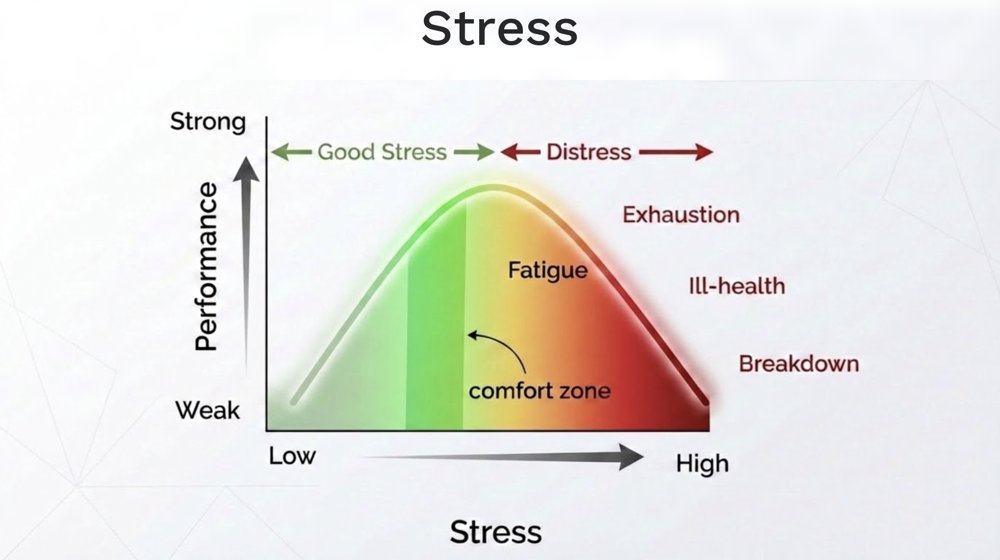
Acute stress can help you; chronic stress tends to hurt you
One of the most useful distinctions in this whole area is between acute and chronic stress, because "stress is bad for you" is too blunt a claim to be accurate.
Acute stress
Short bursts of stress — a tight deadline, a competitive game, a difficult conversation — activate the alarm response and then resolve. In moderate doses, this kind of stress can sharpen focus, mobilize energy, and even enhance performance in the moment. The body is well-adapted to handle stress that comes and goes.
Chronic stress
It's prolonged, uncontrollable stress — the kind that doesn't resolve, like ongoing financial strain, a hostile environment, or an unrelenting workload — that does the real damage. Sustained resistance-stage activation and the allostatic load it produces are linked to cardiovascular strain and weakened immune function. The controllability of the stressor matters as much as its duration: stress that feels inescapable is consistently more damaging than stress of similar intensity that feels manageable.
The link from chronic stress to physical illness isn't merely theoretical. In a striking demonstration, Cohen, Tyrrell, and Smith (1991) assessed healthy volunteers' recent psychological stress, then exposed them — with consent — to a common-cold virus through nasal drops and quarantined them to watch what happened. The higher a person's stress level, the more likely they were to actually develop a cold, in a clean dose-response pattern, with infection rates rising step by step alongside stress. Because the viral exposure was held constant and the design was experimental, this is unusually strong evidence that psychological stress genuinely compromises immune defense — not merely that stressed people report feeling sicker. It's a cornerstone finding of psychoneuroimmunology, the field studying how psychological states, the nervous system, and immune function are wired together.
Fight-or-flight isn't the whole story
◆ Where the science has moved
Cannon's fight-or-flight response was developed largely from research on male samples, and for decades it stood in as the default account of how organisms respond to stress. Taylor et al. (2000) pointed out that this leaves out a well-documented alternative pattern: tend-and-befriend. Under stress, humans — and, on average, women somewhat more than men, though the pattern isn't exclusive to either sex — also respond by nurturing offspring and dependents ("tending") and by seeking out and strengthening social bonds ("befriending"), a pattern Taylor and colleagues linked to oxytocin. This isn't a replacement for fight-or-flight so much as a reminder that the fast sympathetic-arousal response is not the only evolved way humans handle threat. It also helps explain one of the most robust findings in stress research: social support is one of the strongest known buffers against the harmful effects of stress, which fits naturally with a tend-and-befriend account and less naturally with a fight-or-flight-only account.
Coping: two different jobs
Once a stressor is appraised, coping is what you actually do about it — and psychologists distinguish two broad strategies that do different jobs.
Problem-focused coping
Directly targets the stressor itself: making a study plan, having the hard conversation, fixing the budget. This tends to work best when the situation is genuinely within your control — when there's something real to change.
Emotion-focused coping
Targets your emotional response to the stressor rather than the stressor itself: reframing the situation, seeking comfort, allowing yourself to feel upset before moving on. This tends to work best when the situation is largely outside your control — when there's nothing left to directly fix.
Neither strategy is universally "better." Using problem-focused coping on something you genuinely cannot control (an illness, someone else's decision) tends to produce frustration and a sense of futility. Using only emotion-focused coping on something you actually could act on (an unaddressed conflict, an unfinished assignment) can let a solvable problem drift and compound. The skill is matching the strategy to how controllable the situation actually is.
Mindset changes the biology, not just the mood
A newer line of research complicates the idea that stress is simply something to be minimized. Crum, Salovey, and Achor (2013) tested whether a person's general stress mindset — the belief that stress is enhancing (it can improve performance and growth) versus debilitating (it only harms) — actually changes outcomes, not just self-report. Their findings suggest it does: people who held a more "stress-is-enhancing" mindset showed different physiological stress responses and better performance under pressure than people who held a "stress-is-debilitating" mindset, even when facing comparable stressors. This doesn't mean stress is secretly always good, and it doesn't mean you can simply decide your way out of a genuinely overwhelming situation. It means the story you tell yourself about what stress is for is itself one of the ingredients that shapes how stress plays out in your body and your performance — which loops back to Lazarus and Folkman's appraisal model from the start of this page.
The myth
All stress is bad for you, and being hard on yourself when you're struggling is what keeps you disciplined and on track.
What's actually true
Acute stress can be adaptive, and even how you frame stress shapes its physiological and performance effects (Crum et al., 2013) — so "all stress is bad" is already an oversimplification. The second half of the myth doesn't hold up either: self-criticism tends to undermine motivation and well-being rather than protect it, while self-compassion — treating yourself with the same kindness you'd offer a struggling friend — is associated with lower anxiety and depression and greater resilience, without the costs people fear from "going easy" on themselves. The next section covers why.
Self-compassion: what it is, and what it isn't
This is the part of the page I'd ask you to slow down for. Self-compassion is one of the more misunderstood constructs in psychology, partly because the word "compassion" gets used loosely in everyday speech, and partly because people assume it must be a synonym for something softer or lazier than it actually is. Neff (2003) gave the construct a precise, three-part definition, and each part is doing real work.
Component 1 · Self-kindness (vs. self-judgment)
Responding to your own pain, failure, or inadequacy with warmth and understanding rather than harsh self-criticism. This doesn't mean ignoring the failure or pretending it didn't happen — it means the internal tone you take toward yourself in response to it is supportive rather than punishing.
Component 2 · Common humanity (vs. isolation)
Recognizing that suffering, failure, and personal inadequacy are part of the shared human experience — something everyone goes through — rather than something that happens uniquely and shamefully to you alone. Struggle stops feeling like evidence of personal defectiveness and starts feeling like evidence of being human.
Component 3 · Mindfulness (vs. over-identification)
Holding painful thoughts and feelings in balanced, clear awareness — neither suppressing them nor exaggerating them by getting swept up in the story around them. You notice the pain without either pushing it away or drowning in it.
◆ What self-compassion is not
It is not self-pity, which tends to involve feeling sorry for yourself in a way that emphasizes how uniquely bad your situation is — the opposite of common humanity. It is not self-indulgence or an excuse to avoid responsibility; treating yourself kindly after a mistake is compatible with, and in Neff's framework tends to support, actually correcting the mistake. And it is not weakness: the research base linking self-compassion to lower anxiety and depression and to greater resilience — including a meta-analysis pooling results across dozens of studies (MacBeth & Gumley, 2012) — runs in the opposite direction of the "self-compassion makes you soft" assumption.
Self-compassion is also conceptually distinct from self-esteem, and the distinction matters practically, not just academically. Self-esteem generally depends on evaluating yourself positively — feeling good about yourself often requires feeling above average, successful, or validated by others, which means self-esteem tends to wobble when you fail, get criticized, or compare unfavorably to someone else. Self-compassion doesn't require any of that. You can hold a compassionate stance toward yourself precisely in the moments when you performed poorly, made a mistake, or fell short — moments where self-esteem is hardest to maintain. Because it doesn't depend on constant success or on outperforming others, self-compassion tends to be more stable across ups and downs than self-esteem is (Neff & Vonk, 2009).
The myth
Self-compassion is just self-esteem with a gentler name, or it's a form of self-pity that lets you off the hook.
What's actually true
Self-esteem is largely evaluative (how good do I feel about myself, often relative to others) and tends to be unstable, dropping exactly when you need support most. Self-compassion (Neff, 2003) doesn't ask you to evaluate yourself favorably at all — it asks you to respond to your own struggle with kindness, a recognition that struggle is shared and human, and balanced awareness. That's also what separates it from self-pity, which isolates ("this is happening to me and it's uniquely unfair") rather than connects ("this is part of being human").
Bodhi says
A simple test I'd suggest for yourself: next time you make a mistake, notice what you'd say to a close friend in the identical situation, and then notice whether that's what you actually said to yourself. The gap between those two responses is, roughly, the gap self-compassion research is pointing at — and closing that gap is a trainable skill, not a fixed personality trait you either have or don't.
Broader buffers: mindfulness, exercise, and the biopsychosocial picture
Self-compassion isn't the only well-supported lever here. Regular mindfulness practice and regular physical exercise are both general, well-evidenced ways to buffer the effects of stress on the body and mind. Neither is a cure-all, and neither substitutes for addressing a genuinely unmanageable external stressor. What ties all of this together — appraisal, coping strategy, social support, mindset, self-compassion, mindfulness, exercise — is the biopsychosocial model of health: physical health outcomes emerge from the interaction of biological factors (the HPA axis, immune function, genetics), psychological factors (appraisal, coping style, mindset, self-compassion), and social factors (relationships, support, culture), not from biology alone. Stress research is one of the clearest demonstrations of why psychology treats health as a mind-body system rather than two separate domains.
Check yourself
The one thing to carry out of this unit
Stress is not simply a fact about what happens to you — it's shaped by how you appraise a demand against your resources, whether the stressor is acute or chronic and controllable or not, the mindset you bring to it, and the social support available to you. And how you treat yourself while you're struggling is not a minor detail: self-compassion — self-kindness, common humanity, and mindfulness, held together, and distinct from both self-esteem and self-pity — is a well-evidenced, trainable buffer against the costs of stress, not a soft indulgence that undercuts discipline. If this unit leaves you with one practical takeaway, let it be that the voice you use with yourself under pressure is itself a psychological variable worth managing deliberately.
References
Cohen, S., Tyrrell, D. A. J., & Smith, A. P. (1991). Psychological stress and susceptibility to the common cold. New England Journal of Medicine, 325(9), 606–612. https://doi.org/10.1056/NEJM199108293250903
Crum, A. J., Salovey, P., & Achor, S. (2013). Rethinking stress: The role of mindsets in determining the stress response. Journal of Personality and Social Psychology, 104(4), 716–733.
Holmes, T. H., & Rahe, R. H. (1967). The Social Readjustment Rating Scale. Journal of Psychosomatic Research, 11(2), 213–218. https://doi.org/10.1016/0022-3999(67)90010-4
Lazarus, R. S., & Folkman, S. (1984). Stress, appraisal, and coping. Springer.
MacBeth, A., & Gumley, A. (2012). Exploring compassion: A meta-analysis of the association between self-compassion and psychopathology. Clinical Psychology Review, 32(6), 545–552. https://doi.org/10.1016/j.cpr.2012.06.003
Neff, K. D. (2003). Self-compassion: An alternative conceptualization of a healthy attitude toward oneself. Self and Identity, 2(2), 85–101.
Neff, K. D., & Vonk, R. (2009). Self-compassion versus global self-esteem: Two different ways of relating to oneself. Journal of Personality, 77(1), 23–50.
Selye, H. (1956). The stress of life. McGraw-Hill.
Taylor, S. E., Klein, L. C., Lewis, B. P., Gruenewald, T. L., Gurung, R. A. R., & Updegraff, J. A. (2000). Biobehavioral responses to stress in females: Tend-and-befriend, not fight-or-flight. Psychological Review, 107(3), 411–429.